
10 Black Paint Ideas for a Bold and Sophisticated Home

Got Homes & Gardens content. Now the next URL.Good, have that content. Next: ideal.house best black paints.Good, got sincerelymariedesigns content. Next: simpolo.com and decor8.ai.Got simpolo content. Now decor8.ai.# 10 Black Paint Ideas for a Bold and Sophisticated Home
Black paint ideas work best when you treat black as a genuine neutral rather than a shock colour, pairing it with texture, warm lighting, and the right undertone for your room. Done well, an all black room feels rich and cocooning rather than heavy. Done carelessly, it just reads as a room with the lights off.
I’ve painted rooms black for clients who were convinced it would make their home feel like a cave, and watched the same room become the one everyone gravitates to once the sofa, the lamps, and the artwork went back in. Black paint has a reputation problem it doesn’t deserve. The ten ideas below cover where it genuinely earns its place in a home, and how to use it so the room still feels inviting rather than intimidating.
1. Colour-drench a small room in soft black
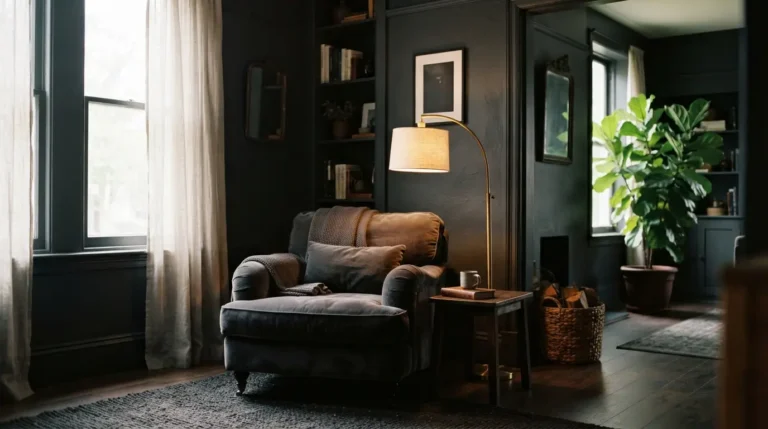
A small room, box room, snug, downstairs loo, or reading nook, is often the best place to start with black, not the worst. Taking one soft black shade up the walls, across the ceiling, and onto the trim removes the hard line where wall meets ceiling, so your eye stops measuring the room’s edges. Instead of feeling boxed in, the space reads as enveloping.
The key word here is soft. A true, flat black can feel gothic in a small space. Look for a black with a warm brown or grey base instead, something closer to a deep charcoal that reads as black in low light but has a little give to it in daylight. This is the approach behind popular soft blacks like Farrow & Ball’s Railings, which works across walls and ceilings without tipping into starkness.
2. Choose a warm black over a stark cool black
Not all black paint behaves the same way, and this is the detail most black paint ideas lists skip entirely. Warm blacks carry a hint of brown or red in their base and feel cosy, inviting, and easier to live with day to day. Cool blacks lean towards blue or green undertones and read as crisper, more modern, and, in a room without much natural light, noticeably colder.
If you’re nervous about committing to a whole wall, buy two or three sample pots in different undertones and paint large swatches directly on the wall you’re considering. Look at them morning, afternoon, and evening with your usual lighting on. The difference between a warm and a cool black is subtle on a paint chip and much more obvious once it’s covering an entire wall.
| Black type | Undertone | Best for | Watch out for |
| Warm black | Brown or red base | Bedrooms, living rooms, dining rooms, low-light spaces | Can look slightly brown under warm bulbs if overdone |
| Cool black | Blue or grey base | Home offices, modern kitchens, bathrooms with strong light | Reads cold in rooms with little natural light |
| True black | No visible undertone | Accent walls, trim, furniture, doors | Can look flat or harsh across a whole room |
3. Paint the ceiling black for unexpected drama
A black ceiling is one of the most talked-about black paint ideas among designers precisely because most homeowners never consider it. In a living room or dining room with reasonable ceiling height, a black ceiling draws the eye up, adds real drama at night under lamplight, and makes the rest of the room’s colours feel more considered by contrast.
This isn’t a move for every room. Low ceilings will feel lower still, so it suits spaces with at least standard-to-generous ceiling height. It also pairs best with a room that already has good ambient lighting, since a dark ceiling with only one central bulb will simply disappear into shadow rather than reading as a design choice.
4. Use a black accent wall to anchor a lighter scheme
If a full black room feels like too much of a leap, a single accent wall gives you the drama without the commitment. This is the most common entry point into black interior design, and for good reason: it lets black do what it does best, acting as a grounding, picture-frame backdrop, without absorbing all the light in the room.
A reliable way to keep the balance right is the 60-30-10 approach: let your black wall and any black furniture make up roughly 60% of the visual weight, mid-tone furnishings around 30%, and lighter or brighter accents the final 10%. Artwork tends to look sharper against black than against white, since the wall recedes and lets the piece do the talking.
5. Bring black into the kitchen through cabinetry or an island

Matte black cabinetry or a single black kitchen island has become one of the more enduring black interior trends, largely because it works in both traditional and contemporary kitchens. A black island against white or pale wood cabinetry creates an immediate focal point without darkening the whole room, since the surrounding cabinets and worktops keep the space feeling open.
Matte black paint and matte black finishes show fingerprints and water marks more readily than a satin or semi-gloss finish, which matters in a kitchen where hands are on cabinets constantly. If you love the look of matte but want less maintenance, ask your decorator or cabinet supplier about a low-sheen or eggshell black instead of a true flat matte.
6. Start small with black interior doors and trim
If you’re still deciding how committed you are to black paint in your home, doors, architraves, and skirting boards are the lowest-risk way to test the waters. A black interior door against white walls reads as a deliberate, tailored detail rather than a bold statement, and it’s one of the easiest changes to reverse if you change your mind later.
This is also genuinely useful in homes with tired brown wood trim from a previous decade. Painting old stained trim black, rather than white, tends to feel more current and hides scuffs better than white trim does over time.
7. Use high-gloss black in bathrooms to bounce light back
Black in a bathroom sounds like it would feel cold and clinical, but a high-gloss or glossy black finish behaves very differently from a matte one. Gloss reflects light rather than absorbing it, so a black-tiled or black-painted bathroom wall next to a mirror and good lighting can feel surprisingly bright and jewel-box-like rather than dim.
This works especially well in small bathrooms and downstairs cloakrooms, spaces that are used briefly rather than lived in, which makes them a good place to experiment with a bolder colour choice than you might commit to in a bedroom. Pairing black tiles or black paint with brass or chrome fixtures adds another reflective surface to help the room feel less enclosed.
8. Pair black with gold or brass for a luxe, high-contrast look

Black and gold is consistently one of the most requested black colour combinations, and it earns the reputation. Gold and brass have warm, metallic undertones that cut through the intensity of black, turning what could be a flat, heavy wall into something that reads as considered and expensive.
You don’t need gold surfaces everywhere to get the effect. A black wall or black cabinetry with brass door handles, a single statement light fixture, or picture frames in warm metal does most of the work. Velvet, marble, and high-gloss lacquer all amplify the pairing further if you want to lean into a more maximalist look, but even one or two gold accents against a matte black wall will noticeably lift the scheme.
9. Create a black home office for focus and calm
Black has a genuine practical case in a home office, beyond just looking sophisticated. A dark, matte wall behind a desk limits visual distraction and glare on screens, which is part of why black has become a popular choice for studies and work-from-home spaces rather than just living rooms and bedrooms.
For a home office, warmer blacks tend to feel calmer over long working hours than cold, blue-based ones. Pair the wall with a light or wood-toned desk and good task lighting, since a black wall with only overhead lighting will feel gloomy fast, whereas the same wall with a desk lamp and a floor lamp feels intentional and focused.
10. Paint a black front door for instant kerb appeal
A black front door is the most low-risk, high-impact of all black paint ideas, since it affects only one surface and makes no difference to how a room feels from the inside. A black door against a light-coloured exterior reads as classic and timeless in a way that few other exterior colours manage, and it works across period and modern homes alike.
For exterior doors, ask specifically for an exterior-grade paint rather than an interior black, since exterior formulations are built to handle UV exposure and weather without fading or chalking the way an interior paint would if used outside.
What black paint actually costs and how long it takes
Costs vary by country, by room size, and by whether you’re hiring a decorator or doing it yourself, so treat the figures below as a rough guide rather than a fixed price. A single accent wall typically needs a sample pot (roughly £5 to £10 in the UK) plus one to two tins of your chosen black, and a confident DIYer can usually finish it over a weekend, including drying time between coats. A full room, especially one moving from a light colour to black, usually needs a tinted or stain-blocking primer first and at least two coats of the black paint itself, sometimes three for full, even coverage, which typically stretches the job to two or three days.
Hiring a professional decorator for a full room in the UK generally runs from around £250 to £600 depending on room size, wall condition, and how much prep work is needed, though this varies considerably by region and by country if you’re reading from elsewhere. One trade-off worth knowing before you commit: black walls show scuffs, touch-ups, and uneven patching more visibly than lighter colours, so if a wall gets marked, plan to repaint the whole wall rather than spot-touching it, since a partial fix rarely blends in seamlessly.
Conclusion
Black paint ideas work when black is treated as a considered neutral rather than a bold statement thrown at every wall in the house. Start small if you’re unsure, a door, a piece of trim, one accent wall, and build confidence before committing to a full room. Pay attention to undertone, finish, and lighting, since those three details decide whether a black room feels sophisticated or simply dim. Get them right, and black becomes one of the most versatile colours in your home rather than the riskiest one.
FAQs
Does black paint make a room feel smaller?
It can, but not always. Because black surfaces tend to recede visually rather than advance, many black rooms actually feel more enveloping than genuinely smaller. Rooms that do feel cramped in black are usually suffering from poor lighting or a lack of contrast, not the colour itself.
What’s the difference between matte black paint and other black finishes?
Matte black paint has no sheen, which gives the deepest, most velvety colour but also shows marks and fingerprints more easily and can’t be spot-cleaned as readily as a satin or eggshell finish. Satin and semi-gloss blacks reflect more light and hold up better to touching and cleaning, which is why they’re generally recommended for trim, doors, and kitchen cabinetry rather than open wall space.
Is an all black room a passing trend or a lasting choice?
Black has been used as a grounding neutral in interior design for decades, appearing everywhere from Georgian-era dark libraries to contemporary minimalist interiors, so it tends to age better than more of-the-moment bold colours. Warmer, softer blacks in particular read as timeless rather than trend-driven.
What colours go best with black walls?
Warm whites, natural wood tones, brass and gold accents, and jewel tones like emerald or deep plum are among the most reliable pairings for a black interior, since they add warmth and light without competing with the black for attention. For a more graphic look, crisp white trim against black walls gives a classic, high-contrast result.
Do I need a special primer before painting a wall black?
Yes, in most cases. Moving from a light wall colour to black usually needs a grey or deep-tinted primer first to reduce the number of black topcoats needed for full, even coverage. Skipping the primer step is one of the most common reasons people end up needing three or four coats instead of two.