
How to Layer Bathroom Lighting for the Perfect Balance

Layering bathroom lighting for the perfect balance means combining three distinct types, task, ambient, and accent, rather than relying on the single central ceiling light most bathrooms are built around. That one fitting is also the single most common reason a bathroom feels flat and clinical rather than considered, since it leaves shadows exactly where you need to see clearly and offers no way to soften the room for an evening bath.
Understand the Three Lighting Layers
Task lighting is the functional layer, bright, shadow-free light positioned specifically where you shave, apply makeup, or need genuine precision. Ambient lighting is the general base layer that fills the room with even, comfortable light rather than leaving dark corners. Accent lighting is the finishing layer, used to highlight a niche, a piece of art, or an architectural feature rather than to actually illuminate a task. A bathroom with all three working together reads as considered and flexible; one relying on any single layer alone will always feel either too flat or too harsh for at least some of what actually happens in the room.
Check Your Safety Zones Before Choosing Any Fixture
This is the detail every purely aesthetic lighting guide skips, and it’s genuinely not optional. UK bathrooms are divided into zones based on proximity to water, and each has a minimum IP, ingress protection, rating that any fixture in that zone must meet. Zone 0 is inside the bath or shower itself and needs fittings rated for full immersion. Zone 1 covers the area directly above the bath or shower, and Zone 2 extends roughly 60cm beyond that. Anything outside these zones is less restricted, though a bathroom’s general humidity still makes a moisture-rated fixture the sensible choice throughout. In practical terms, an IP65-rated fixture handles direct water jets and suits a shower area well, while IP44 is adequate for a zone further from direct splashing, like above a basin. Always check the specific zone rating required before buying any fixture, and if you’re at all unsure which zone a spot falls into, get a qualified electrician to confirm rather than guessing, this is a genuine safety requirement, not a style preference.
Place Task Lighting Where You Actually Need to See Clearly
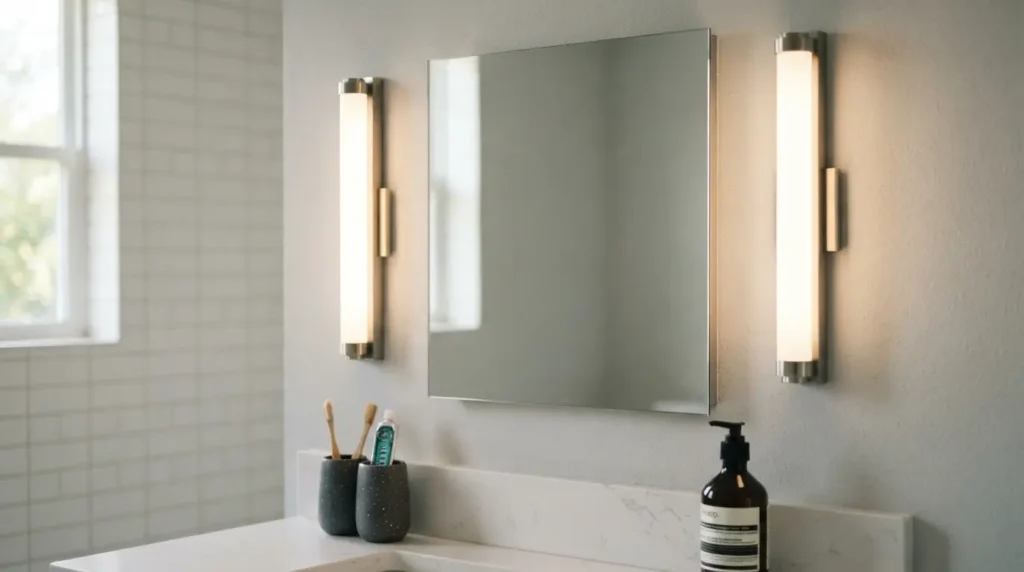
A single light directly above the mirror casts a downward shadow across your face, exactly the opposite of what task lighting is meant to achieve. Vertical fittings positioned on either side of the mirror, at roughly head height, give much more even, shadow-free light across the face, closer to how natural daylight actually falls. An illuminated mirror with integrated lighting solves the same problem in one fitting, and it’s worth choosing one with a genuinely bright, even light source built in rather than a decorative frame light that looks the part but doesn’t deliver real task-level brightness.
Build the Ambient Base Layer, Then Add Accent Lighting for Depth
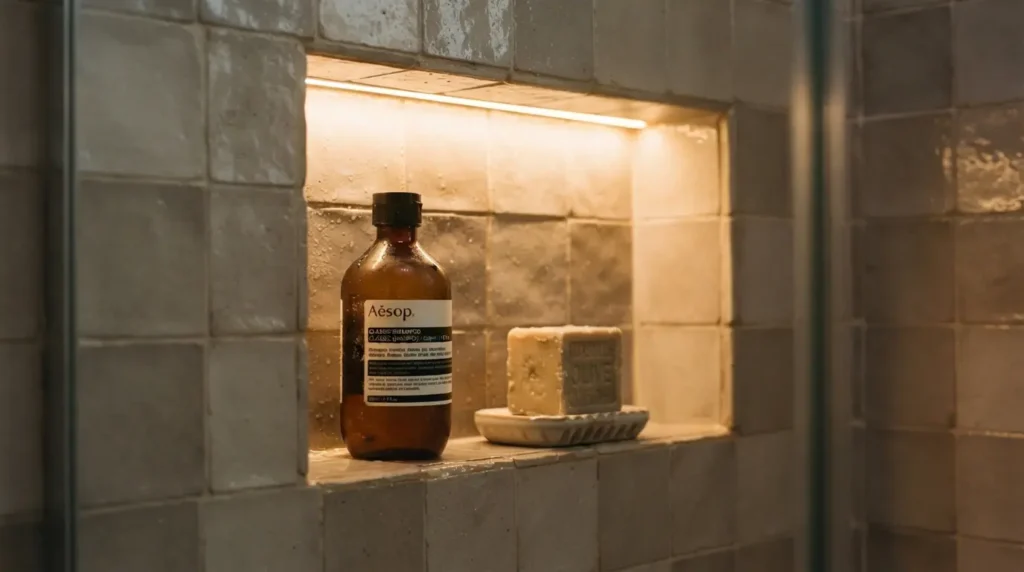
Ceiling downlights or a flush LED panel give the room its general, even base level of light, filling in the shadows a single central pendant would otherwise leave in the corners. Once that base layer is working properly, accent lighting is where the room gets genuine character: an LED strip run along the underside of a floating vanity, inside a recessed shower niche, or along a mirror’s edge adds depth and a sense of considered design without adding meaningful task brightness. This layer is optional in a way task and ambient lighting aren’t, a bathroom works perfectly well without it, but it’s the detail that makes the difference between a functional room and one that genuinely feels finished.
Match Colour Temperature to Each Layer’s Job
Colour temperature, measured in Kelvin, matters as much as brightness for how a bathroom actually feels to use. A cooler white, roughly 4000K, suits task lighting around the mirror, since it reads as crisp and true-to-life, which matters when you’re actually trying to see clearly. A warmer white, closer to 2700-3000K, suits ambient and accent lighting, since it creates the relaxed, inviting feel you want for a bath or a quiet evening in the room. Mixing temperatures across layers, rather than lighting the whole room in one uniform tone, gives you a bathroom that genuinely shifts character between a bright, functional morning and a softer evening, all from the same fixtures.
Wire in Dimmers and Plan Circuits Early
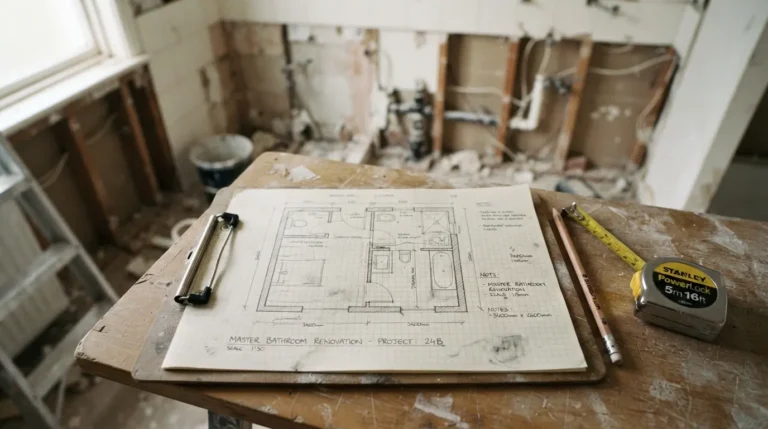
Dimmable ambient and accent lighting gives you real control over the room’s mood, bright for the morning routine, soft for an evening soak, without needing separate fixtures for each. This is worth planning at the electrical first-fix stage of any renovation, since running additional circuits and dimmer-compatible wiring after the walls are finished and tiled is a considerably bigger job than including it from the start. If a full rewire isn’t realistic, prioritise a dimmer on the ambient layer specifically, since that’s the light doing the most work in setting the room’s overall mood.
Adjust the Balance for a Small or a Large Bathroom
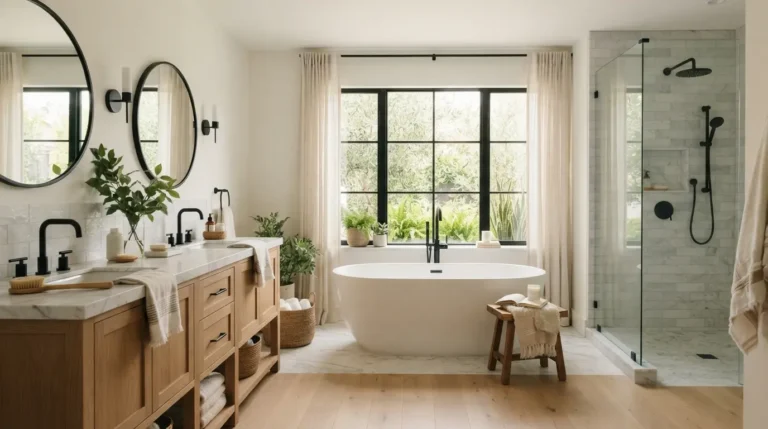
A small bathroom benefits from recessed downlights that keep the ceiling looking clean, paired with a mirror that has genuinely bright integrated lighting to double as both task light and a way to bounce brightness around a compact space. A larger bathroom can support a more layered scheme without feeling cluttered, ceiling downlights combined with wall lighting and niche accents, with the vanity area kept brighter than a softer, dimmer zone around the bath. In either size, coordinate your fixture finishes, chrome, matt black, brushed brass, with your taps and hardware, mismatched metal finishes are a small detail that undermines an otherwise well-planned lighting scheme.
Choose LED for Genuine Long-Term Value
LED fittings use meaningfully less power than older halogen bulbs and last considerably longer, often tens of thousands of hours rather than the far shorter lifespan of a halogen equivalent, which matters in a bathroom where fixtures are sometimes awkward to access for replacement. The upfront cost is generally higher than a basic halogen fitting, but the combination of lower running cost and rarely needing to change a bulb makes LED the sensible default for every layer in a bathroom scheme, not just a trend to follow.
Final Thoughts
Layering bathroom lighting for the perfect balance comes down to giving each layer, task, ambient, and accent, its own proper placement, safety rating, and colour temperature, rather than expecting one central fitting to do every job at once. Plan the safety zones and circuits early, choose LED throughout, and the bathroom will feel genuinely bright and functional in the morning, and just as genuinely relaxing come evening.
FAQs
What are the three types of bathroom lighting?
Task lighting provides bright, functional light for grooming tasks like shaving or makeup. Ambient lighting is the general base light that fills the room evenly. Accent lighting highlights specific features, like a niche or piece of art, without adding significant overall brightness.
What IP rating do I need for a bathroom light?
It depends on the zone. Fixtures inside the bath or shower need the highest rating for full immersion, those directly above or near the bath or shower need a rating suited to direct water contact, and areas further away can use a lower-rated, still moisture-resistant fitting. Check the specific zone requirement or ask an electrician before buying.
Can I put a pendant light in a bathroom?
Only outside the water-exposed zones, and it still needs to be genuinely suited to a humid room. A pendant works better positioned away from the bath or shower, as part of the ambient layer, rather than directly above a wet area.
What colour temperature is best for bathroom lighting?
A cooler white around 4000K suits task lighting for genuine clarity, while a warmer white around 2700-3000K suits ambient and accent lighting for a relaxed, inviting feel. Mixing both across different layers gives the room more flexibility than one uniform temperature throughout.
Should bathroom lights be on a dimmer?
Ambient and accent lighting genuinely benefit from dimming, giving you control over the room’s mood through the day. Task lighting around the mirror is usually better left at a consistent, genuinely bright level, since dimming it undermines its actual job.