15 Bay Window Ideas to Make the Most of This Beautiful Feature

The best bay window ideas start with the glazing style and structure, then build outward into how the space actually gets used, whether that’s seating, dining, a home office, or a display ledge. Get those two layers right and a bay window stops being an awkward gap in the furniture plan and becomes the best spot in the room.
Most people either overdress a bay with heavy curtains that hide it completely, or leave it bare and wonder why it still feels unfinished. Neither approach uses what you’re actually paying for: extra floor space, extra light, and a genuine architectural feature. Here are 15 ways to get more out of yours, from the structural choices to the styling details.
1. Match the Style to Your Home: Splay, Box, or Bow
Bay window style isn’t just aesthetic, it affects light, glazing cost, and how furniture fits inside the recess. A splay bay angles out from a central picture pane, a box bay projects at sharp 90-degree corners, and a bow window curves smoothly across four or more narrow panes.
Splay bays suit Victorian and Edwardian terraces and are the most common style in the UK. Box bays read more modern and work well on newer builds or extensions. Bow windows soften a facade and are common on suburban semis, though the curved fabrication typically costs 20 to 30% more than a straight splay of the same width. If you’re extending or replacing a bay entirely, match the new style to your home’s period rather than picking whatever looks best in a showroom.
2. Boost Kerb Appeal from the Street
A well-kept bay window is one of the highest-value features on a front elevation, and estate agents consistently point to it as a selling feature. Fresh frame colour, clean glazing, and tidy pointing around the brickwork do more for kerb appeal than almost any other single update to the front of the house.
If the existing frames are sound, a repaint or a professional clean can refresh the whole facade for a fraction of a full replacement. Anthracite grey and black frames are popular right now, though white or a wood-effect foil still suits period properties better if you’re in a conservation area.
3. Add a Window Seat
A built-in window seat is still the single most requested addition to a bay, turning unused floor space into genuine seating with storage underneath. It works in almost any room and any bay shape, from a boxed budget bench to a full bespoke fitted design.
Because there’s so much to get right here, cushion foam density, radiator ventilation, structural fixing, we’ve covered window seats in full detail in a separate guide. If this is the idea you’re most interested in, that’s the one to read next.
4. Create a Dining Nook in the Bay
A round or oval table fits neatly into most three-panel bays and softens the hard angles better than a square one. A 105cm round table comfortably seats four, and pairing it with a built-in banquette along the window edge instead of freestanding chairs on all sides saves real floor space in a smaller kitchen or dining room.
Add a cluster of woven pendant lights above the table to zone the space, especially if the bay sits within an open-plan kitchen-diner. For inspiration on the seating side of this setup, our guide to dining bench ideas covers styles that pair well with a bay window table.
5. Build a Home Office Corner
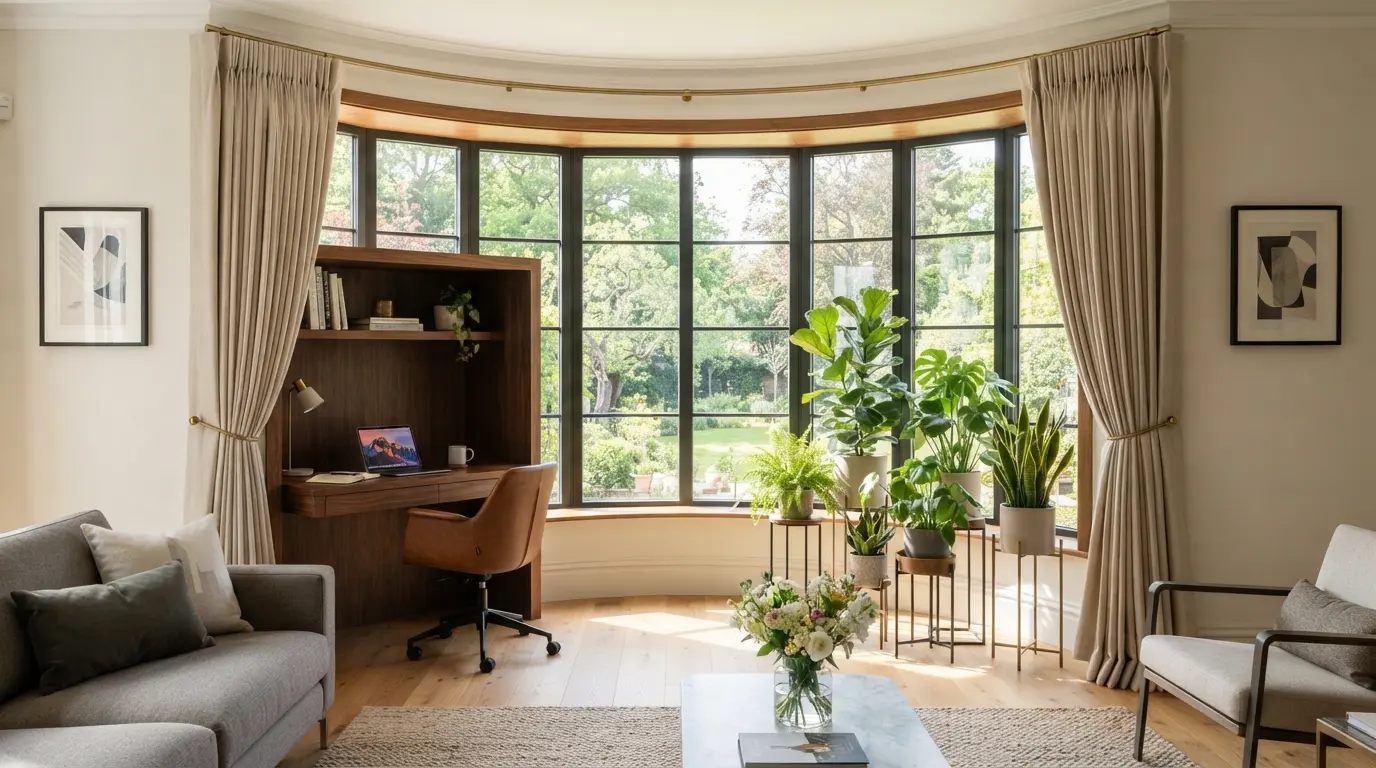
Facing a desk toward the bay gives you natural light and a view, which genuinely helps on video calls and long work sessions, though it also means facing away from the room. Facing the desk inward instead, with your back to the window, uses the bay as a decorative backdrop and avoids screen glare on sunny days.
A narrow desk 40 to 50cm deep fits most bay ledges without blocking the window’s opening sections. Keep at least one casement clear of furniture so you can still get proper ventilation into the room, particularly important if you’re working from that corner for hours at a time.
6. Turn the Ledge into a Kitchen Herb Garden
A south or west-facing kitchen bay gets more consistent sun than almost anywhere else in the house, which makes the sill an obvious spot for a row of potted herbs. Basil, mint, and rosemary all do well here, and having them within arm’s reach of the hob is genuinely useful, not just decorative.
Use a drip tray or a lined runner under the pots, since condensation and watering splashes will mark bare timber or painted sills over time. If you’re planning wider changes to the kitchen bay, our guide to adding a breakfast bar is worth reading alongside this one.
7. Add Floating Shelves for Display
Narrow floating shelves fitted either side of the bay, rather than across the window itself, give you display space without blocking any light. This suits a living room or bedroom bay better than a kitchen one, where steam and grease make open shelving harder to keep clean.
Keep the brackets hidden and the shelf depth shallow, around 15 to 20cm, so the shelves read as a deliberate architectural detail rather than an afterthought. Rotate what’s on them seasonally: framed photos, a small lamp, or fresh flowers all work better than a permanent, static arrangement.
8. Make a Statement in the Bathroom
A bathroom bay window is an underused opportunity for a freestanding bath positioned to catch the light, provided you have the privacy for it or a good obscured or frosted glazing option. It turns an ordinary bathroom into a genuinely memorable one without touching the layout of the rest of the room.
Moisture is the real risk here, both on the glazing itself and on any painted surfaces nearby, so this is not a spot for a standard emulsion finish. Our guide on moisture resistant bathroom paint covers what actually holds up around a steamy bay window versus what just looks good on the tin.
9. Frame the Recess with Wall Panelling
Wood cladding or panelling on the interior walls of the bay, rather than the flat wall around it, draws attention to the window as a distinct architectural moment. Light, unfinished or lightly stained timber works particularly well against black or anthracite frames for a modern rustic look.
This is a project best measured with a paper template first, the same way you’d template a window seat top, since bay walls are rarely perfectly square. Keep panelling below sill height so it doesn’t compete with the glazing bars themselves.
10. Layer Your Window Treatments
Layering sheers with drapery, or pairing woven wood shades with a blackout blind underneath, is one of the defining window treatment trends for 2026, and it suits a bay better than a single flat treatment ever does. A ceiling-mounted curtain track that follows the bay’s angles lets the outer layer wrap the full curve, while a fitted blind on each individual pane handles daily privacy and light control.
Standard wall-mounted rods don’t follow a bay’s shape well, which is the single most common styling mistake we see on these windows. For the full breakdown on tracks, poles, and blind types for a bay specifically, see our guide on dressing a bay window with curtains or blinds.
11. Colour-Drench the Recess
Painting the reveals, sill, and surrounding wall of the bay in the same tone as the rest of the room, rather than picking the woodwork out in bright white, is a strong 2026 trend and it makes a small bay feel like part of the room instead of a separate box. Terracotta, olive, and warm clay tones are especially popular this year for this treatment.
This only works well if the frames themselves are a colour that can handle it, typically timber or a coloured uPVC or aluminium finish rather than standard white. Test the colour in the bay itself before committing, since the light bouncing off three angled walls behaves differently than a single flat wall.
12. Add a Pendant Light or Task Lighting
A single statement pendant hung low over a dining table in the bay, or a small adjustable task light clipped to a shelf for reading, does more for the evening feel of the space than overhead room lighting ever will. Bay windows are bright by day and can feel oddly dark and unfinished by night without a dedicated light source.
Keep pendant cords or track lighting on a dimmer if the bay doubles as both a daytime workspace and an evening seating spot. This is a small addition, usually well under a day’s work for an electrician, but it’s one of the details that separates a styled bay from a genuinely finished one.
13. Create a Kids’ or Pet Corner
A low cushion, a soft rug, and a shallow basket for toys turns a bay into a genuinely used play spot rather than a grown-up feature the kids ignore. The same setup, scaled down with a washable pet bed, works just as well for a dog that likes watching the street.
Keep anything permanent, like a built-in bench, on the sturdier end if young children will be climbing on and off it daily, and skip delicate fabrics like velvet in a bay that’s going to see this kind of use.
14. Zone It with a Rug and Textiles
A small rug placed directly in front of the bay, sized so feet land on it rather than bare floor, visually separates the recess from the rest of the room even without a step or a change in flooring. Layer in cushions and a throw that pick up one or two colours from elsewhere in the room rather than matching everything exactly.
This is the cheapest idea on this list and one of the most effective, since it needs no construction and can be changed seasonally without any real cost or commitment.
15. Check Planning Permission Before You Change the Structure
Bay windows are often load-bearing, supporting brickwork or a roofline above, so any structural change needs proper bay pole jacks and, in some cases, an engineer’s calculations. This applies whether you’re widening the opening, removing the bay entirely, or adding one where none existed before.
Like-for-like replacement, swapping old frames for new ones in the same opening, usually falls under Permitted Development in the UK and doesn’t need a planning application. Adding a brand-new bay, especially on a front elevation, generally does need consent, and conservation areas or listed buildings add further restrictions on materials and style. Rules differ outside the UK, so check with your local building authority before any structural work begins.
What Does It Cost to Replace a Bay Window?
Replacing a bay window costs more than a standard casement because of the angled frames, multiple sections, and structural supports involved, and prices vary significantly by material and by country. As a rough UK guide, budget by material rather than by a single flat number.
| Material | Typical UK Cost (3-panel bay, fitted) | Notes |
| uPVC | £1,500–£4,000 | Cheapest option, low maintenance, 20 to 30 year lifespan |
| Timber | £4,000–£7,000 | Best for period character, needs repainting every 5 to 6 years |
| Aluminium | £4,500–£8,500 | Slim frames, durable, higher upfront cost |
Bow windows typically add 20 to 30% on top of an equivalent splay bay due to the curved fabrication. If the existing frame is structurally sound, replacing just the glazing units can cost significantly less than a full frame replacement, often a quarter of the price. Get at least three quotes, since labour alone can run £250 to £300 a day and most bay installations take one to three days depending on complexity.
Conclusion
The bay window ideas that actually get used share one thing in common: they start with the structure and the light, then add function on top, rather than the other way round. Pick one or two ideas from this list that match how you actually use the room, get the planning and glazing right first, and the styling will follow naturally. If seating is the direction you’re leaning, that’s worth reading about in full detail before you commit to a build.
FAQs
What is the difference between a bay window and a bow window?
A bay window has angled or square sections meeting at distinct corners, usually three panes. A bow window curves smoothly with four or more narrow panes and no sharp corners.
Do I need planning permission to change a bay window?
Like-for-like replacement usually doesn’t. Adding a new bay, especially on the front of the house, generally does, and conservation areas or listed buildings add extra restrictions.
How much does it cost to replace a bay window in the UK?
Budget roughly £1,500 to £4,000 for uPVC, £4,000 to £7,000 for timber, and £4,500 to £8,500 for aluminium on a standard three-panel bay, with bow windows costing more due to curved fabrication.
What is the best window treatment for a bay window?
Layered treatments work best: a fitted blind on each pane for daily privacy and light control, paired with a curtain on a ceiling-mounted track that follows the bay’s angles for softness and warmth.
Are bay windows load bearing?
Often, yes, particularly in older properties where the bay supports brickwork or a roofline above. Any structural change should use proper bay pole jacks and, where there’s doubt, an engineer’s assessment.
What is the best furniture for a bay window?
It depends on the room: a built-in bench for a living room or bedroom, a round table for a dining or kitchen bay, or a narrow desk for a home office corner. Match the furniture depth to your bay’s actual measurements rather than a standard size.