
12 Side Table Ideas to Complete Your Living Room

A side table completes a living room by giving every seat a place to rest a drink, a lamp, or a book within arm’s reach, while filling gaps that would otherwise look unfinished. The right side table ideas balance height, material, and function rather than just filling space, and the wrong ones are obvious the moment you try to actually use them.
Most living rooms end up with a side table that was either an afterthought, whatever happened to fit, or a leftover from a set that never quite matched the sofa it landed next to. Neither approach gets you a room that feels finished. What follows are twelve genuinely different approaches, covering shape, function, and placement, not just decor tips for whatever table you already own.
What Makes a Side Table Work in a Living Room?
A good side table sits close to the height of your sofa or chair arm, within about 2 to 5cm either way, so you can reach a drink or phone without leaning or reaching up. Width matters too: 40-45cm suits a tight spot beside an armchair, 45-56cm is the standard workhorse size, and anything from 60cm up reads as a statement piece.
Placement matters as much as size. A side table needs to sit close enough to touch from a seated position, not admired from across the room, which is the single most common reason a beautiful table ends up feeling useless. In projects I’ve worked on, the biggest mistake isn’t picking an ugly table, it’s picking a lovely one that’s 15cm too tall for the sofa arm or too far from the actual seat to reach without standing up.
1. Nesting Tables for Flexible Extra Surface
A set of two or three nesting tables gives you one compact footprint most of the time, then extra surface the moment you need it, for a second drink, a laptop, or extra guests. Slide the smaller tables out from under the largest one and you’ve doubled your surface area without adding a single new piece of furniture to the room.
This works particularly well in smaller living rooms where a single large side table would eat too much floor space. The trade-off is that nesting sets are often sold as a fixed trio in matching finishes, so you have less freedom to mix materials than with a single standalone table.
2. C-Shaped Table That Slides Over the Sofa Arm

A C-table, named for its shape when viewed from above, slides its base under the sofa so the tabletop hovers directly over the cushion or arm, putting a surface exactly where a laptop, plate, or mug actually needs to be. It solves the reach problem better than almost any other table type, because the surface comes to you rather than the other way round.
The trade-off is that a C-table only really works alongside a specific sofa arm height and depth, so measure the gap under your sofa before buying rather than assuming a standard size will slide in cleanly. It also tends to look more functional than decorative, which suits a reading or work-from-sofa setup better than a formal sitting room.
3. A Pair of Matching Tables for Symmetry
Two identical side tables flanking a sofa or a pair of armchairs create a calm, balanced look that reads as intentional the moment you walk into the room. This is the safest option if you’re not confident mixing styles, since matching pairs are close to impossible to get visually wrong.
The honest trade-off is that a fully matched pair can feel a little showroom-flat compared with a room built from pieces collected over time. A good middle ground is a matching pair with different styling on top, so the tables themselves are identical but what sits on them varies.
4. Mismatched Pair for a More Collected Look
Two side tables that share one detail, wood tone, leg shape, or a similar height, but differ everything else, give a room the feeling of having been put together gradually rather than bought as a set. This is the look most designers reach for when a client wants a living room that feels layered rather than staged.
Getting this right takes a bit more care than a matching pair. A good rule of thumb is to keep both tables within a similar height range and similar visual weight, since a delicate glass table beside a chunky reclaimed-wood one usually looks like a mismatch rather than a deliberate contrast.
5. Side Table With Built-In Storage
A table with a drawer, a lower shelf, or a fully enclosed cabinet base earns its place in a small living room by doing double duty, holding remote controls, coasters, or spare throws out of sight rather than cluttering the surface. This is especially useful next to a sofa used daily, where clutter accumulates fast without somewhere to put it.
The trade-off worth knowing is that storage tables are usually bulkier than open-legged designs, so they suit a room with a bit of floor space to spare rather than a tight corner. Drawer runners on budget versions can also wear out faster than the table itself with years of daily use, so check the drawer mechanism, not just the tabletop finish, before buying.
6. Drum or Stool-Style Table for Texture
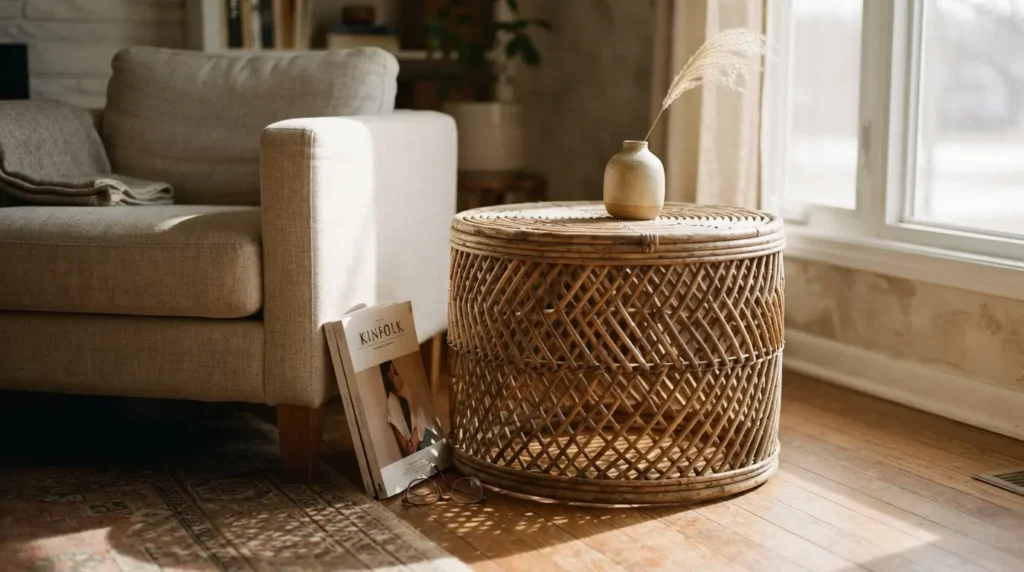
A rattan garden stool, a leather drum table, or a woven cane cylinder brings a completely different texture into a room otherwise dominated by flat wood and upholstery surfaces. These pieces are usually light enough to move around easily, which makes them genuinely useful as extra seating or a plant stand when you’re not using them as a side table.
This is one of the easiest ways to add warmth without committing to a full redecorate, since a single stool-style table can shift the whole feel of a corner. The trade-off is stability: a lightweight woven stool isn’t the best choice for a heavy table lamp or anything liable to get knocked, so keep what sits on top proportionate to the base.
7. Two Small Side Tables Instead of One Coffee Table
Replacing a single coffee table with two smaller side tables pulled up in front of the sofa gives you more flexibility to rearrange the room for movie nights, extra guests, or simply cleaning underneath. It’s a genuinely practical swap in a living room that gets used hard rather than styled for photographs.
This idea suits households with kids or a lot of foot traffic better than a single large coffee table, since two smaller tables are easier to shift out of the way entirely. The trade-off is surface area, two 45cm tables side by side don’t always add up to the same usable top space as one larger coffee table, so it works best with a sofa layout that has room either side.
8. Vintage or Repurposed Piece With Character
An old trunk, a vintage stool, a converted sewing table, or a reclaimed barrel brings genuine character that a new piece can’t fake, and it’s often cheaper than an equivalent new design in a similar style. Second-hand marketplaces and local vintage dealers are worth checking before committing to something new, particularly for a one-off statement piece.
The trade-off is condition and stability. A vintage find might need a wobble fixed, a surface resealed, or felt pads added to protect your flooring, so budget a little time and a small amount of money for touch-ups rather than expecting it to be ready to use straight out of the van.
9. Mixed-Material Table for a Lighter Visual Footprint
A table built from glass, wire, or slim metal takes up far less visual space than an equivalent solid wood piece, which matters in a small living room where every solid surface adds to a feeling of clutter. This works especially well beside a chunky sofa, where a heavier table would compete for attention rather than complement it.
The honest trade-off is maintenance. Glass tops show fingerprints, dust, and drink rings more visibly than a matte wood or stone surface, so they suit a household willing to wipe them down regularly rather than one that wants a set-and-forget piece.
10. Corner-Filling Table for an Awkward Gap
A triangular or wedge-shaped table tucks into a corner that a standard round or square table simply can’t use efficiently, turning genuinely wasted space into somewhere useful for a lamp or a small stack of books. This is a specific-use piece rather than a general one, so measure the corner carefully before shopping, since not every retailer stocks this shape as standard.
Where this idea earns its place is in older or oddly proportioned rooms, alcoves, bay window corners, or the gap beside a chimney breast, where a conventional table would either not fit or leave an awkward triangle of dead space behind it.
11. Tray-Top or Trolley-Style Table for Flexibility
A table with a removable tray top, or a small drinks trolley pressed into service as a side table, gives you a surface that can leave the room entirely when you need it, carried through to the kitchen for drinks or cleared off in seconds. This suits anyone who entertains regularly and wants a table that adapts rather than staying fixed in one spot.
The trade-off is that trolley-style tables on castors can feel less substantial underfoot than a fixed table, and cheaper wheels can mark hard flooring over time, so check the castor quality if your living room has wood or tile underfoot rather than carpet.
12. Stone or Marble-Topped Table for a High-Use Surface
A table with a stone, marble, or engineered composite top handles daily wear, hot mugs, condensation rings, and the occasional knock far better than most wood finishes, which makes it the practical choice for a side table that gets used constantly rather than admired occasionally. It also reads as a more design-led, higher-end piece even at a modest size.
The trade-off is weight and cost. Genuine stone tops are heavier to move than wood or metal equivalents and typically sit at a higher price point, so they suit a table you plan to keep in one spot rather than rearrange often.
Choosing the Right Material for Daily Use
Every material trades off differently between looks, upkeep, and how it holds up to daily living. Wood is the most forgiving all-rounder, stone and marble handle heat and moisture best, and glass or metal give the lightest visual footprint but need the most regular wiping down.
| Material | Best For | Maintenance Reality |
| Solid wood | Warmth, most living room styles | Occasional polish, watch for water rings without a coaster |
| Stone or marble | Daily use, hot drinks, high-traffic homes | Wipe clean easily, natural stone can etch with acidic spills |
| Glass or mixed metal | Small rooms, minimal visual weight | Shows dust and fingerprints, needs regular wiping |
| Rattan or woven cane | Texture, lightweight, easy to move | Keep away from direct heat sources, dust with a soft brush |
| Engineered/composite tops | Budget-friendly durability | Generally low maintenance, check edge finish for chipping over years |
What Side Tables Cost, and Where the Money Actually Goes
Side tables span an enormous price range because you’re paying for different things at each level, not just a bigger table. A basic flat-pack piece and a solid stone-topped design might look similar in a photo but perform very differently after two years of daily use.
| Budget Level | Typical Price Range (approx.) | What You’re Paying For |
| Budget | £20-£80 | Basic MDF or laminate, simple construction, fine for light use |
| Mid-range | £80-£300 | Solid wood or better veneers, sturdier joints, wider style choice |
| Design-led | £300-£800 | Named designers, quality stone or solid hardwood, better finishing |
| Investment or bespoke | £800+ | Commissioned pieces, premium materials, made-to-order sizing |
These figures are approximate and vary a good deal by country and retailer, so treat them as a planning guide rather than a fixed quote. A reasonable rule of thumb is that anything under about £50 is unlikely to survive daily hard use for more than a few years, which is fine for a piece you’re not attached to but worth knowing before you buy several at once for a whole room.
Common Side Table Mistakes to Avoid
The single biggest mistake is buying on looks alone without checking the height against your actual seating, which is a five-minute measurement that saves months of a table that never quite works. A close second is choosing a table too small for what you actually put on it, most people underestimate how much surface a lamp, a coaster, and a phone genuinely take up together.
Overcrowding the top is another common trap. A side table with every inch covered in objects looks cluttered rather than styled, and it stops functioning as the useful surface it’s meant to be. Leaving a clear section for a drink or a phone matters more than fitting in one more decorative object.
Finally, matching every side table exactly to your coffee table is rarely necessary and can flatten the room’s character. A shared wood tone or a similar leg shape is usually enough of a connection without needing an identical set.
Conclusion
The right side table ideas for your living room come down to matching height and function to how you actually sit and use the space, not just picking whatever looks good in a single photo. Measure your sofa arm before you shop, decide what job the table actually needs to do, drinks, storage, lighting, or simply filling an awkward gap, and choose the material based on how hard it will really be used. Get those basics right first, and any of the twelve ideas above will genuinely finish the room rather than just occupy a corner of it.
FAQs
What should I put on a side table in the living room?
A functional item like a lamp, plus one or two decorative pieces at different heights, a small vase, a candle, or a book stack, while leaving a clear space for a drink or phone. Fewer, better pieces read as more intentional than a crowded surface.
How tall should a living room side table be?
Aim for a height close to your sofa or chair arm, within roughly 2 to 5cm either way, so you can reach items without leaning or reaching up awkwardly.
Should a side table have a lamp on it?
Not always, but a lamp is one of the simplest ways to add warm, layered lighting to a living room in the evening, especially if the room otherwise relies on a single overhead light.
How do I style a small side table without clutter?
Choose fewer, slightly larger pieces rather than many small ones, and keep one section of the tabletop consistently clear for everyday use like a drink or a phone.
What side table material is best for everyday living rooms?
Stone, marble, or a sealed wood finish handle daily use, hot drinks, and the odd knock better than glass or unfinished wood, which show marks more easily.
Can I use two side tables instead of a coffee table?
Yes, and it’s a practical option for households that want more flexibility to rearrange the room or move seating out of the way for cleaning or hosting.
Do side tables need to match my coffee table?
No, sharing one detail like wood tone or leg shape is usually enough to tie the pieces together without needing an exact match.