12 Kitchen Flooring Ideas That Are Practical and Stylish

The best kitchen flooring ideas balance three things: a surface that handles spills and foot traffic, a finish that hides daily mess, and a look that works with your cabinetry rather than fighting it. Porcelain, LVT, engineered wood and natural stone deliver on all three in different ways. The twelve ideas below show how.
Here is the problem with most flooring inspiration. It shows you a beautiful photograph taken on the day the room was finished, with nothing on the counters and the grout still brilliant white. What it does not show you is the same floor eighteen months later, after a dropped pan, a dishwasher leak and two winters of muddy boots. The ideas that follow are the ones that still look right on an ordinary Tuesday, not just on a shoot day.
1. Wood-Effect Porcelain for the Look Without the Upkeep
Wood-effect porcelain gives you the warmth of timber grain with the waterproofing and scratch resistance of tile. It is the single most practical way to get a wood look into a kitchen, and modern printing has made the grain, knots and colour variation convincing enough that most people will not spot it underfoot.
The detail that separates a good wood-effect floor from an obviously fake one is the number of different plank designs in the batch. Fewer than eight or so and the repeat pattern becomes visible across a large room. Ask your supplier how many face variations a range has before you commit.
Grout is the other giveaway. Keep joints tight, ideally 2mm to 3mm, and choose a grout that matches the mid-tone of the plank rather than a contrasting shade. Wide, pale grout lines between wood-effect planks immediately read as tile rather than timber.
2. Patterned Vinyl Against Plain Cabinetry
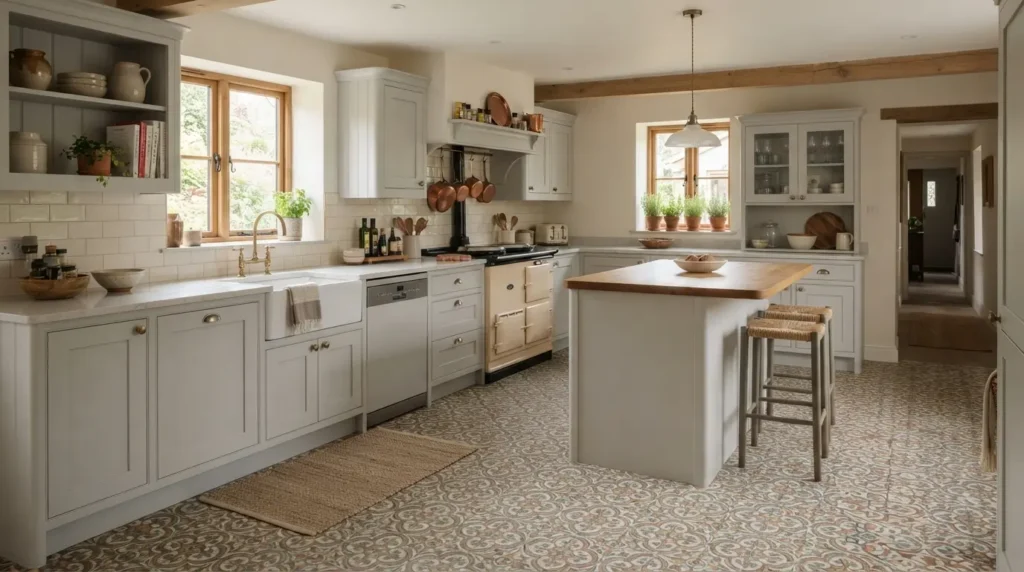
Pattern on the floor works best when everything else in the room is calm. A bold geometric or encaustic-style vinyl against simple oak or painted Shaker cabinets gives a kitchen genuine personality without committing you to anything expensive or permanent.
Vinyl is the sensible material for this because it is water resistant, softer underfoot than tile, and low cost enough that changing your mind in six years is not a disaster. It also repels dirt well and is more forgiving if someone slips.
One practical warning that gets left out of most inspiration pieces: patterned floors fight badly with awkward spaces. If your kitchen has curved walls, angled corners or lots of interruptions from units and appliances, the pattern gets cut off mid-motif and looks unresolved. In those rooms, a plain or lightly textured floor is the better call regardless of how much you like the pattern.
3. Polished Concrete for a Contemporary Kitchen
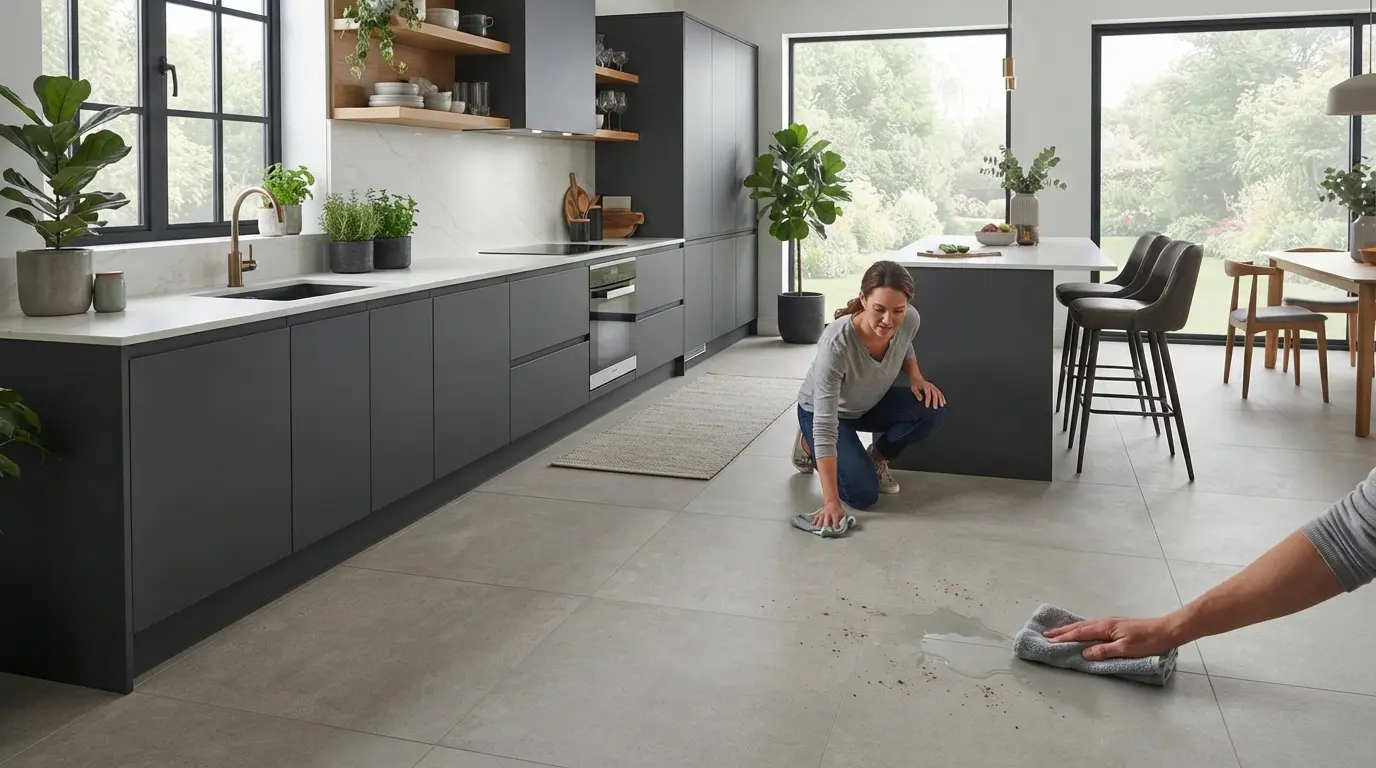
Polished concrete suits flat-panel cabinetry, integrated appliances and open-plan layouts, and it handles heavy traffic and spills without complaint. It can also be tinted or stained, so it does not have to read as cold industrial grey.
The honest issue is cost. Newly poured and polished concrete typically starts somewhere around £120 per square metre in the UK and climbs from there, which makes it a genuinely expensive choice across a large open-plan space. Costs vary by country and by how much preparation your existing slab needs.
It also needs repolishing every few years to keep its finish, and it is hard and cold underfoot without underfloor heating. If you want the look for less, concrete-effect porcelain tiles, large-format sheet vinyl and linoleum all get you close for a fraction of the outlay and none of the repolishing.
4. A Neutral Floor Under Coloured Cabinets
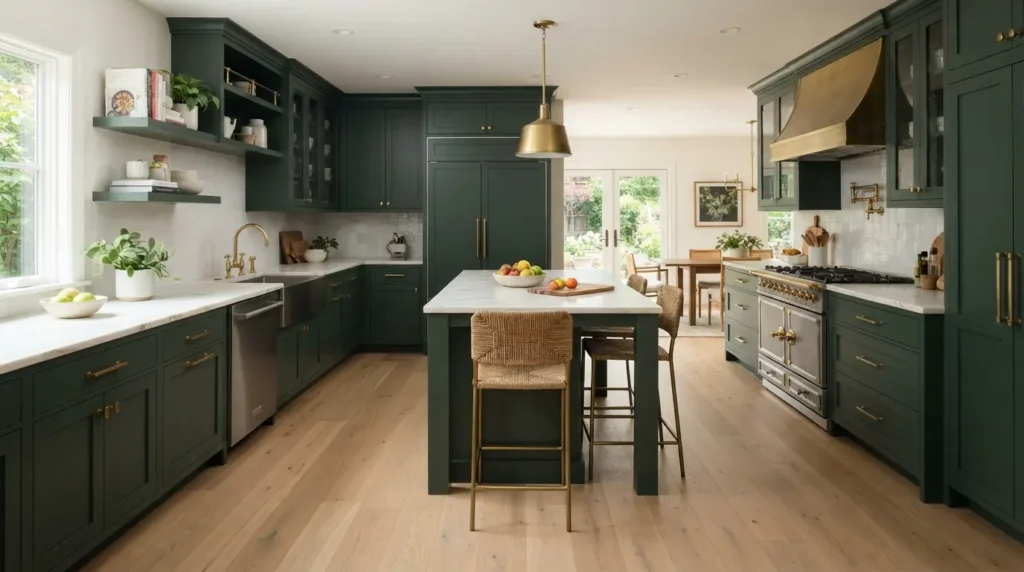
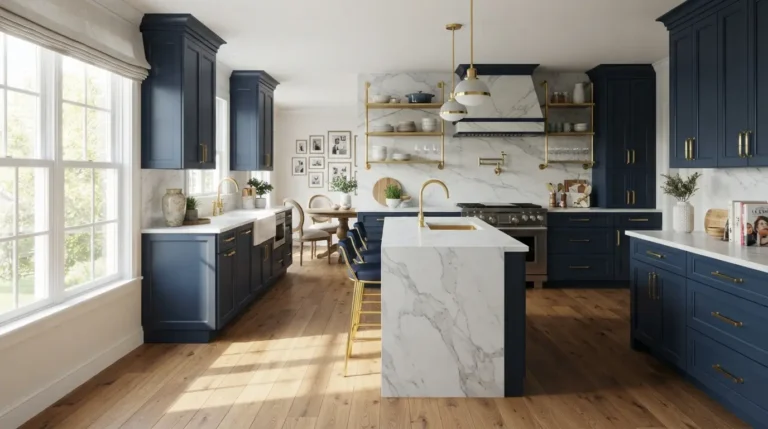
When your cabinetry is doing the talking, the floor’s job is to stay quiet. A honed limestone, warm greige porcelain or plain oak lets navy, forest green or ochre cabinets be the focal point without two elements competing.
Ask for a honed rather than polished finish on any stone or tile in a kitchen. Honed is less slippery when wet, which matters a lot in a room where water hits the floor regularly, and a matt closed surface holds less dirt and is easier to keep looking clean.
A good rule of thumb on tone: if your cabinets are light, a mid to darker floor grounds the room; if your cabinets are dark, a lighter floor stops the space feeling heavy. Where uppers and lowers are different colours, pick a floor tone that sits between the two.
5. Terracotta and Warm Clay Tiles
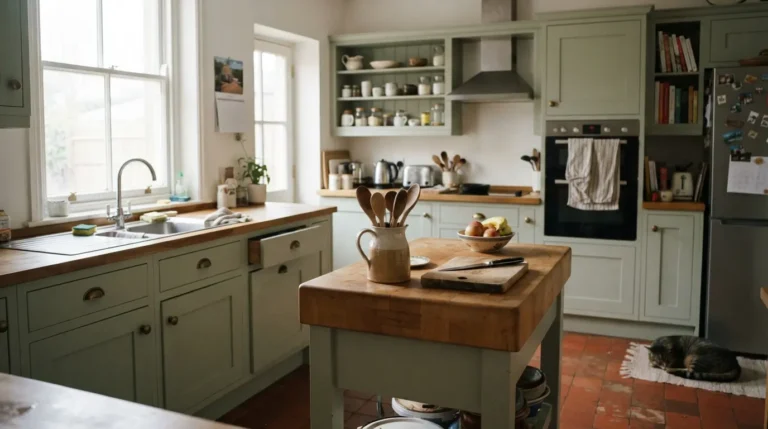
Terracotta brings warmth that grey and white floors simply cannot, and it pairs beautifully with neutral cabinetry, timber worktops and panelled walls. Classic square terracotta suits period and rural homes, while flat matt versions in muted clay shades read as thoroughly modern.
Natural terracotta is highly porous. It must be sealed properly at installation and resealed periodically, or it will take on stains from oil, wine and anything acidic within the first year. In a working kitchen this is real, ongoing maintenance rather than a footnote.
If you want the colour without the commitment, terracotta-effect porcelain gives you the same warm tone with no sealing and far better stain resistance. Most homeowners who love the look but cook a lot end up glad they went this route.
6. Large-Format Tiles to Make a Kitchen Feel Bigger
Large-format tiles mean fewer grout lines per square metre, which reads visually as a calmer, more open floor. In a narrow galley kitchen they add an illusion of width; in a bigger room they give a clean, expansive finish that smaller tiles cannot match.
Large formats are less forgiving to install. They demand a genuinely flat subfloor, since any deviation causes lippage where one tile edge sits proud of the next, and they generate more waste when cut around units. Expect fitting labour to be higher than for standard tiles and order extra material accordingly.
Keep the shade light to mid-tone if maximising perceived space is the goal, since pale floors bounce available light around the room in a way dark ones never will.
7. Checkerboard for Character That Reads Both Ways
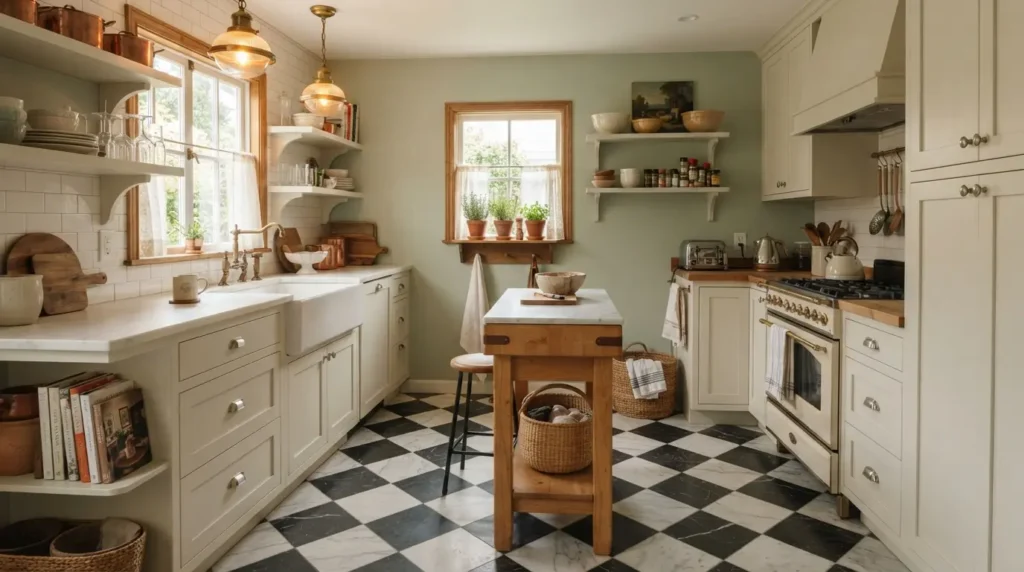
Checkerboard flooring is unusual in that it works in traditional and contemporary kitchens equally well, which is part of why it has never fully gone away. It also happens to work best in the rooms people are most nervous about: small kitchens, where you are only covering a compact area and can afford a beautiful, more expensive tile.
Swapping black for charcoal or mid-grey softens the classic version and stops it reading as a retro pastiche. You can also do the same trick with hexagon tiles in two colours rather than squares, which gives you the rhythm of a checkerboard with a less expected shape.
Counter-intuitively, a larger scale of pattern can make a small room feel bigger, because the eye reads the space as able to accommodate a bigger design. Scaling everything down in a small kitchen often makes it feel busier, not roomier.
8. Engineered Wood Laid in Herringbone
Engineered wood is the version of timber that survives a kitchen, being far more resistant to heat and moisture than solid boards, and it works with underfloor heating within the manufacturer’s temperature limits. Laid in herringbone or chevron, it brings pattern and craft to a room without adding colour.
Two numbers matter when buying. The wear layer should be at least 3mm if you ever want to sand it back, and 4mm to 6mm if you want to do so more than once. And for herringbone or chevron layouts, order roughly 15% extra material rather than the usual 10%, because angled cuts generate significantly more waste.
Herringbone and chevron also take considerably longer to fit than straight planks, so budget for higher labour as well as more material. A floor that takes two days straight-laid can take four or five in herringbone.
9. Cork for Warmth, Quiet and a Softer Underfoot
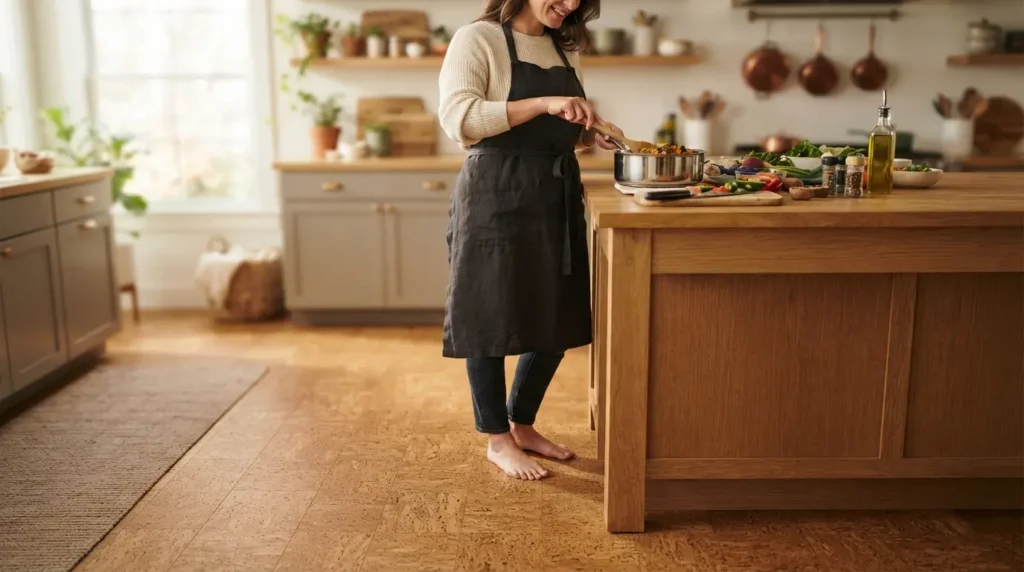
Cork has moved from overlooked to genuinely sought after, and it deserves the attention. It is warm, soft to stand on, naturally insulating for both heat and sound, and naturally resistant to mould and bacteria. For anyone who stands and cooks for long stretches, it is noticeably kinder than tile.
The trade-offs are specific. Cork is sensitive to standing water unless properly sealed, and it fades in direct sunlight, so a kitchen with a big south-facing window will show colour change over time. Glue-down cork tiles handle moisture better than floating ones, so use those where spills are likely.
Rubber sits in a similar category, soft, quiet, easy to clean and available in a wide range of colours and textures. Both are worth a look if a hard, cold floor is the thing putting you off your current options.
10. Different Flooring to Zone an Open-Plan Space
In an open-plan kitchen diner, changing the flooring material is one of the most effective ways to define zones without adding walls. Hard-wearing porcelain in the cooking area and timber or carpet in the living end gives each zone the surface it actually needs.
The transition is where this goes wrong. A badly detailed junction between two materials looks like an accident rather than a decision, so plan the line carefully and use a proper threshold trim. Aligning the change with a structural feature, the edge of an island or a ceiling beam, makes it read as intentional.
A subtler version is a tiled border around the perimeter of the kitchen area in a contrasting colour or shape. It adds detail and soft division, though it needs careful planning up front, and it does limit rearranging furniture later.
11. Slate, Limestone and Flagstone for Longevity
Natural stone is the flooring most likely to outlast the kitchen fitted above it. Slate, limestone and flagstone all bring texture and depth that manufactured surfaces struggle to replicate, and each piece is genuinely different from the next.
Stone with visible texture or veining hides everyday marks and dirt far better than a plain, flat surface, which is a practical argument for busier stone rather than a purely aesthetic one. In a low-light kitchen, a honed stone with a semi-polished finish lifts the room without becoming slippery.
The maintenance is real: all natural stone is porous and needs sealing, and it should be cleaned without harsh chemicals. It is also the most expensive category here, typically £50 to £150 or more per square metre for supply alone before fitting. Where the same stone can run through several rooms, you often get better value on delivery and installation.
12. LVT for the Lowest-Maintenance Option
If low maintenance is the priority, luxury vinyl tile is hard to beat. It is waterproof, scratch resistant, warm and soft underfoot, compatible with underfloor heating, and needs nothing more than a sweep and an occasional mop. Dropped cutlery and food spills leave no mark.
Thickness is the quality signal. Cheap sheet vinyl starts around 1mm and will not last; aim for 3.5mm and up for sheet vinyl. With LVT, the wear layer is the number that matters most, and for a kitchen you want at least 0.5mm, ideally closer to 0.7mm, for the floor to hold up for a decade.
Sheet vinyl has one advantage over LVT that is easy to miss: no joins means no seams for water to get through, which makes it the more waterproof of the two in a room where a leak is possible.
What Each Option Costs and How Long It Lasts
Supply costs below are approximate UK figures per square metre and will vary by country, retailer and specification. Fitting is extra and usually adds £15 to £30 per square metre for click-lock products and £30 to £60 for tile and stone.
| Material | Supply cost (per m²) | Water resistance | Underfloor heating | Realistic lifespan |
| Sheet vinyl | £10–£25 | Waterproof | Yes | 8–15 years |
| Luxury vinyl tile | £25–£60 | Waterproof | Yes | 15–25 years |
| Laminate | £12–£35 | Water resistant only | Yes | 8–15 years |
| Cork | £25–£55 | Good, if sealed | Yes | 15–25 years |
| Ceramic tile | £15–£45 | Good | Yes | 20–40 years |
| Porcelain tile | £25–£70 | Waterproof | Yes, excellent | 25–50 years |
| Engineered wood | £35–£90 | Water resistant | Within limits | 20–30 years |
| Natural stone | £50–£150+ | Needs sealing | Yes | 30+ years |
| Polished concrete | £120+ | Good, if sealed | Yes | 30+ years |
Laminate and vinyl win on price per square metre, but they wear and mark in high-traffic areas and need replacing more often. Over ten to twenty years, porcelain tends to come out well ahead on value, which is the calculation most flooring guides skip.
The Mistakes That Cost People Money
Skipping subfloor preparation causes more flooring failures than any product defect. Subfloors need to be clean, dry, structurally sound and flat before anything is laid. An uneven base makes click-lock planks flex and fail at the joints, shows through thin sheet vinyl as visible ridges, and causes tiles to crack or lift. If your existing floor deviates more than a few millimetres over a two-metre span, budget for levelling compound first.
Choosing colour purely on looks is the second. Black and white floors both show dirt faster than anything else, meaning far more frequent cleaning in the one room that generates the most mess. Mid-tone greys, warm stones and lightly varied finishes hide daily marks far better.
The third is ignoring order of works. Solid flooring like stone and tile should go down before the units for the best finish, and running the floor underneath means you can change the kitchen later without a visible gap. It uses more material, but if you plan to stay ten years or more it is usually worth it.
Finally, always order extra. A good rule of thumb is 10% more than your measured area for straight-laid material, and 15% for herringbone, chevron or diagonal layouts, which generate far more offcut waste. Running short mid-fit and finding the batch has changed is an expensive, avoidable problem.
Conclusion
The kitchen flooring ideas that hold up over time all share the same logic: they suit the way the room is used before they suit the way it photographs. Work out your water resistance, traffic and heating requirements first, then pick the look that fits within what is left. Order a sample and live with it in your own light for a week before committing, and build subfloor prep, wastage and fitting into your budget from the start. The floor is the hardest thing in a kitchen to change your mind about later, which is exactly why it deserves the most thought now.
FAQs
What is the best flooring for a kitchen?
It depends on what you weight most. Porcelain tile is the toughest and works best with underfloor heating. LVT is the most comfortable and lowest maintenance for the money. Engineered wood is the best way to get real timber in a kitchen. Natural stone lasts longest but needs sealing and careful cleaning.
What is the easiest kitchen flooring to maintain?
LVT, vinyl and porcelain tile are the clear winners. All three are effectively waterproof, need nothing more than mopping, and require no sealing, oiling or resealing. Natural stone, solid wood and terracotta all need ongoing treatment to stay looking good.
What is the cheapest floor for a kitchen?
Laminate is the cheapest per square metre, with basic vinyl close behind, and both are also quicker and cheaper to fit than tile or stone. The catch is lifespan: they mark and wear in busy households and need replacing sooner, so the cheapest floor over five years is not the cheapest over twenty.
Should a kitchen floor be lighter or darker than the cabinets?
There is no fixed rule, but a dark floor with light cabinets tends to read more contemporary, while a light floor with darker cabinets reads more traditional. What matters more is that the two have enough contrast to define the space, and that the floor tone avoids the extremes of pure white and near-black, both of which show dirt fastest.
Can I use wood flooring in a kitchen?
Engineered wood, yes. Solid wood is possible but not recommended, since it expands and shrinks with moisture, is vulnerable to standing water, needs regular refinishing, and does not pair well with underfloor heating. If you want the wood look with no compromise on practicality, wood-effect porcelain or LVT gets you there.
Which kitchen flooring works best in a small kitchen?
Larger format tiles or wide planks in a light to mid tone, since fewer joins and paler colours both make a compact room feel more open. A small kitchen is also the one place where an expensive or heavily patterned floor becomes affordable, because you are covering so little area, so it is worth being braver than you might be elsewhere.
Does patterned flooring date quickly?
Some patterns do, some do not. Checkerboard, herringbone, chevron and parquet have been in continuous use for well over a century and do not date in the way a specific colourway or a trend-led geometric will. If you want pattern but worry about longevity, choose a classic layout in a neutral palette rather than a distinctive motif in a fashionable colour.