
What Are Acoustic Panels and Do They Actually Work?

Acoustic panels are surface mounted panels made from porous materials like fibreglass, mineral wool, foam or PET felt, designed to absorb sound inside a room and reduce echo, flutter and reverberation. They do work, but only for that specific problem. They will not stop noise passing through a wall from a neighbour or the next room.
That last point trips up almost every homeowner I speak to before an installation. Someone hears their upstairs neighbour’s television or their own voice bouncing harshly around a home office, buys a box of foam panels expecting silence, and ends up disappointed because they bought a product for the wrong problem entirely. This acoustic wall guide sorts out what these panels genuinely fix, what they don’t, and how to tell which one you actually need.
Acoustic Panel Explained: What They’re Actually Made Of
An acoustic panel works because it’s porous, not because it’s dense. Sound waves enter the material, where friction inside the fibres converts sound energy into a small amount of heat, which is what reduces the reflected sound bouncing back into the room.
The most common cores are rigid fibreglass, mineral wool and PET felt, the last of which is usually made from recycled plastic fibres compressed into a dense but still porous board. Foam panels, the pyramid and wedge shaped tiles sold cheaply almost everywhere, work on the same principle but are lighter and generally less effective per inch of thickness than fibreglass or mineral wool cores.
Do Acoustic Panels Work, or Is It Just Marketing?
These panels genuinely work for what they’re designed to do: absorbing sound inside a room to reduce echo and reverberation. Performance is measured using NRC, the Noise Reduction Coefficient, on a scale from 0.00, meaning total reflection like bare glass, to 1.00, meaning near total absorption.
A panel rated NRC 0.85 absorbs roughly 85 percent of the sound that hits its surface. Most decent fibreglass or mineral wool panels sit somewhere between 0.85 and 1.00, while budget foam tiles often land closer to 0.4, which is still an improvement over a bare wall but noticeably weaker. In projects I’ve worked on, the panels themselves rarely disappoint once the right product is chosen. The disappointment almost always comes from someone expecting a sound absorption product to also stop sound transmission, which is a different job entirely.
Acoustic Panels vs Soundproofing, What’s the Real Difference
These panels absorb sound within a room. Soundproofing blocks sound from travelling between rooms. The two solve completely different problems, and confusing them is the single most expensive mistake homeowners make with acoustic treatment.
Soundproofing relies on mass, airtight sealing and decoupling, using materials like mass loaded vinyl, resilient channels and additional layers of plasterboard built into the wall structure itself. Absorption panels take the opposite approach: lightweight, porous, and mounted on the surface rather than built into it. A simple test tells you which one you need. Clap your hands in the room. If you hear a ringing tail or harsh echo, that’s an absorption problem and wall panels will help. If the complaint is hearing a neighbour’s television or footsteps through the wall, that’s a transmission problem, and no amount of surface treatment will fix it.
Will Acoustic Panels Help With Noisy Neighbours?
They will not stop noise coming from a neighbouring flat or room, no matter how many you install or how high their NRC rating is. That kind of noise travels through the structure of the building, and stopping it requires soundproofing measures like added mass, sealed gaps and decoupled wall layers, not surface absorption.
What wall panels can do in a noisy neighbour situation is take the edge off the room’s own reflected sound, which sometimes makes external noise feel slightly less intrusive simply because the room itself is quieter and less reverberant. It’s a modest secondary benefit, not a fix, and it’s worth setting that expectation honestly before anyone spends money assuming otherwise.
NRC vs STC: The Two Ratings That Get Confused
These two ratings measure completely different things, and checking a product listing for the wrong one is an easy way to buy the wrong product entirely.
| Rating | What It Measures | Used For | Typical Range |
| NRC (Noise Reduction Coefficient) | Sound absorption inside a room | Wall panels, echo and reverberation control | 0.00 to 1.00 |
| STC (Sound Transmission Class) | Sound blocking between rooms | Soundproofing, walls, doors, partitions | Roughly 25 to 65+ |
If a product listing only shows an NRC rating, it absorbs sound and does not block it, regardless of how the marketing copy is worded. A genuine soundproofing product will list an STC rating instead, or alongside NRC if it does both.
Where These Panels Actually Make a Noticeable Difference
They earn their keep in rooms where sound clarity matters more than blocking outside noise: home offices used for video calls, home theatres, music practice rooms, open plan living rooms with hard flooring, and podcast or recording setups. Anywhere sound bounces off bare walls, glass or hard flooring and creates that hollow, metallic quality is a good candidate.
The worst untreated rooms are usually rectangular with two parallel hard surfaces, since sound reflects directly back and forth between them, creating flutter echo. One panel on one wall barely touches this problem. Treating both of a pair of parallel walls, even lightly, cuts the effect dramatically compared with concentrating all the coverage on just one side of the room.
How Much Wall Coverage Do You Actually Need?
A good rule of thumb is covering roughly 15 to 25 percent of a room’s total wall surface area with panels rated NRC 0.85 or higher to get a noticeable, meaningful improvement in most home spaces. You don’t need to cover every wall edge to edge. You need the right walls covered properly.
For a home office or bedroom, a single accent wall, often the wall behind you during video calls or the wall opposite a hard window, is usually enough to take the harshness out of the room. Larger open plan living rooms with high ceilings and hard flooring typically need panels split across two or three surfaces, including the ceiling in more serious cases, to control both echo and the flutter between opposing walls.
How Are Wall Panels Installed?
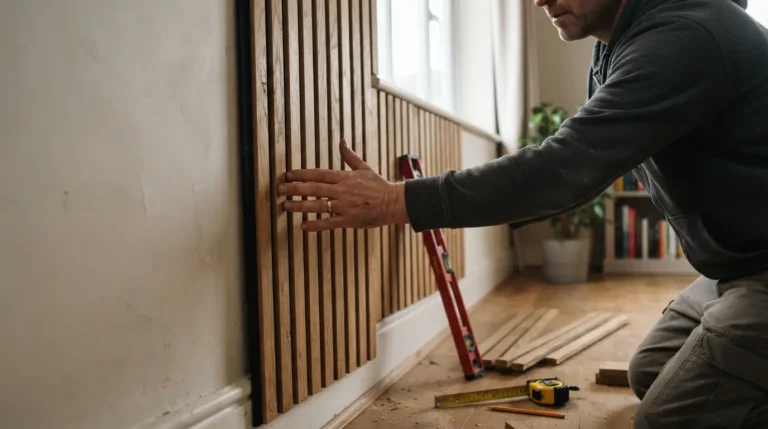
Most of these panels mount using one of three methods, chosen based on weight and whether the installation needs to be permanent or removable.
- Impaling clips, for a permanent fixing directly into the wall
- Z-clips, for panels you may want to remove or reposition later
- French cleats, for heavier panels that need extra load support
Lighter foam or felt panels can often be fixed with a few dabs of adhesive rather than mechanical fixings, though this makes future repositioning harder without damaging the wall finish. Heavier panels, particularly larger fibreglass boards, generally benefit from a proper mechanical fixing rather than adhesive alone, since a heavy panel held only by glue is a real risk over time, especially in a warm room where adhesive can soften.
What Does It Cost to Treat a Room With Sound Absorbing Panels?
| Option | Typical Cost Range (approximate, GBP) |
| Budget foam panel pack (covers a small area) | £30 to £80 |
| Mid range fibreglass or PET felt panels, per panel | £25 to £70 |
| Premium fabric wrapped panels, per panel | £60 to £150+ |
| Treating one accent wall in a home office (materials only) | £150 to £400 |
| Treating a full living room across two or three walls | £500 to £1,500+ |
| Professional acoustic consultation and install | £600 upwards, varies significantly by room size |
Costs vary a great deal by country, panel material and finish, so treat these as a starting point rather than a fixed quote. Most homeowners find that a mid range fibreglass or PET felt panel gives noticeably better sound panel effectiveness than budget foam for a relatively small price difference, which makes it the better value choice in most home projects rather than the cheapest option on the shelf.
Do Wall Panels Need a Fire Rating?
For a private home, fire rating is rarely a legal requirement, though it’s still worth checking a product’s specification if you’re covering a large area of wall. For any commercial space, office, school or building open to the public, a Class A fire rating, tested to a recognised standard, is typically required by code, so this becomes non negotiable rather than optional in those settings.
Common Mistakes When Buying Sound Absorbing Panels
The most expensive mistake is buying foam panels expecting them to block noise from another room, when foam and fibreglass panels only absorb sound within the space they’re mounted in. A close second is covering only one wall in a rectangular room and wondering why the echo barely changed, when the untreated parallel wall is still bouncing sound straight back.
Thin, budget foam is also frequently oversold on effectiveness. It helps, but a genuine fibreglass or mineral wool panel at the same thickness will usually outperform it by a wide margin, which matters if you’re treating a room based on a tight budget and want the best result per panel rather than the lowest price per panel.
Conclusion
Acoustic panels do exactly one job well: absorbing sound inside a room to cut echo and reverberation, and for that job they genuinely work when you choose a properly rated product and cover the right walls. What they won’t do is block noise coming from outside the room, so the real skill is diagnosing which problem you have before spending money. Clap your hands, listen for the echo, and treat your parallel walls first. That single step solves more acoustic complaints than any panel count alone ever will.
FAQs
What are acoustic panels used for?
They are used to absorb sound inside a room, reducing echo, reverberation and the harsh, bouncy quality that untreated hard surfaced rooms often have.
Do acoustic panels work for soundproofing?
No. They absorb sound within a room but do not stop sound passing through walls, floors or ceilings. That requires soundproofing methods like mass loaded vinyl, resilient channels or added structural mass.
Do cheap foam acoustic panels actually work?
They do absorb some sound, particularly at higher frequencies, but budget foam typically has a lower NRC rating than fibreglass, mineral wool or PET felt panels of the same thickness, so the improvement is usually more modest.
How many acoustic panels do I need for a room?
Covering roughly 15 to 25 percent of the total wall surface with panels rated NRC 0.85 or higher is a reasonable target for a noticeable improvement in most home rooms, prioritising a pair of parallel walls over spreading coverage too thinly.
Will acoustic panels stop me hearing my neighbours?
No. That’s a sound transmission problem, which wall panels don’t address. Reducing noise from neighbours requires soundproofing measures built into the wall or floor structure itself.