How to Choose the Right Rug Size for Under a Dining Table

Choosing the right rug size for under a dining table comes down to one core rule: the rug needs to extend far enough beyond the table that your chairs stay fully on it even when pushed back to sit down or stand up. Get this wrong and you end up with the genuinely annoying, common problem of a chair leg catching the rug’s edge or dropping half off it every time someone pulls their seat out.
Start With Your Table’s Actual Dimensions
Before looking at rug sizes, measure your actual dining table, its length and width if rectangular, or its diameter if round or oval, rather than assuming a standard size will automatically work. As a real worked example, a table measuring roughly 90cm by 180cm (about 36 by 71 inches) needs considerably more rug than its own footprint to work properly underneath it, which is exactly why skipping this measurement step is one of the most common reasons a dining rug ends up too small once it’s actually down.
Add Enough Clearance for Chairs to Stay On the Rug When Pushed Back
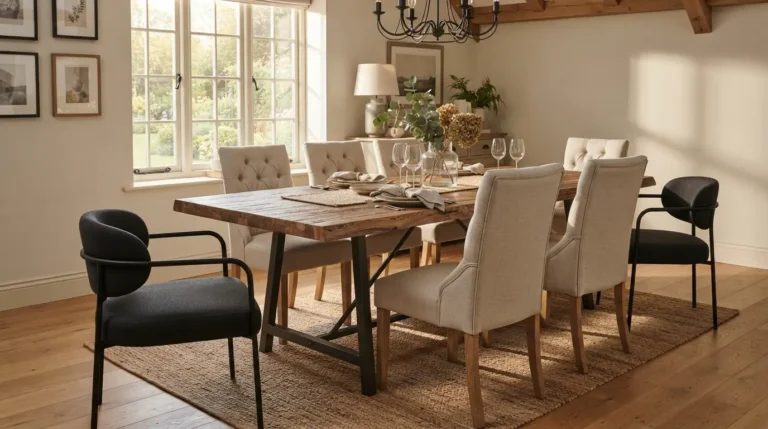
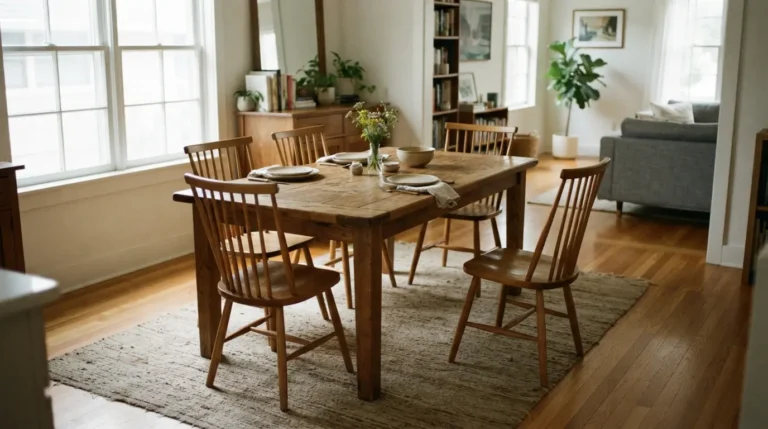
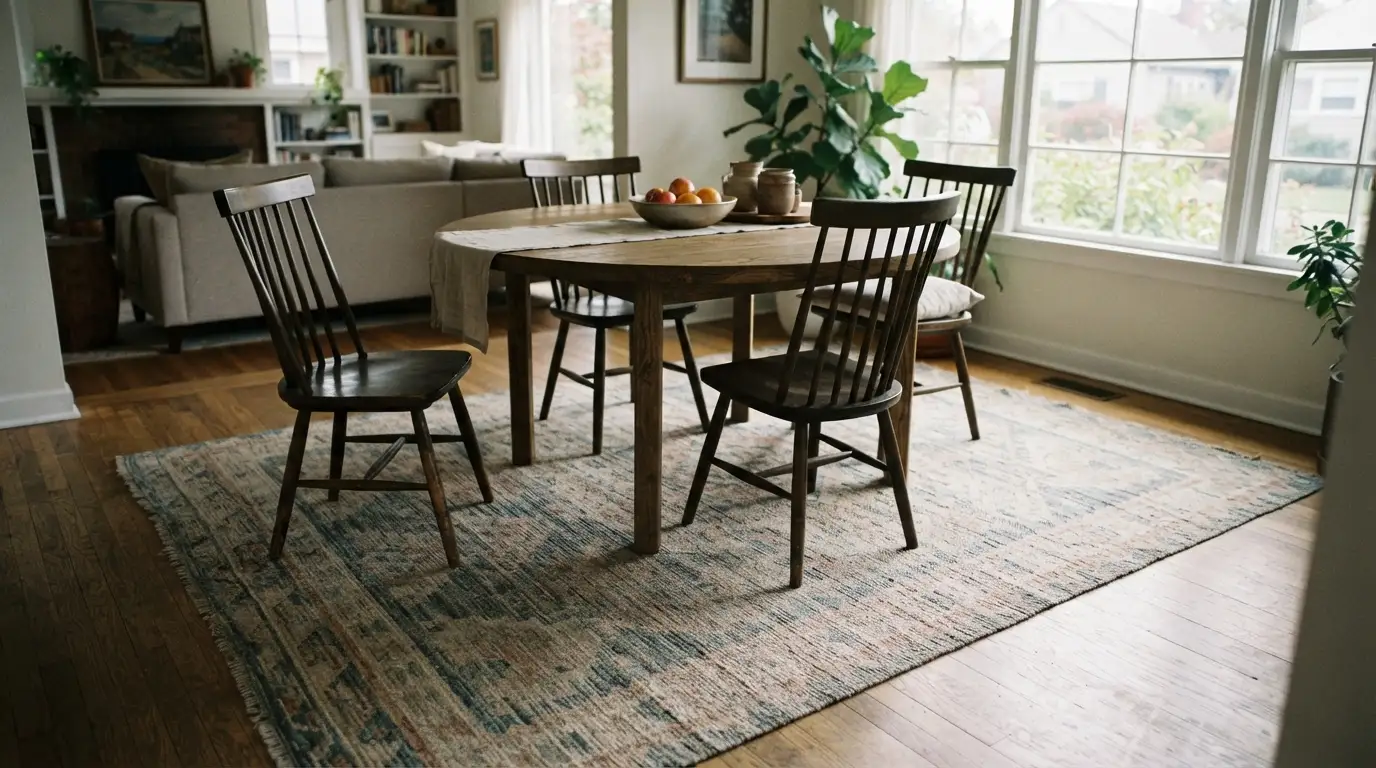
This is the rule that matters most, and it’s worth committing to memory. The rug should extend at least 60cm (roughly 24 inches) beyond each side of the table, which in practical terms means adding around 1.2 metres (about 4 feet) to both the length and width of your table’s own measurements to find your minimum workable rug size. Using the example table above, that works out to a minimum rug size of roughly 2.1 by 3 metres (7 by just under 10 feet). This clearance is what actually lets someone push their chair back from the table without the rear legs sliding off the rug’s edge onto bare floor, a small detail that makes a genuinely noticeable difference to how the room feels to actually sit and eat in.
Check the Rug’s Exact Listed Dimensions, Not Just Its Rounded Size
This is a detail worth checking carefully before you order. A rug listed under a rounded size, say 2.4 by 3 metres, can actually measure several centimetres longer, shorter, wider, or narrower than that headline figure once you check the specific product’s detailed dimensions. Always look at the exact measurements listed for the particular rug you’re considering rather than assuming every rug labelled with the same rounded size is genuinely identical, since a few centimetres either way can be the difference between the rug meeting your minimum clearance and falling just short of it.
Consider Your Room Size for the Maximum Rug Size
Once you know your minimum size, your room itself, and any other furniture in it, sets the practical ceiling on how large you can actually go. Leave a reasonable gap of clear floor, several centimetres at least, between the rug’s edge and your walls, a rug that runs almost to the skirting board on every side can look cramped rather than intentional, even if it technically fits the room. Also think about any other furniture nearby, a sideboard or console, its legs shouldn’t sit awkwardly close to the rug’s edge, ideally landing clearly in front of or behind the furniture’s legs rather than right at the boundary where the transition looks accidental.
Test Your Chosen Size With Tape Before You Buy
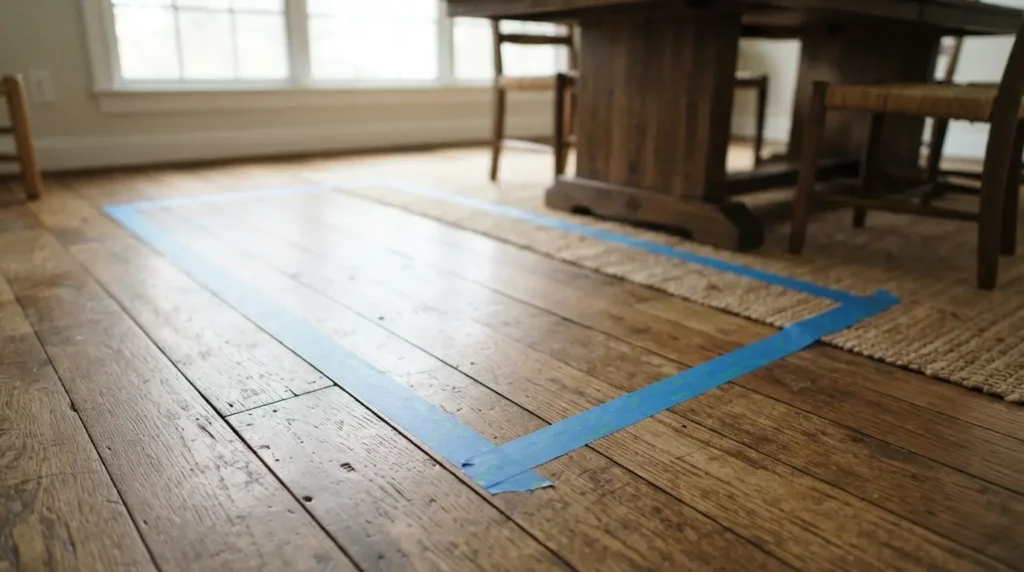
If you’re torn between two rug sizes, mark out the exact dimensions of each option directly on your floor using painter’s tape before committing to either. This gives you a genuinely accurate sense of how the rug will actually sit in the room, relative to your table, your chairs, and any nearby furniture, in a way that comparing numbers on a screen simply can’t replicate. This small step costs nothing but a few minutes and a roll of tape, and it catches sizing mistakes before they become an expensive one.
Choose a Weave and Material Suited to a Dining Room
Beyond size, the rug’s construction genuinely matters for how well it performs under a dining table specifically. A flatweave or low-pile rug lets chairs slide back and forth far more easily than a thick, plush pile would, particularly important if your chairs have casters or get moved frequently through a typical meal. On material, wool or a durable synthetic fibre handles the spills, dropped food, and general daily wear a dining room rug faces considerably better than a more delicate natural fibre, worth prioritising if the table sees regular use from children or simply a household that eats there daily.
Don’t Skip the Rug Pad
A proper rug pad underneath genuinely extends the rug’s life, stops it shifting, sliding, or bunching up as chairs move across it, and provides a real barrier protecting your floor from spills that soak through. This is worth budgeting for as part of the total cost of the rug itself, not an optional extra, since a rug moving underfoot every time a chair’s pulled out is both an annoyance and a genuine trip hazard over time.
Final Thoughts
Choosing the right rug size for under a dining table really comes down to measuring your actual table, adding genuine clearance so chairs stay on the rug when pushed back, and checking the exact product dimensions before you buy rather than assuming a rounded size will work. Test your final choice with tape on the floor first, and the rug will function properly under daily use, not just look right in a single photo before anyone’s actually sat down to eat.
FAQs
What’s the standard rug size for a dining room?
A commonly used size is roughly 2.75 by 3.65 metres (9 by 12 feet), but this is only a helpful starting reference, not a fixed rule. Your actual table’s dimensions, plus the clearance needed for chairs, should genuinely determine your rug size rather than defaulting to whatever’s most commonly sold.
How far should a dining rug extend beyond the table?
At least 60cm (around 24 inches) beyond each side of the table is the reliable minimum, ensuring chairs stay fully on the rug even when pushed back from the table to sit down or get up.
Does rug shape need to match table shape?
It’s not a strict requirement, but a rectangular rug generally suits a rectangular table more naturally, while a round or oval rug often complements a round or oval table better. Many people do successfully pair a rectangular rug with a round table, so treat this as a preference rather than a fixed rule.
What type of rug is best for a dining room with kids?
A durable wool or synthetic fibre in a flatweave or low-pile construction handles spills, dropped food, and daily wear considerably better than a delicate natural fibre or a deep plush pile, both of which show stains and general wear more readily.
Do I need a rug pad under a dining room rug?
Yes, genuinely. A rug pad prevents shifting and bunching as chairs move across the rug, extends the rug’s overall lifespan, and provides a barrier protecting your flooring from spills that would otherwise soak straight through.