15 Bedroom Feature Wall Ideas to Transform Your Space

Bedroom feature wall ideas only earn their place if they make the bed the clear centre of the room. A clever wall on the wrong surface, or a treatment that fights the headboard, looks like a project rather than a bedroom. The wall behind the bed is the default. Everything else is a special case.
These 15 ideas run from a tin of paint to timber, paper, and fabric. Each one includes where it works, what it sits with, and the practical snag. Pick one. A bedroom with two feature walls rarely looks restful.
Start with the wall and the light
Stand in the doorway and see which wall you face. That is the feature, almost always the bed wall. Skip the window wall. Note sockets, a radiator, and any slope. Deep colour needs a warm lamp at the side, or it dies at night. Pattern needs a flat enough surface that the repeat does not wander.
If you want the step-by-step before the ideas, how to create a feature wall in a bedroom covers prep, paint, and paper in order. The ideas here assume that groundwork.
1. A deeper paint colour behind the bed
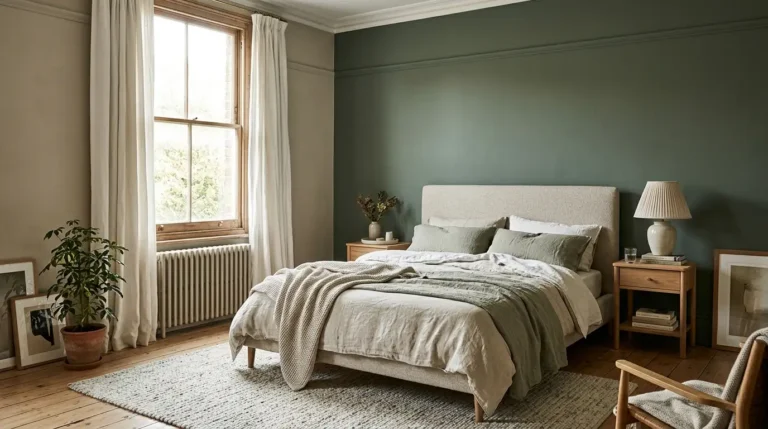
The simplest feature wall is a deeper version of the room colour on the bed wall only. Sage against a paler sage, clay against warm white, navy against greige. It frames the bed without a new material.
Cut a clean line at the corners. A wavy edge between two colours looks unfinished. Use the same sheen on both walls so the join is about colour, not shine. Eggshell is easier to wipe where pillows touch.
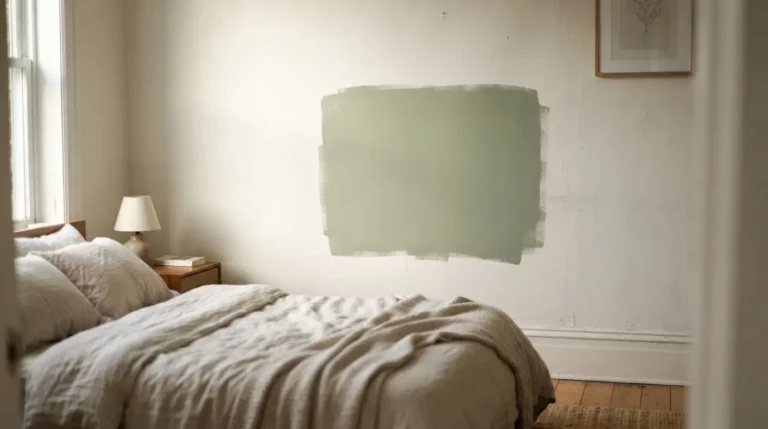
This is the best first feature if you are unsure. You can repaint it in an afternoon later.
2. Colour drenching on the bed end only
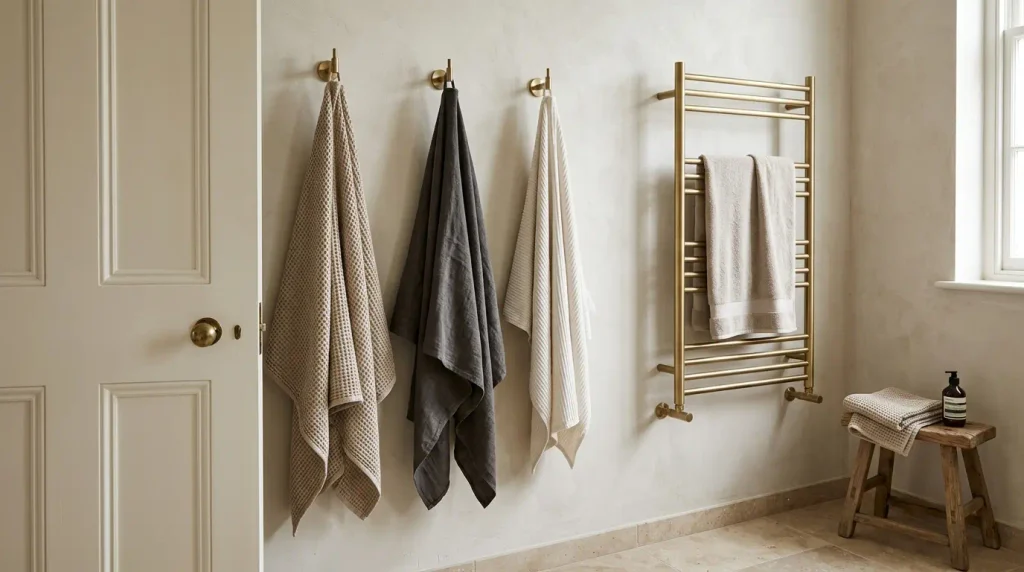
Paint the bed wall, the skirting on that wall, and the return into the corner in one colour. The other walls stay lighter. The bed end feels wrapped, and the white skirting stripe disappears, which is useful because white skirting against a dark wall shows every scuff.
Do not drench the ceiling unless the room is tall enough. In a low room, keep the ceiling lighter so it does not sit on the bed. In a tall Victorian room, a slightly deeper ceiling can help.
Lamps and bedding should be lighter than the drenched wall, or the bed vanishes.
3. A painted arch in place of a headboard
A painted arch, a soft half-circle or a tall rectangle with a curved top, sits behind the pillows and replaces a headboard. Mark it with a pencil and a string line so the curve is even. Paint the arch in a colour a step deeper than the wall, or in the same colour as the bedding is not. Contrast is the point.
Size it wider than the mattress and taller than the pillows, or it looks like a halo that missed. In a rented room this is still just paint, so it is easier to reverse than timber.
It suits plain beds with no frame. On a heavy upholstered headboard it is redundant.
4. A painted block at headboard height
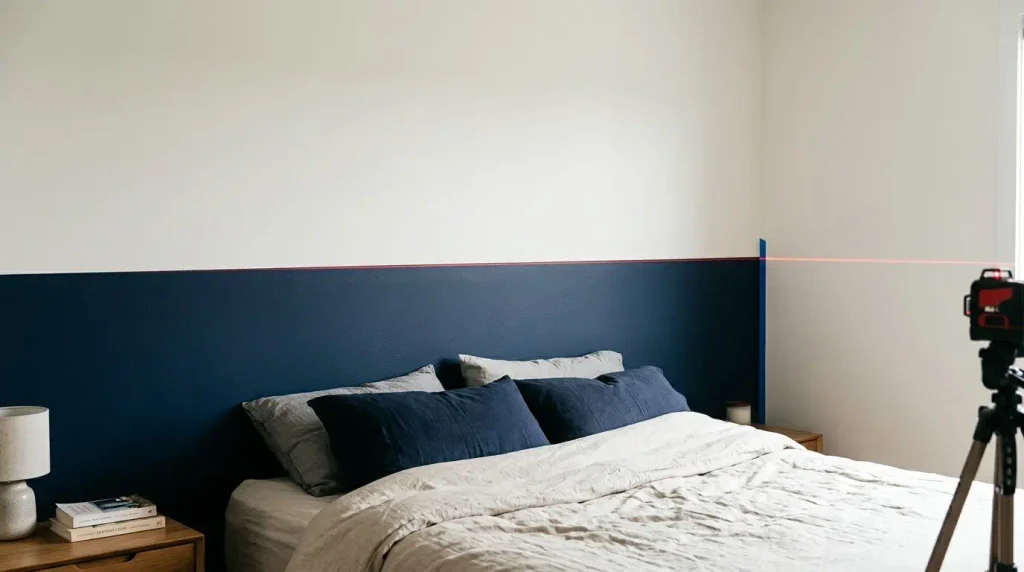
A horizontal block of colour, starting at the skirting or just above it and stopping around 120 to 140 centimetres, gives you a headboard shape without a curve. Mask a level line. A spirit level is not optional. Bedroom floors are rarely level, so measure from the ceiling or use a laser if you have one, and check by eye from the door.
The block should be wider than the bed. Stopping exactly at the bed edges looks tight. A soft clay, dusty blue, or warm brown on a greige wall is enough.
Hang nothing on the block, or hang one picture centred. A row of hooks turns it into a hall.
5. Shaker panelling behind the bed
Shaker-style panels add shadow and make a plain bed wall look built. Paint them the same colour as the wall for a quiet version, or a deeper colour for a clearer feature. The build notes in how to add wall panelling to a bedroom cover battens, adhesive, and paint. Leave enough clearance that the headboard does not knock the rails.
Spacing should relate to the bed. A rail that lands in the middle of a pillow looks accidental. Plan the layout on paper first, including sockets. You can box around a socket or move it, and moving it is an electrician’s job if you are not qualified.
This suits period rooms and new-builds equally, as long as the wall is flat enough to take battens.
6. Board and batten on the lower wall
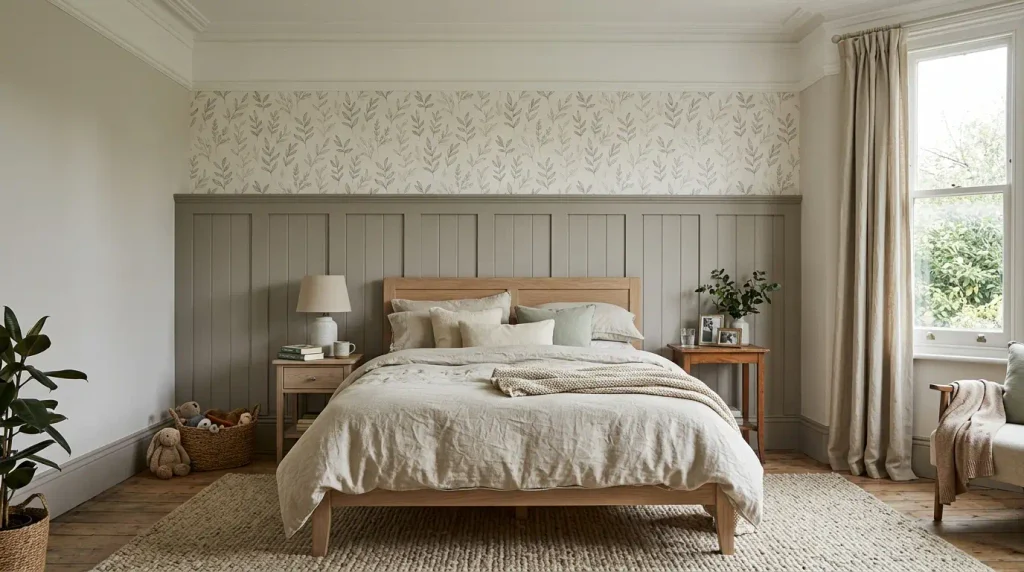
Board and batten, with a chair-height rail and vertical strips below, protects the wall where bags and the bed frame bump it. Above the rail, paint or a simple paper finishes the feature. It is a practical bedroom feature wall idea in a family house, not only a style choice.
Use moisture-stable timber in a room that gets steamy from an en suite next door. Prime every cut end before it goes up, or the edges swell and show. Paint the whole assembly, including the back of the rails if you can, so bare timber does not flash at the gaps.
Keep the top rail level, even if the skirting is not. Scribe the bottom battens to the skirting rather than forcing a straight line onto a wavy floor.
7. Vertical timber slats
Slim timber slats, spaced evenly and painted or left in a clear oil, add height behind the bed. The gap between slats is the design. Too tight and it looks like a fence. Too wide and it looks unfinished. A finger-width gap is a sensible start, tested on the floor before you fix anything.
Slats collect dust. In a bedroom that is fine if you can vacuum the tops. They are a poor choice above a pillow if the timber is rough, because hair and fabric catch. Sand and finish them properly.
Fix into battens, not straight into unknown plaster, and know where the cables are. A slat wall is not the place to discover a buried wire.
8. Wallpaper on the bed wall
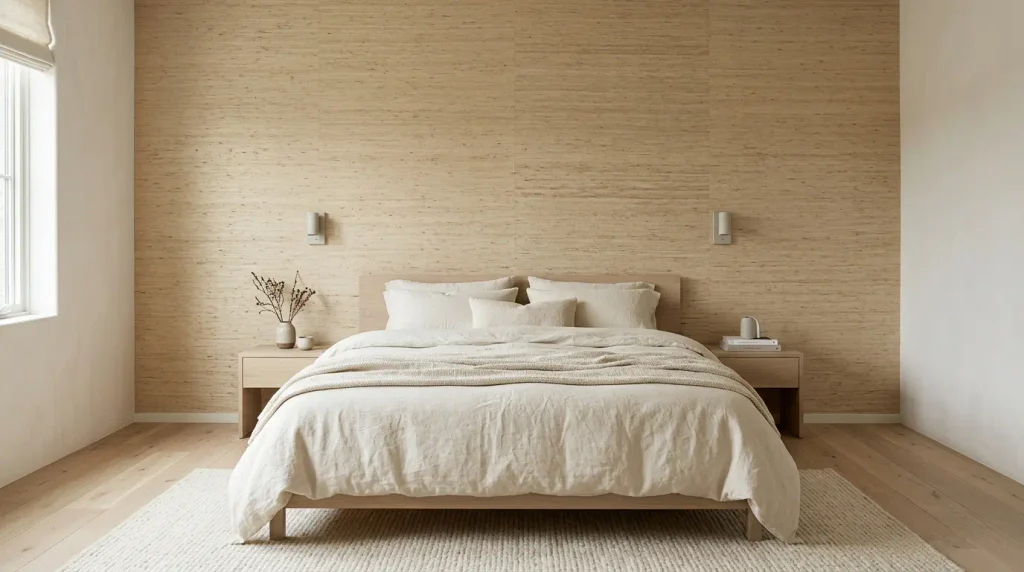
A papered bed wall is a feature as soon as the pattern is visible from the door. Small botanicals, grasscloth, and close-tone stripes are easier to sleep beside than a large scenic print. Centre the repeat on the bed.
The other walls should be painted in a colour taken from the paper’s ground. That link is what makes the paper look chosen. A random white on the side walls makes the paper look stuck on.
Order a sample length and tape it up for a few nights. Wallpaper is a worse surprise than paint, because you live with the repeat at eye level.
9. A paper panel framed in timber
Frame a section of wallpaper with a simple timber bead, slightly wider than the bed, and paint the bead to match the wall or the paper ground. You use less paper, the edges look finished, and a less perfect hang is hidden by the frame.
This is a good way to use a more expensive paper. It also suits alcove bedrooms where a full wall of pattern would be cut to pieces by the chimney breast.
Keep art off the panel. The frame is already the border.
10. Limewash or a mineral paint finish
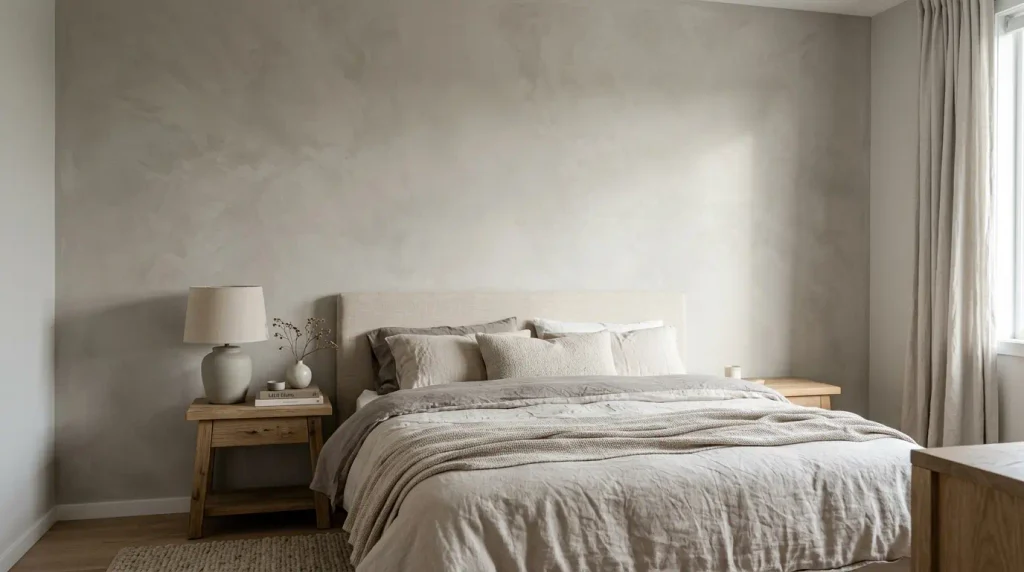
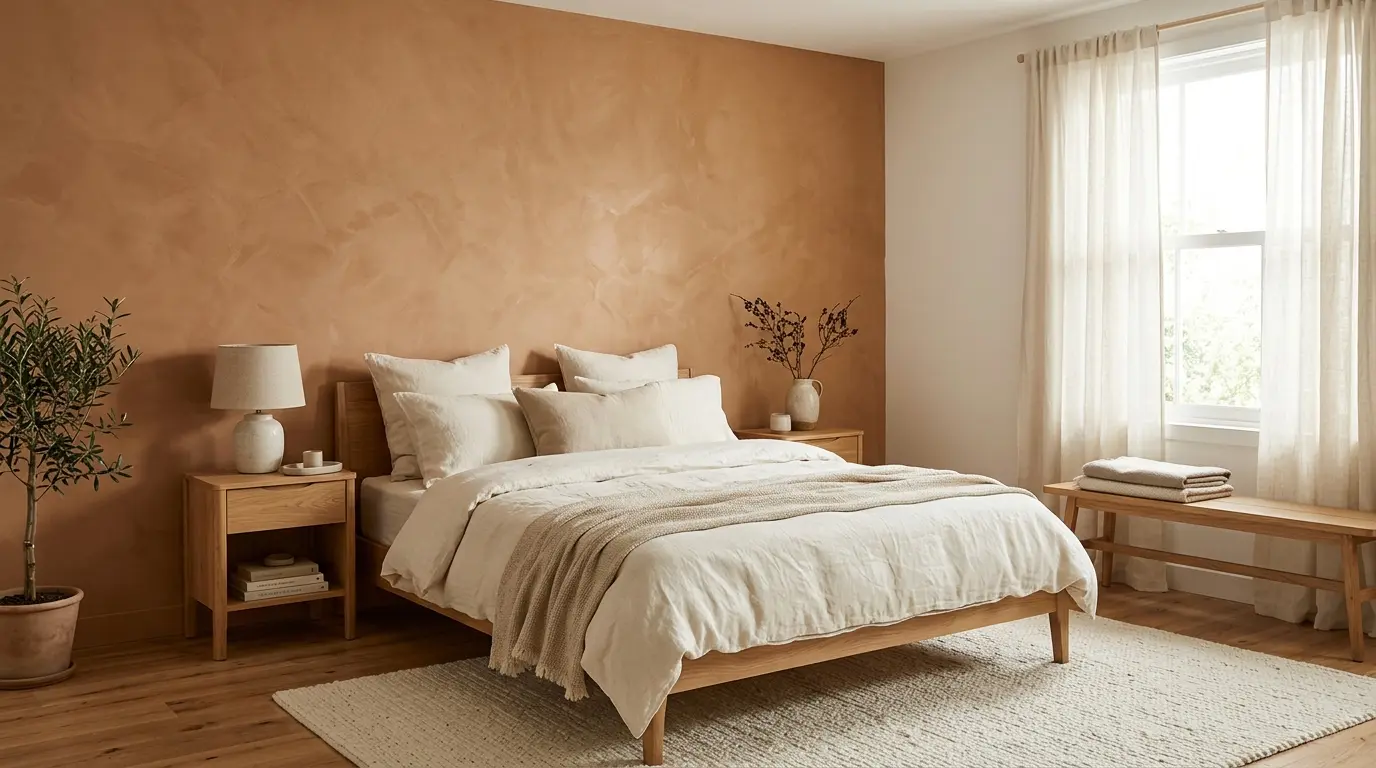
A limewash-style or mineral finish on the bed wall gives movement that flat emulsion does not. The colour shifts as you walk past. Soft clays, stones, and warm greys suit bedrooms. A very patchy application looks like a mistake, so practise on a board and follow the product’s wet-edge rules.
These finishes can be harder to touch up than standard emulsion. Keep a note of the mix. They are also a poor choice if you want a sharp, modern line. The point is variation.
Pair with plain bedding and timber. A glossy headboard fights the matt, chalky surface.
11. An upholstered wall panel
A fabric panel, fixed to a timber frame and hung or screwed behind the bed, is a headboard that became a wall. Linen, wool, and velvet all work. Velvet marks if you lean on it every night, so linen or a tight weave is the practical daily choice.
Make the panel wider than the mattress and tall enough that pillows do not spill off the top edge. Fire safety matters if you are fixing fabric over a large area. Use materials sold for interiors, and do not cover sockets.
This is a project for a competent maker, or a bought panel, not a first attempt with a staple gun on a Sunday night. Staples that show ruin it.
12. Brick slips on a chimney breast
If the bedroom has a chimney breast, brick slips on that breast can be the feature, with the bed on the same wall or opposite. Real exposed brick is a bonus if it is sound and not crumbling into the bed. Slips need a flat substrate and a proper adhesive, and they add weight, so the wall must be able to take them.
Bedroom brick should be toned down. A whitewash or a soft lime wash stops it looking like a restaurant. Bedding in cream and a timber bed keep it domestic.
Dust is the ongoing job. Brick is not a low-maintenance finish next to pillows. A sealed surface is easier to wipe.
13. A mirror wall, used carefully
A large mirror on the wall opposite the window bounces light and can help a small bedroom. A mirror directly behind the bed is less restful, because you see movement and the doorway in it at night. If you use mirror as the feature, put it where it reflects the window or a calm wall, not the bed itself.
Safety glass or acrylic matters in a room where people move in the dark. Fix into studs or proper plugs. A heavy mirror on weak plaster is a risk.
One large mirror looks considered. A grid of small mirrors looks busy in a bedroom.
14. A short gallery above the headboard
A tight group of frames, hung as one block above the bed, can be the feature on a plain painted wall. Keep the frames related and the mats wide. A random cluster that spreads towards the ceiling looks unsettled from the pillow.
Hang the lowest frame high enough that you do not hit it when you sit up. Use proper hooks for the wall type. Command-style strips fail on textured paint and on anything heavy.
The wall colour should be quiet. The pictures are the feature. A strong paint colour plus a busy gallery is two features.
15. A half-height headboard wall in panelling and paint
Combine a lower run of panelling with a painted or papered section above, stopping at a picture rail or a simple timber strip. It suits taller period rooms and gives you a line to hang from. More built options are in bedroom wall panelling ideas. The join between panel and paint needs to be straight, because it crosses the wall you see every night.
Colour can change at the rail: deeper below, lighter above, which lifts a low feeling, or the reverse if you want the bed end darker. Keep bedding plain so the rail stays the sharp line.
This is more work than a paint block and more forgiving than full-height panelling in a room with a awkward ceiling line.
What to budget
A painted feature wall is usually the cost of a sample pot and a tin, often well under £60 if you already own brushes. Wallpaper for one wall often lands between about £60 and £250 before tools, more for designer rolls. Timber panelling in DIY materials commonly sits around £40 to £200 for a bed wall, plus paint. A decorator or joiner changes the figure more than the materials do, and city rates run higher.
Spend on prep and on the line you will see: the corner, the rail, the pattern centre. A cheap treatment hung straight beats an expensive one hung crooked.
| Idea | Skill level | Best room |
| Deeper paint | Beginner | Any bedroom |
| Painted arch or block | Beginner, if you can mask a level line | Plain beds, rentals |
| Wallpaper | Beginner to intermediate | Flat bed walls |
| Shaker or batten | Intermediate | Rooms you own |
| Slats, brick, upholstered panel | Intermediate to skilled | Main bedrooms with a clear wall |
Conclusion
Choose one bedroom feature wall idea, put it behind the bed, and let the other walls stay calm. Paint is the right start. Panelling, paper, and fabric are worth it when you want shadow or pattern and you can finish the edges properly. Warm light at the side of the bed matters as much as the treatment itself.
What is the best feature wall for a small bedroom?
A painted bed wall in a colour related to the other walls, or a small-scale paper on that wall only. Large slats and dark full-height treatments can work, but they need pale bedding and decent light. Avoid a second feature on the window wall.
Can a feature wall replace a headboard?
Yes. A painted arch, a colour block, a panel, or a papered wall can do the job of a headboard. If you keep a headboard, make it plainer than the wall.
Do feature walls make a bedroom feel smaller?
A single darker wall can add depth rather than shrink the room, if the other walls are lighter and the bed has pale linen. Dark on every wall is a different scheme. Clutter shrinks a room faster than colour does.
Where should art go on a feature wall?
Either one piece centred above the bed, or nothing. A feature wall that is already patterned or panelled rarely needs a gallery as well.