12 Ottoman Bed Ideas for Hidden Storage in Your Bedroom

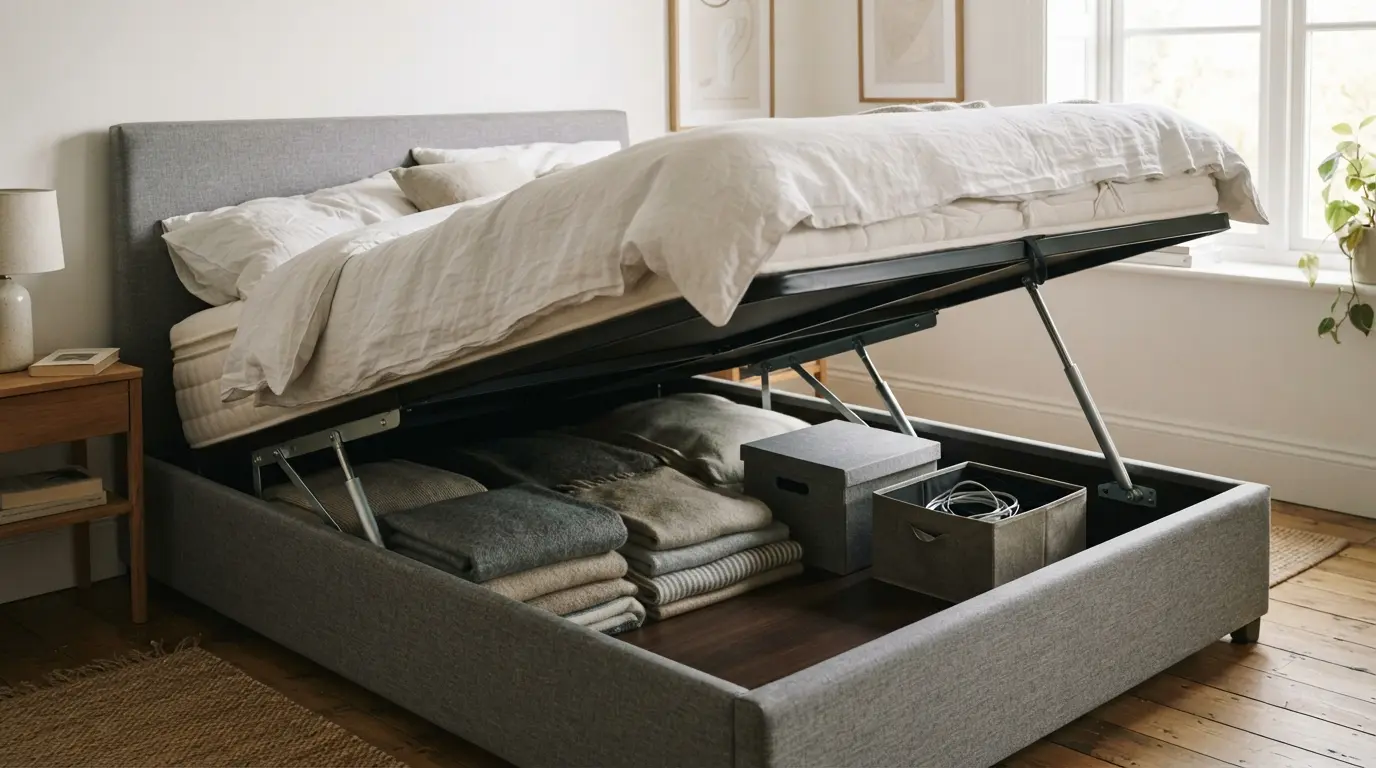
Ottoman bed ideas work because they solve a genuine space problem, lifting the entire mattress to reveal one large storage compartment underneath, without needing a separate wardrobe or under-bed boxes taking up floor space elsewhere. The 12 ideas below cover the styles and configurations worth considering, along with the honest practical checks, opening clearance, mattress weight, everyday accessibility, most inspiration guides skip in favour of another styled photo.
1. End-Opening for Single-Sided Room Placement
An end-opening ottoman lifts from the foot of the bed, which makes it the more flexible choice when the bed sits against a wall on one long side, since you only need clearance at the end rather than along an entire edge. This suits a bedroom where space is tight on one side, a wall-mounted headboard wall, a fitted wardrobe run, since the storage still opens fully without needing to pull the whole bed away from the wall first. It’s also generally the more forgiving configuration for a smaller bedroom overall, since the clearance space needed at the foot of the bed is often already there as a walkway, rather than requiring dedicated empty floor space you’d otherwise use for something else.
2. Side-Opening for the Widest Storage Access
A side-opening ottoman lifts along the long edge of the bed instead, giving a genuinely wider, easier reach into the storage cavity, useful if you’re storing larger, bulkier items you want to see and access easily rather than digging to the back. The trade-off is real: this configuration needs clear floor space along that entire side of the bed to lift properly, so it suits a room where the bed isn’t pushed up against a wall on both long sides. If you’re torn between the two and your room genuinely allows either, side-opening is worth the preference specifically if you plan to access the storage often, since reaching across the full width rather than down from one end is noticeably easier when you’re regularly retrieving specific items rather than doing a rare seasonal swap.
3. Choose the Right Gas Strut Rating for Your Mattress Weight
This is a detail most buying guides gloss over, and it genuinely affects how the bed performs day to day. The gas struts that lift the mattress are rated for a specific weight range, sometimes listed by their Newton rating, and a strut rated for a lighter memory foam mattress will strain or fail to lift smoothly under a heavier pocket-sprung one. Check this rating against your actual mattress weight before buying, not just the bed frame’s general size, since a mismatch here is one of the more common, entirely avoidable disappointments with an otherwise well-chosen ottoman bed. A heavier mattress on struts rated too low won’t just be harder to lift, it can wear the mechanism out faster over years of daily use, so it’s worth confirming this detail with the retailer directly rather than assuming a standard rating fits every mattress type.
4. Organise the Storage Cavity With Dividers or Boxes
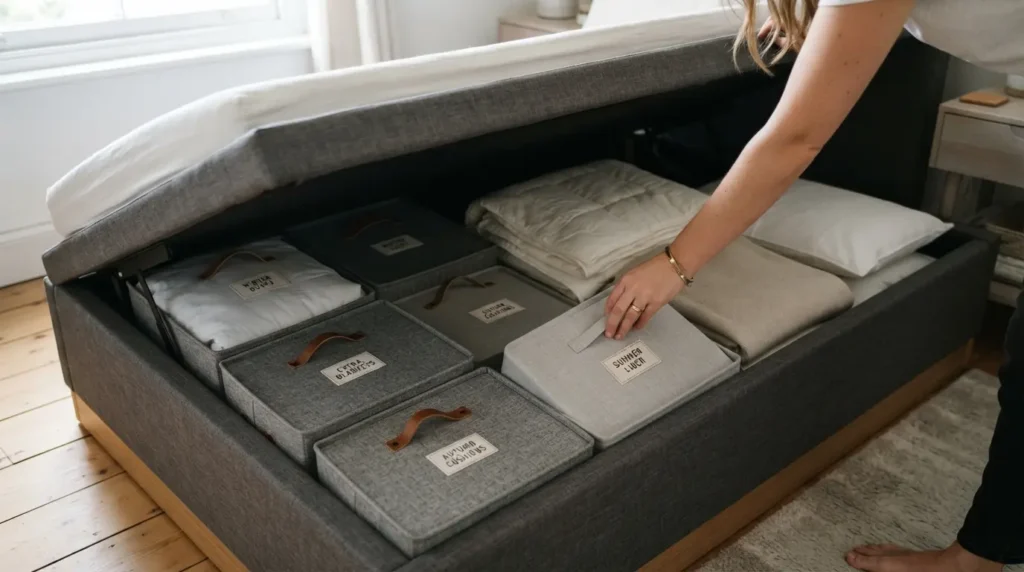
An empty ottoman storage compartment looks generous in a product photo, but without some structure inside, it becomes one large, chaotic space where a jumper migrates to the bottom and stays lost for months. Fabric storage boxes or simple dividers keep the cavity genuinely organised, seasonal bedding in one section, out-of-season clothes in another, rather than one deep, undifferentiated space you have to fully unpack to find anything specific. Clear or labelled boxes work better than opaque, unmarked ones specifically because you’re looking down into the space from above rather than at eye level, a labelling system that would feel unnecessary in a normal wardrobe genuinely earns its place here.
5. Use It for Seasonal, Not Daily, Items
Be honest about what actually belongs in an ottoman’s storage before you fill it. Lifting the entire mattress is a genuine two-handed job that takes a moment, so it’s a poor fit for anything you need several times a day, and a good fit for things you access rarely: spare bedding, off-season clothing, suitcases, keepsakes. Treat the daily-access test as a real filter when deciding what goes in, rather than using it as general overflow storage for things that would actually be easier to reach in a drawer. A genuinely useful habit is doing a seasonal swap, out-of-season duvets and clothing going in as the weather changes, rather than treating the space as a permanent, static store you fill once and never revisit.
6. A Velvet or Bouclé Ottoman for a Soft, Luxe Look
A fully upholstered ottoman base in velvet or bouclé brings genuine softness and texture to the bedroom, turning a purely functional storage solution into a considered piece of furniture in its own right. Velvet shows pressure marks over time in high-contact areas, though an ottoman base sees far less direct daily contact than a headboard does, so this matters less here than it would on the part of the bed people actually lean against.
7. A Low-Profile Ottoman for a Minimalist Bedroom
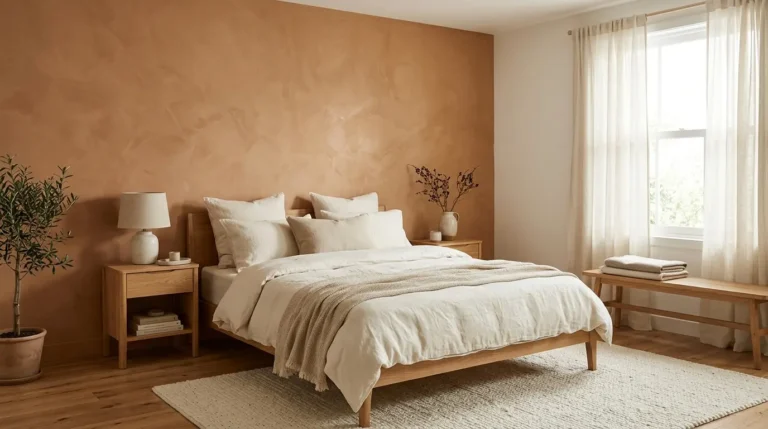
A simple, low-profile headboard paired with a clean-lined ottoman base suits a pared-back, minimalist bedroom far better than an elaborately tufted or tall design would. This keeps the visual focus on the room’s other elements, lighting, art, a considered colour scheme, rather than the bed itself competing for attention, which is exactly the effect a minimalist scheme is usually going for.
8. A Tall, Tufted Headboard Ottoman for Real Drama
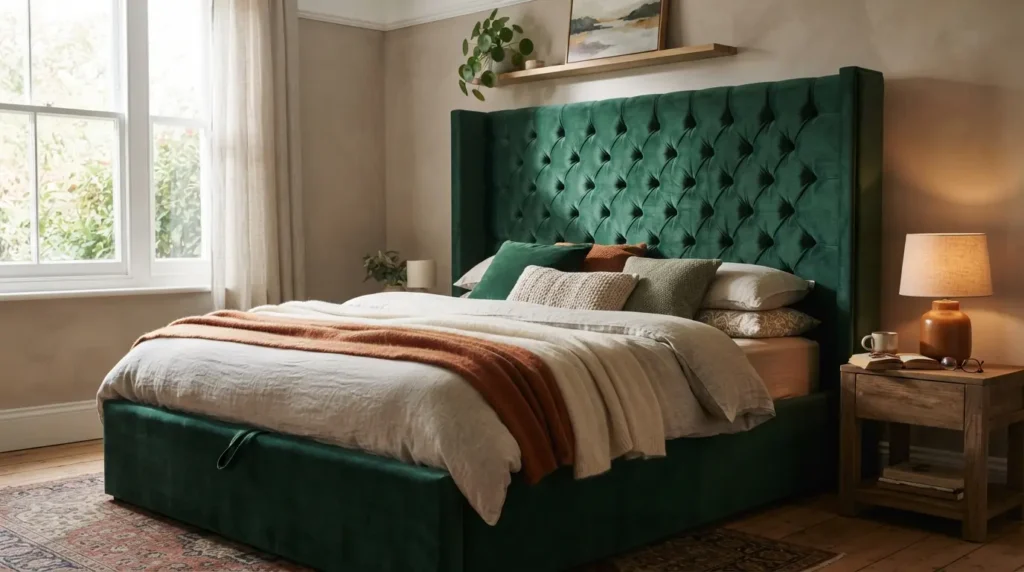
At the opposite end of the scale, a genuinely tall, deep-buttoned or channel-tufted headboard on an ottoman base gives the storage practicality without sacrificing a real style statement. This suits a larger bedroom with the wall space to support a substantial headboard, and it’s worth choosing a headboard height and depth that’s actually proportionate to your bed size and room, rather than the tallest option available purely for impact.
9. An Ottoman Bed for a Small Bedroom or Studio Flat
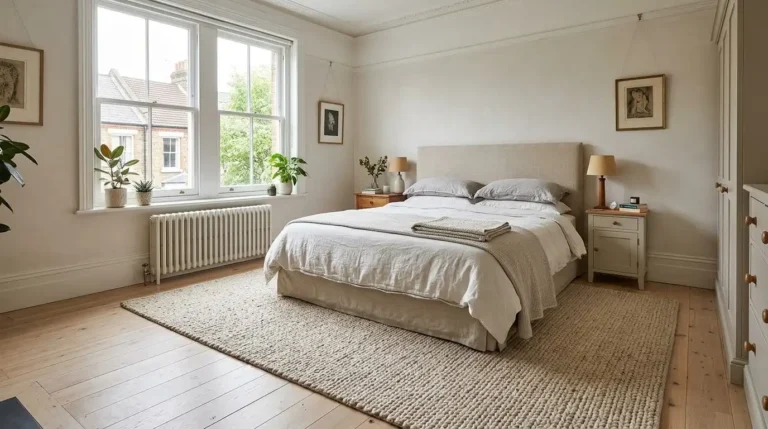
This is where an ottoman genuinely earns its keep beyond styling: in a small bedroom or a studio flat where a separate wardrobe or chest of drawers simply doesn’t fit, the bed itself becomes the primary storage. This is worth planning deliberately rather than as an afterthought, measure what you’d normally store in a wardrobe and check honestly whether the ottoman’s capacity can actually replace it, rather than assuming any ottoman bed provides equivalent storage to dedicated furniture. In a genuinely tight studio layout, this single piece of furniture doing double duty can be the difference between a room that feels workable and one that feels permanently short on space, which is a real practical win beyond the styling appeal.
10. Check Ceiling Height and Clearance Above the Bed
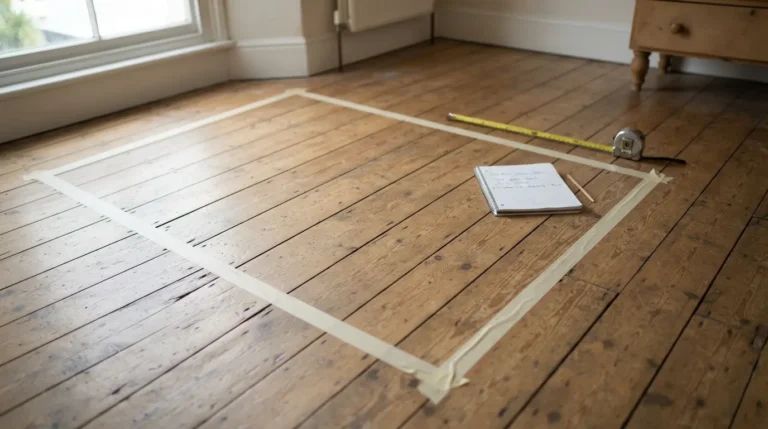
This is a genuinely overlooked practical detail. An ottoman needs enough clearance above the bed for the mattress to lift fully open, which matters specifically in a loft or attic bedroom with a sloped ceiling, or any room with lower-than-standard ceiling height. Measure the actual vertical space above where the bed will sit before ordering, rather than assuming a standard ottoman mechanism will have room to open fully in a room with any ceiling constraint. This is worth checking against the specific product’s opening height, not just eyeballing the room, since the figure varies between mechanisms and bed sizes, and a mattress that can’t lift to its full open position defeats the purpose of choosing an ottoman in the first place.
11. Pair It With Coordinating Furniture for a Cohesive Look
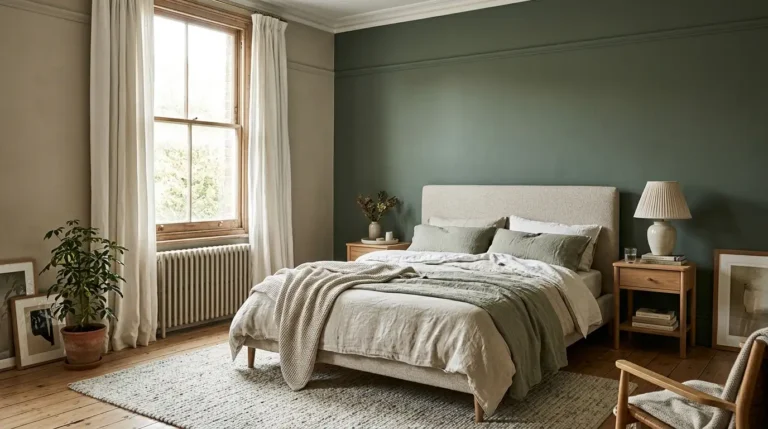
An upholstered ottoman base ties into the rest of the room more convincingly when it’s paired with at least one other upholstered or fabric-matched piece, a headboard in the same material family, a bench, or coordinating curtains. This is a simple styling principle, but it’s the detail that stops an ottoman bed reading as a standalone, purely functional purchase and makes it feel like part of a considered bedroom scheme instead.
12. Know the Genuine Downsides Before You Buy
This is the section every purely promotional ottoman bed guide skips entirely, and it’s worth knowing honestly before you commit. Lifting a heavier mattress solo, particularly a dense pocket-sprung or hybrid mattress, is a genuine two-handed effort and can be awkward for one person managing it alone, worth testing in a showroom if that’s a realistic concern for your household. Ottoman beds also typically cost more than an equivalent divan or standard bed frame, a fair trade if the storage genuinely replaces furniture you’d otherwise need to buy, but not a like-for-like price comparison if you’re simply choosing it for the look. And because platform-top ottoman bases don’t offer a sprung option, a mattress genuinely designed to feel its best on a springy base will perform differently here, worth checking your mattress type is actually suited to a firm, flat platform before committing. Delivery is also worth considering realistically, a large upholstered ottoman base with an internal mechanism is bulkier and heavier than a standard bed frame, so confirm your staircase and doorway access can accommodate it before ordering, particularly in an upper-floor flat with a tighter stairwell.
Final Thoughts
The best ottoman bed ideas balance genuine style with the practical realities most promotional content leaves out: the right opening style for your room, a gas strut rated for your actual mattress, and an honest sense of what belongs in that storage versus what’s better kept somewhere more accessible. Choose the configuration and look that suits your bedroom, check the clearance and mechanism details before you order, and the bed will genuinely solve your storage problem rather than just looking like it does in a photo.
FAQs
What’s the difference between end-opening and side-opening ottoman beds?
An end-opening ottoman lifts from the foot of the bed, needing clearance only at that end, which suits a bed positioned against a wall on one long side. A side-opening ottoman lifts along the length of the bed, giving wider access to the storage but needing clear floor space along that entire edge.
Can one person lift an ottoman bed on their own?
Generally yes, provided the gas struts are correctly rated for the mattress weight, but a heavier pocket-sprung or hybrid mattress can still make it a genuine two-handed effort. It’s worth testing the lift action in person if you’ll usually be opening it alone.
Do ottoman beds work with any mattress?
Ottoman bases are platform-topped, so they suit any mattress physically, but a mattress specifically designed to feel its best on a sprung base will perform somewhat differently on a firm platform. Check your mattress’s recommended base type before assuming it’s an ideal match.
How much storage space does an ottoman bed actually give you?
It varies by bed size and base depth, but a genuine ottoman generally offers considerably more usable storage than under-bed boxes alone, often comparable to a small wardrobe’s worth of space, particularly in larger bed sizes.
Are ottoman beds worth the extra cost over a divan?
It depends on whether the storage genuinely replaces furniture you’d otherwise need. If it lets you skip buying a separate wardrobe or drawer unit in a small room, the extra upfront cost is often worth it; if you’re choosing it purely for the look with plenty of existing storage already, a standard divan or bed frame may suit you just as well for less.