How to Choose the Right Dining Chairs for Your Table

Choosing the right dining chairs for your table starts with measuring, not browsing. Check the seat height math, the table’s base, and how much room you actually have around it before you fall in love with a design, and the style choice becomes the easy last step rather than the first mistake.
Most people do this backwards. They pick a chair they love online, order it, and only then discover the arms hit the apron, the base clashes with the table legs, or there’s no room to actually pull the chair out. Here’s the order that actually avoids that, worked through properly.
Start With the Height Math, Not the Style
Standard dining tables sit 71 to 76cm (28 to 30 inches) high, and standard dining chair seat height runs 45 to 48cm (18 to 19 inches), which should leave 25 to 30cm (10 to 12 inches) of clearance between the seat and the tabletop. Subtract the chair’s seat height from the table height. If the result lands in that range, the fit works.
Don’t stop at the published table height, though. A thick tabletop, a deep apron, or a low-hanging trestle rail can all eat into that clearance even when the headline numbers look standard. Measure from the floor to the underside of the actual lowest point, whether that’s the tabletop, the apron, or the base, not just to the top of the table.
Check the Base Before You Fall for a Chair Design
A four-leg table restricts exactly where chairs can sit, since each corner leg blocks a chair from tucking in at that spot. A pedestal or trestle base is more forgiving, since there’s nothing at the corners, but a slim pedestal doesn’t automatically mean any chair fits underneath, since a thick top or deep apron can still limit clearance regardless of what’s holding the table up.
Proportion matters here too. A heavy, chunky table with substantial legs generally wants a chair with some visual weight to match, while a delicate pedestal table gets overwhelmed by a bulky, fully upholstered chair. A good rule of thumb: stand back and look at the table and chair together before ordering, not just the chair on its own against a white background.
Match Chair Shape to Table Shape
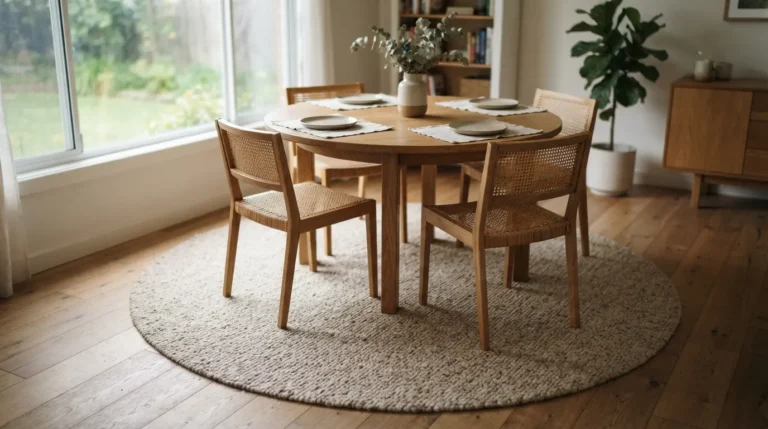
Round and oval tables work best with chairs that have a slim, open base and a curved or gently angled back, since the seating naturally follows the table’s curve without any hard corners fighting the shape. This layout also keeps every seat roughly equidistant from the centre, which is genuinely useful for conversation and for keeping kids from bumping into sharp corners.
Rectangular and long tables suit clean-lined side chairs along the length, with the option of armchairs at each end for a bit of visual anchoring. Square tables in a small space usually work best kept simple, with slim, armless chairs on all four sides so the room doesn’t feel crowded the moment everyone sits down.
Plan for Armchairs Separately From Side Chairs
Armrests need to clear the underside of the table or apron by roughly 20 to 25cm (8 to 10 inches), and this is the single most common reason a chair someone loves in the shop doesn’t actually work once it’s home. If you’re not certain about the apron depth on your table, default to armless side chairs, which are the safer, more universally compatible choice.
Where armchairs do work well is at the head and foot of a rectangular or oval table, giving those two seats a bit more presence without needing the same clearance check on every single chair around the table. Measure the exact arm height on the specific chair you’re considering rather than assuming a “standard” armchair will automatically clear your table.
Count Seats Correctly for Your Table Size
Allow roughly 60cm (24 inches) of table edge per seat, plus a little breathing room between chairs, to figure out how many will actually fit without elbows colliding. Use your table’s real length or diameter against this figure rather than trusting the seller’s stated seating capacity, which sometimes assumes a tighter squeeze than you’d want for regular use.
| Table Size | Typical Seating (comfortable, not squeezed) |
| 90–107cm round/square | 4 |
| 122–137cm round or oval | 4–6 |
| 150–180cm rectangular | 6 |
| 180–220cm rectangular | 6–8 |
| 220cm+ rectangular or extended | 8–10 |
These figures assume side chairs along the length and, where relevant, armchairs at the ends. Swap in wider upholstered chairs and you’ll typically lose one seat from each end of the range.
Extendable Tables Need a Second Measurement
An extendable table has to be measured twice, once at its everyday closed length and once fully extended, since the chair count and spacing that works for a weeknight dinner won’t match what you need when the leaves go in for guests. Plan your permanent chair set around the closed size, then keep two or three matching or complementary folding or stackable chairs in a cupboard for the extended length.
Keep the chair width consistent between your everyday set and your extra chairs where possible. A noticeably wider or narrower spare chair at a fully extended table stands out immediately, even if the style is close enough to pass at a glance.
Leave Room to Get Up From the Table
Keep at least 91cm (36 inches) of clearance between the table edge and the nearest wall or furniture so chairs can be pulled out and people can get up without everyone else shifting. In a high-traffic dining space, where people are walking behind seated diners regularly, push that up to 107 to 122cm (42 to 48 inches).
If you’re adding a rug under the table, size it so the chairs stay on the rug even when pulled fully out, which generally means adding 60 to 75cm (24 to 30 inches) beyond the table’s footprint on every side. A rug that only covers the table itself looks undersized the moment anyone sits down and slides their chair back.
Matching vs Mixing: Choose One Unifying Element
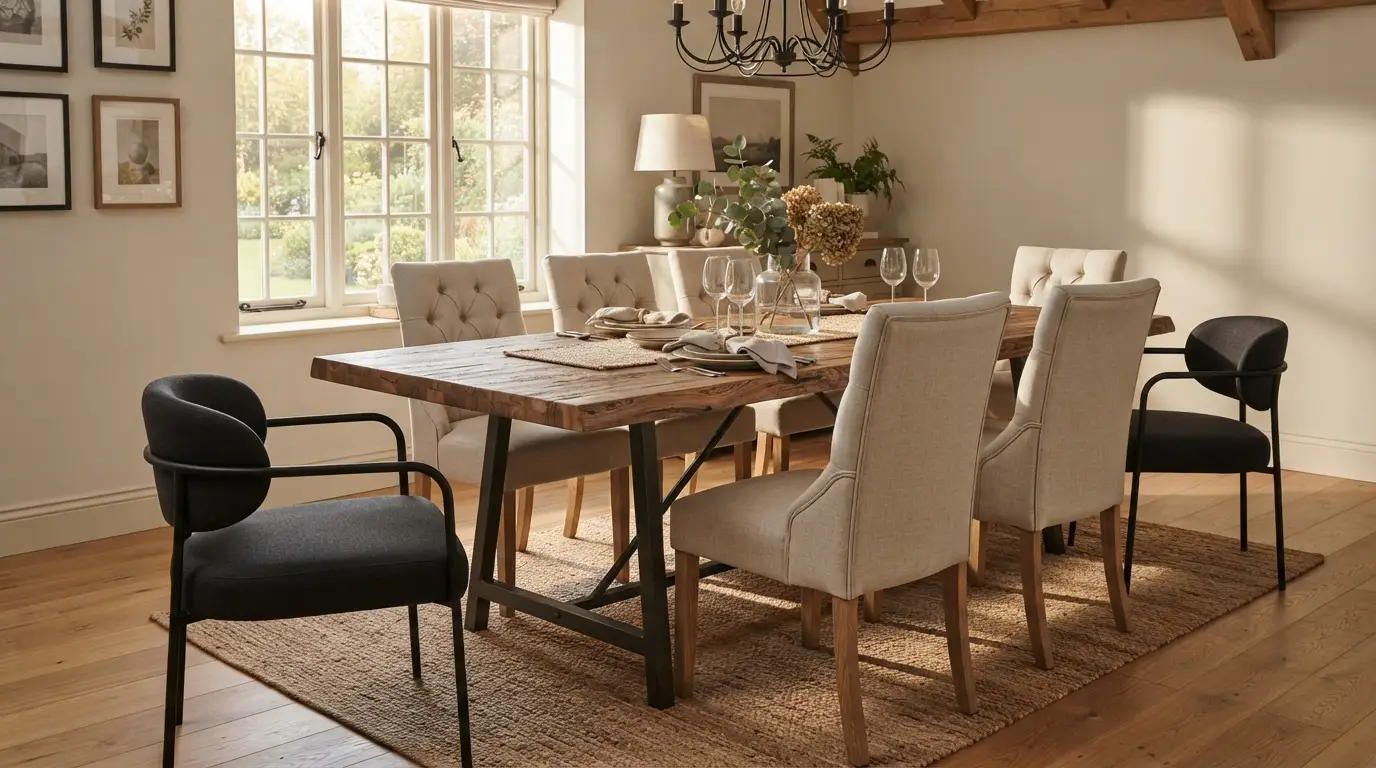
A fully matched table and chair set from a single collection is the safest option and always looks coordinated, but it can read as a little flat if every piece in the room comes from the same range. Mixing chairs with a table from a different collection adds personality, provided you anchor the combination with one clear unifying element rather than letting everything drift.
Pick a single thread to hold the room together: matching wood tones even with different silhouettes, a shared colour picked up from the tabletop or another chair, or pieces from roughly the same design era, like mid-century chairs with a mid-century table. Treat the table as the hero piece and let the chairs play a supporting role, rather than trying to make every element compete for attention. For inspiration on adding a bench as part of that mix, our guide to dining bench ideas covers pairing one with chairs on the opposite side.
Common Mistakes When Buying Chairs for a Table
The most common mistake is ordering based on a product photo alone, without checking the apron depth or base width against the actual chair dimensions, which is how armchairs end up permanently stuck a few inches too far from the table. Always cross-check the chair’s arm height and overall width against your table’s specific measurements, not the general category it falls into.
The second mistake is forgetting the extendable table problem until the leaves are already in for a dinner party, by which point there’s no time to source matching extra chairs. The third is choosing seating purely on how it looks in isolation and skipping the proportion check against the table itself, which is how a beautifully photographed chair ends up looking oddly small or oversized once it’s actually in the room. If you want a fuller breakdown of specific chair styles and what each one is built from, our companion guide on types of dining chairs is worth reading alongside this one.
Conclusion
Getting dining chairs right for your table comes down to measuring before you shop, not after. Check the seat height math, the base and apron clearance, and the real space around the table, and almost any style you like the look of will actually work once it’s home. Start with a tape measure, not a wishlist, and the rest of the decision gets a lot simpler from there.
FAQ
What is the ideal gap between a dining chair seat and the tabletop?
Aim for 25 to 30cm (10 to 12 inches) of clearance. Measure from the top of the chair seat to the underside of the tabletop or apron, whichever hangs lower.
Do dining chairs need to match the table exactly?
No. A matched set is the safest choice, but mixing works well too, provided you anchor the look with one shared element, such as wood tone, colour, or design era, rather than letting the pieces compete.
How many chairs fit around a round table?
A 90 to 107cm round table typically seats four comfortably, while a 122 to 137cm round table can usually take four to six, depending on chair width. Allow roughly 60cm of table edge per seat as a general guide.
Can I use armchairs at every seat around the table?
You can, but check apron clearance carefully for every position, since armrests need roughly 20 to 25cm of clearance underneath the table. Many households find it easier to use armchairs only at the head and foot and side chairs along the length.
How do I choose chairs for an extendable dining table?
Measure both the closed and fully extended length, plan your main chair set around the everyday closed size, and keep a couple of matching or complementary folding or stackable chairs on hand for when the table is extended.
What size rug do I need under a dining table with chairs?
Add roughly 60 to 75cm (24 to 30 inches) beyond the table’s footprint on all sides, so chairs stay on the rug even when pulled fully out during use.