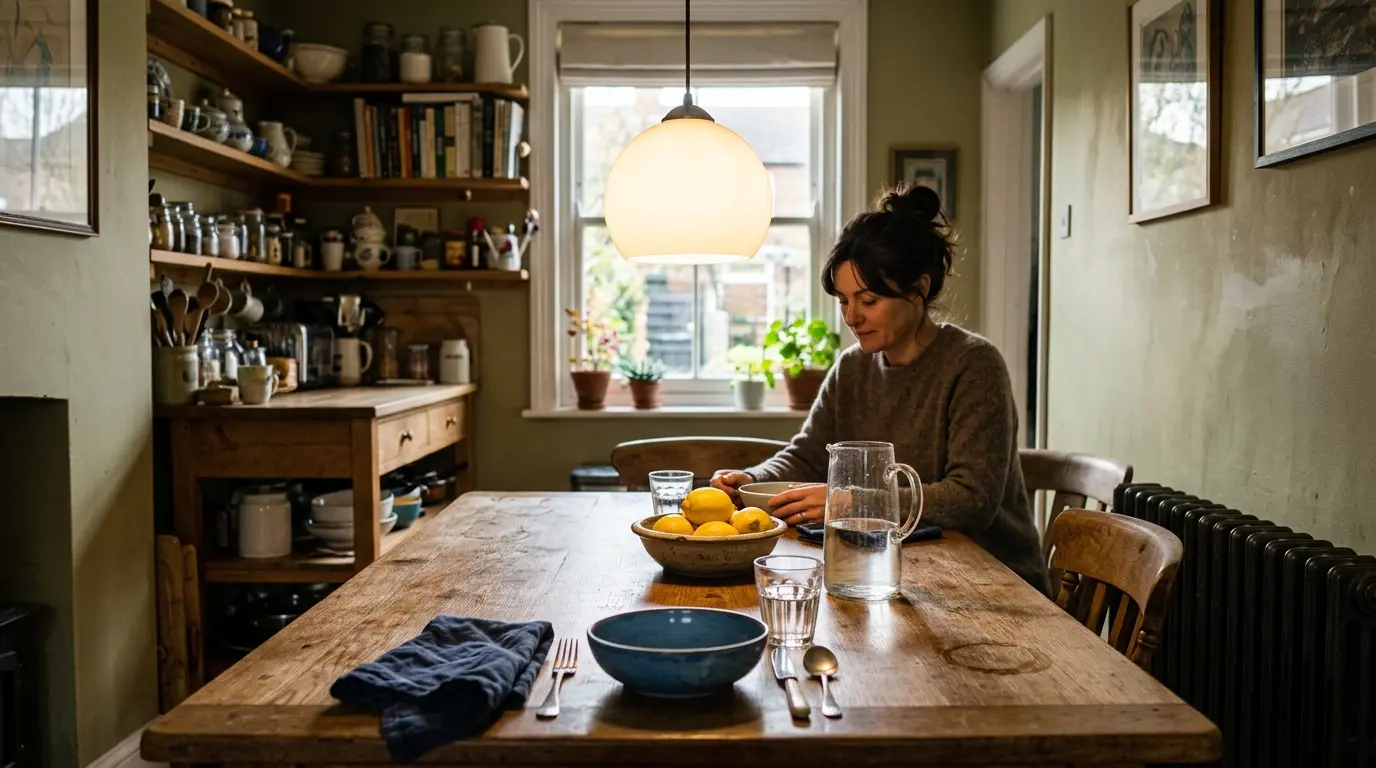
How High Should a Pendant Light Hang Over a Dining Table?

How high should a pendant light hang over a dining table? Hang the bottom of the shade 75cm to 90cm (about 30 to 35 inches) above the tabletop, and start at 80cm if you are unsure. Go higher for wide, downward facing shades or low ceilings. Go lower for slim fittings you can see past.
Search for pendant height dining table advice and you will see 60cm, 75cm, 80cm and 90cm all stated as fact. None of them is wrong, but each suits a different shade, ceiling and table. Pick the wrong one and you get glare in your eyes, a blocked view of the person opposite, or a light that looks lost in the room.
Why the Answer Is a Range, Not One Number
The range solves two problems at once. Hang a pendant too high and the light spreads across the whole room instead of pooling on the table. Hang it too low and the shade blocks sightlines, which makes conversation awkward. Retailer guidance varies, with some quoting 60cm to 80cm and others 75cm to 90cm. Most land between 75cm and 85cm, so treat 80cm as your starting point.
Always measure from the tabletop to the bottom of the shade, not from the floor. Table heights vary, and the gap above the surface is the part you live with. With a 240cm ceiling and a typical table, that puts the base of the fitting roughly 150cm to 160cm from the floor.
How to Test Your Pendant Light Height Before You Drill
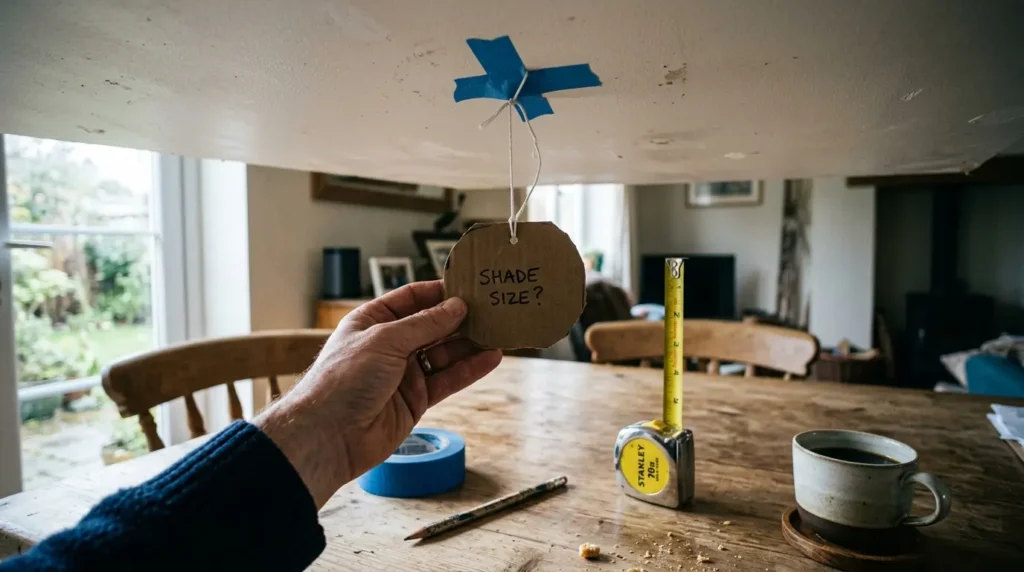
A figure on paper tells you little about how a room feels. This test takes about 20 minutes and costs nothing.
- Cut a piece of card roughly the size of your shade and tie it to a length of string.
- Fix the string to the ceiling above the centre of the table and set the card 80cm above the tabletop.
- Sit at every seat in turn. If you can see the person opposite without moving your head, the height works.
- Stand and walk around the table. Passing a dish or reaching across should not bring your head near the shade.
- Repeat in the evening with the room lights off and a lamp on the table, so you see how the light will pool.
How low can you hang a light? Lower feels more intimate, and some manufacturers suggest as little as 55cm for small pendants. Most households find that anything under 70cm starts to block sightlines or catch tall guests. Go that low only with a slim or clear fitting, and check the height with the tallest person who uses the table.
Pendant Light Height Guide by Ceiling Height
Ceiling height shifts the gap. Lower ceilings push you towards the upper end so the fitting does not feel oppressive. In tall rooms, an older rule adds about 7cm for every extra 30cm of ceiling, but follow it with care. A pendant hung too high in a tall room looks stranded. A better fix is a larger or longer fitting at close to 80cm above the table.
| Ceiling height | Gap above tabletop | What works best |
| 230cm (7ft 7in) | 85cm to 90cm | Slim shade, short drop under 30cm |
| 240cm (7ft 10in) | 75cm to 85cm | 80cm suits most fittings |
| 270cm (8ft 10in) | 80cm to 95cm | Wider or longer fitting to hold the space |
| 300cm (9ft 10in) | 90cm to 100cm | Only with a large fitting |
Treat these as starting points and confirm with the string test. On a sloping ceiling, measure the drop directly above the table, not at the highest or lowest point. Choose a fitting made for angled ceilings so the shade hangs straight.
How Shade Shape and Bulb Type Change the Hang Height
Two pendants at the same height can behave very differently.
- Wide, downward facing shades throw a tight pool of light and block more of the view. Hang them at 85cm to 90cm.
- Slim or tapered shades block very little, so 75cm feels comfortable and flatters food and faces.
- Closed shades focus light downwards. Hang them a little higher so the same fitting covers more of the table.
- Open bottomed fittings show the bulb. Hang one too low and everyone stares into the filament. Raise it slightly or use a frosted bulb or diffuser.
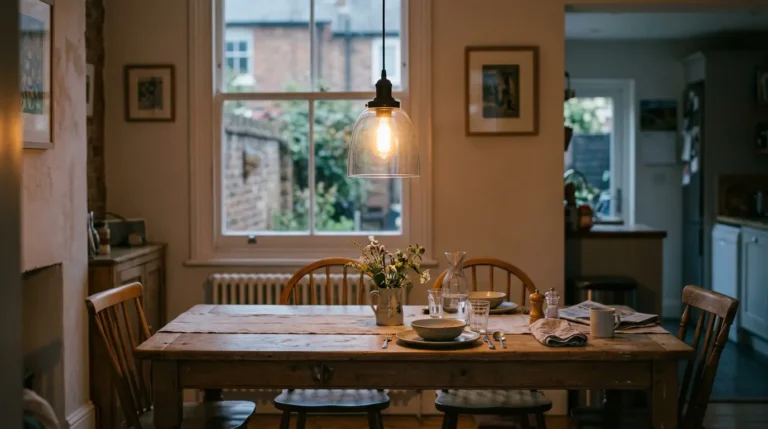
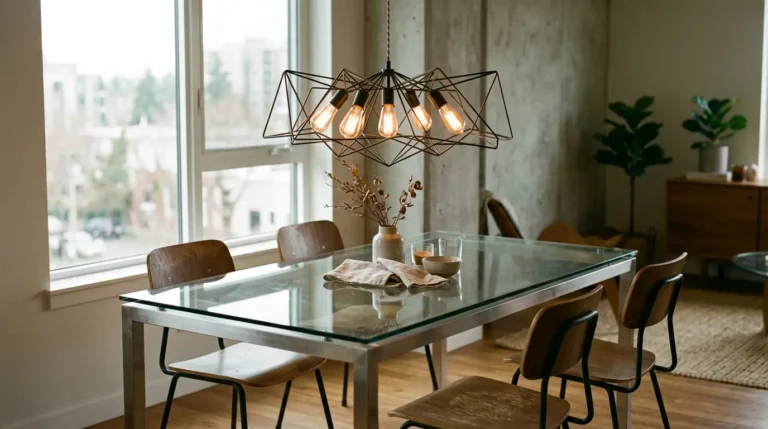
- Glass and open cage pendants look light, so they can hang lower. Solid metal or ceramic reads heavier and wants extra height.
Light Position Over a Dining Table: Centre It on the Table, Not the Room
The most common mistake in open plan kitchen diners is centring the light on the ceiling point instead of the table. The existing ceiling rose is often in the wrong place. A cable and hook arrangement or a ceiling track lets you reposition the light without rewiring.
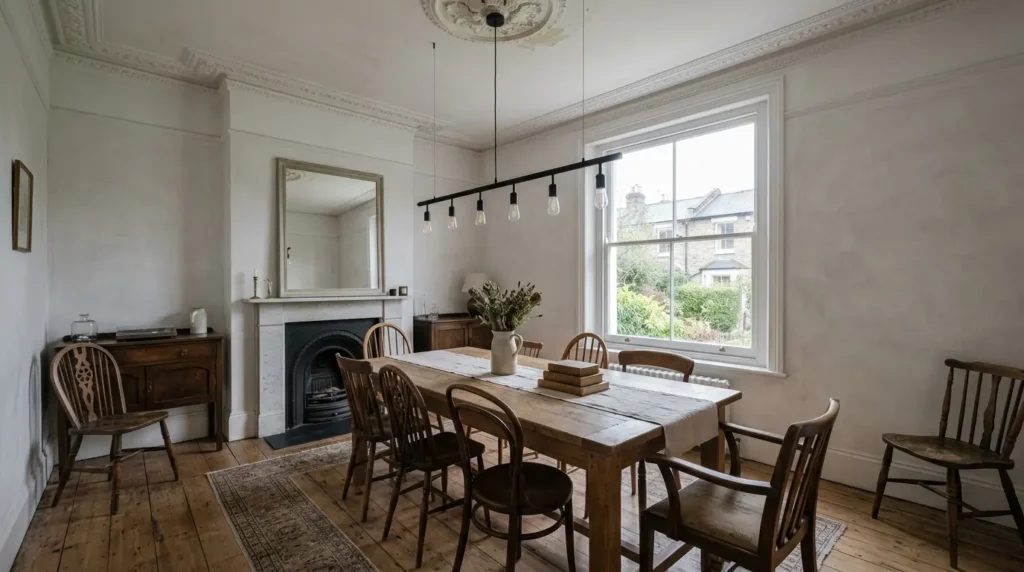
Size matters as much as position. For a single pendant, choose a diameter of one third to one half of the table width. A 120cm round table suits a 40cm to 60cm shade. Round fittings sit well over round tables, and linear fittings suit rectangular ones.
For longer tables:
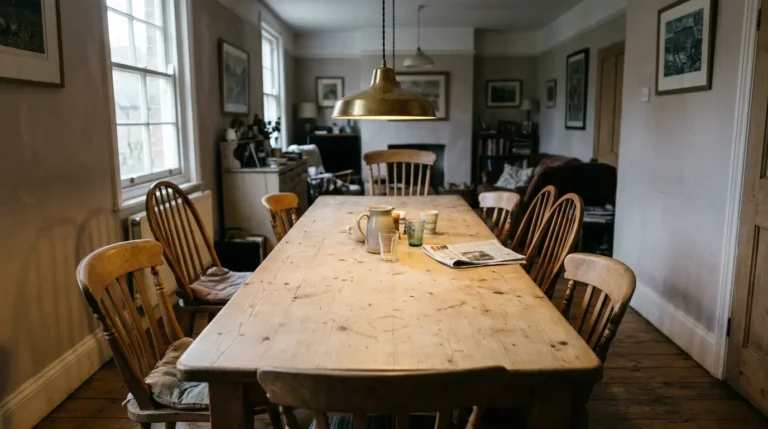
- Up to about 150cm: one large pendant or a linear fitting.
- 150cm to 180cm: two or three smaller pendants. Three small ones at 50cm to 60cm spacing also work on a 150cm table.
- Over 180cm: two medium pendants hung about a third in from each end, or a linear bar.
Space multiple pendants 50cm to 80cm apart, centre to centre, with wider shades at the larger spacing. Keep the outer ones at least 30cm in from the table ends. Hang them at exactly the same height. Staggered drops look deliberate in a stairwell but unsettled over the flat line of a table.
Two cases get skipped in most guides. If your table extends for guests a few times a year, centre the light on the closed table and choose a wider or linear fitting so the extended ends still catch light. If the table doubles as a desk, hang a diffused fitting slightly higher to cut glare on screens, and add a lamp for task light.
What It Costs and How Long It Takes
These figures are approximate, in pounds, and vary by country, trade rates and ceiling type.
| Job | Approximate cost | Typical time |
| String and card test | Free | 20 minutes |
| Adjusting an adjustable cord or chain | Free | 15 to 30 minutes |
| Hooks and cable to shift an off centre light | £10 to £40 | 1 to 2 hours |
| Electrician shortens cable or swaps the fitting | £60 to £150 labour | 1 to 2 hours |
| Electrician moves the ceiling point to the centre | £150 to £400, plus plaster and paint repair | Half a day, plus drying and decorating |
| Compatible LED dimmer | £15 to £60, plus fitting labour | About 1 hour |
| Rise and fall fitting | From about £100, often more | 1 to 2 hours to fit |
| Well made glass pendant | Around £65 to £130 for many mid range styles | Delivery varies |
A few trade-offs are worth knowing. Rise and fall fittings sound flexible, but most people set them once and leave them. Pay for one only if the table changes role or you truly vary the height. Heavy glass or ceramic shades need a fixing suited to the weight, so confirm the ceiling can carry it. Moving a ceiling point is the costly route, yet it is usually the only tidy fix when the table sits well off centre. Use a qualified electrician for new wiring, and check local rules, since regulations on domestic electrical work differ by country.
Getting the Light Itself Right
Height is only half the job. Warm white between 2200K and 3000K suits dining tables. Cooler light above 4000K feels clinical and does food no favours, and mixing colour temperatures in one room shows straight away, especially near kitchen downlights. An 8W to 12W LED bulb gives light comparable to older 60W to 75W bulbs, which suits most dining pendants.
Fit a dimmer. The level that works for homework is far too bright for dinner. Check that bulb and dimmer are compatible, because some LEDs buzz or flicker on older dimmers. Putting the pendant on its own switch also lets you set the mood separately from kitchen lighting.
A pendant alone makes a bright island in a dark room. A lamp on a sideboard or a wall light gives the eye somewhere to rest. Check the tabletop too. Gloss and glass surfaces reflect the underside of the shade, so look at what you will see from each seat. For upkeep, wipe glass and cages every few months and check the set screws on adjustable cords, which can slip over time.
Conclusion
So, how high should a pendant light hang over a dining table? For most rooms, 80cm above the tabletop is the right place to start, inside a 75cm to 90cm range. Adjust upwards for low ceilings and wide shades, and downwards for slim, open fittings. Run the string and card test before anyone picks up a drill. Centre the light on the table, add a dimmer, and the room will feel considered rather than guessed.
FAQs
How high should a pendant light be above a dining table?
Between 75cm and 90cm from the tabletop to the bottom of the shade. Use 80cm as a starting point, then test it by sitting at each seat.
Do you measure from the floor or the table?
Measure from the tabletop. Table heights vary, so the gap above the surface is the reliable figure.
How low can a pendant light hang?
Some guidance allows 55cm for small pendants, but most homes do better above 70cm. Lower than that tends to block the view across the table.
How high should a pendant hang with a low ceiling?
Aim for 85cm to 90cm above the table, with a slim shade and a short drop under 30cm.
How far apart should two or three pendants be?
Roughly 50cm to 80cm centre to centre. Keep the outer pendants at least 30cm in from the table ends.
How big should a dining table pendant be?
One third to one half of the table width. Larger shades risk head bumps and block the view.
Does a glass or glossy tabletop change the height?
It can. These surfaces reflect the shade and bulb, so a frosted bulb or a slightly higher hang often looks better.
Where should the light go over an extending table?
Centre it on the closed table and use a wider or linear fitting so extended ends stay lit.
Should the pendant have its own dimmer?
Yes. A separate dimmer or switch lets you set dinner lighting without changing the kitchen.