8 Round Dining Table Ideas for a Sociable and Intimate Dining Experience

Round dining tables create an intimate setting where everyone can see and talk to everyone else. They also remove sharp corners that catch in tight UK rooms. The right diameter, base and material decide whether the table feels generous or cramped. These eight ideas cover practical sizes and styles that work for everyday meals and occasional guests.
1. 110cm to 120cm Round Oak Table for Four to Six
A solid oak round table of 110cm to 120cm diameter seats four comfortably and can take six for shorter meals. The continuous grain looks strong on a round top. A pedestal base gives the most flexible seating. Allow 90cm clearance all round so chairs can be pulled out. This size suits most kitchen diners and smaller dining rooms. Pair it with a round rug that extends at least 60cm beyond the table edge. Check the right rug size for a dining table before ordering.
2. Extendable Round to Oval Table for Flexibility
A round table that expands into an oval keeps the everyday footprint small and adds seats when needed. A 110cm round often opens to 160cm or more. Confirm the leaf matches and the top stays level. Pedestal bases work well because they do not interfere with the new shape. Measure the open oval against walls and doorways. This is one of the most practical round options for homes that entertain occasionally.
3. Glass Round Table for Small Bright Spaces
A tempered glass round table of 100cm to 120cm keeps a small room feeling open. The top resists heat and stains but shows marks easily. Choose a thick top and a stable pedestal. Rounded edges are safer. The glass can feel cold, so pair it with warmer chairs and soft lighting. Wipe with a soft cloth only. This style works in modern flats where light and space are limited.
4. Painted Base Round Table With Wood Top
A wood or oak top on a painted pedestal or four-leg base mixes materials. The painted base can be white, grey or a soft colour that ties into the room. Confirm the paint is durable. The wood top still needs oiling or sealing. This combination suits both traditional and contemporary British homes. The round shape keeps the look soft even with a stronger colour on the base.
5. Larger 130cm to 150cm Round for Regular Entertaining
A 130cm to 150cm round table seats six to eight when the room allows. Above about 140cm it becomes harder to reach the centre, so a lazy Susan or serving from the side helps. These need generous clearances and a strong pedestal. The larger diameter creates a more formal feel while still keeping conversation easy. Confirm delivery access because the single piece is wide.
6. Round Table With Built-In Lazy Susan
Some round tables include a rotating centre section for serving dishes. This is useful on diameters over 120cm. The lazy Susan should turn smoothly and sit level. It works well for family meals where dishes are passed around. Check that the mechanism does not reduce the usable edge space for place settings. A solid wood or laminate version is more practical than glass for daily use.
7. Compact 90cm to 100cm Round for Breakfast or Small Flats
A smaller round of 90cm to 100cm seats two to four and fits into a kitchen corner or studio. It still needs 90cm clearance on seating sides. Pedestal bases maximise leg room. These tables work as everyday breakfast spots that can be moved if needed. Choose a durable finish because small tables often see more spills and constant use. Look at small dining room ideas for layout tips.
8. Round Oak Table With Trestle or Cross Base
A round top on a trestle or cross base gives a more substantial look while still allowing seating on most sides. The base must be positioned so it does not block every seat. These suit farmhouse or rustic rooms. The oak top brings warmth. Confirm stability because a round top on a narrower base can tip if weight is placed on one edge. Oil the wood regularly.
Choosing the Right Base and Material for a Round Table
Pedestal bases are the most flexible for round tables because seating is not limited by legs. A wide, stable pedestal prevents tipping. Four-leg or trestle bases can work if positioned carefully so no seat is blocked. For materials, solid oak brings warmth and can be refinished. Glass keeps the room light but shows every mark and fingerprint. Laminate or ceramic tops are easier to wipe and resist heat better than untreated wood. Confirm the top thickness so the table feels solid when someone leans on the edge.
Delivery of a round table is often simpler than a long rectangle because the diameter is the limiting dimension. Still measure doorways and any turns. Once in place, a round table rarely sits against a wall, so the full clearance circle must be free. Mark the diameter on the floor with tape or string before ordering to confirm the space feels right when chairs are pulled out.
Clearance and Height Checks for Round Tables
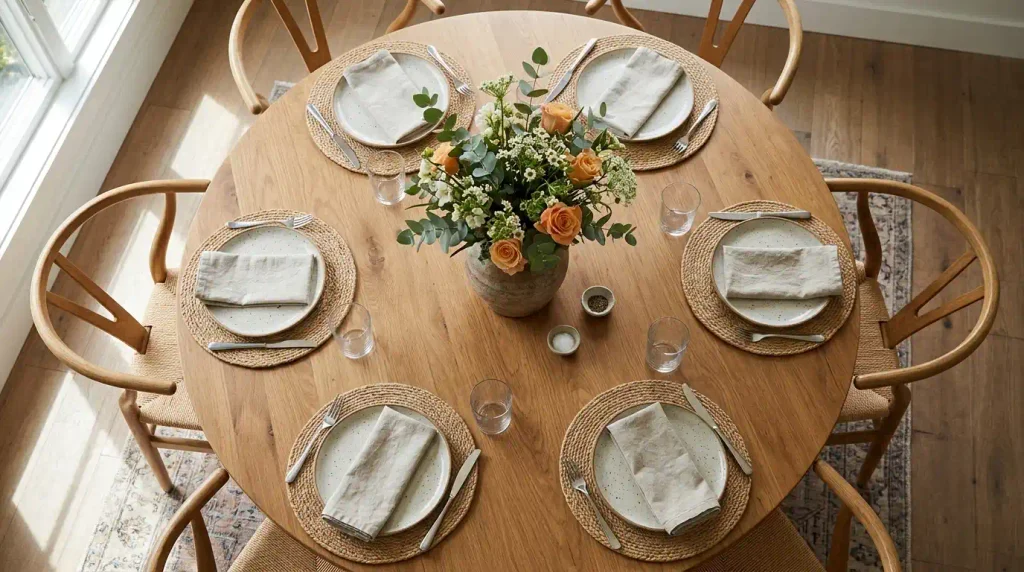
The same 90cm clearance rule applies all the way round a round table. Measure from the edge, not the centre. Standard height remains 74cm to 76cm. Pedestal bases usually give better knee clearance than four legs. Sit in the chairs you plan to use and check that arms clear the edge if the chairs have them. A round table that is too large for the room feels worse than a smaller rectangle because there is no way to tuck it against a wall.
Conclusion
Round dining tables create a more sociable and intimate setting when the diameter matches the number of people and the room. Choose a pedestal base for flexibility, check clearances all round, and pick a material that suits daily use. An extendable round to oval option adds practicality. Get the size right and the table becomes the natural place for conversation.
FAQs
What size round table seats four?
A diameter of 100cm to 120cm seats four comfortably. 90cm is tight for four adults.
Is a pedestal base better for a round table?
Yes. It removes legs that limit seating positions and usually gives better knee clearance all the way round.
How much space do I need around a round table?
At least 90cm from the edge to walls or furniture on all sides used for seating.
Can a round table be extendable?
Yes. Many expand into an oval with one or two leaves. Check the join and the open clearances.