12 Bathroom Cabinet Ideas for Stylish and Practical Storage

The best bathroom cabinet ideas combine a mirror, concealed shelving and, in many modern designs, integrated lighting or charging into one wall-mounted unit. A well-chosen bathroom cabinet solves the storage problem and the mirror problem at once, which is why it’s usually the single highest-impact piece you can add to any bathroom, large or small.
If you’ve ever balanced a toothbrush, a razor and three half-used skincare bottles on the edge of a basin because there was nowhere else to put them, you know why this matters. A bathroom cabinet isn’t a luxury add-on. It’s the piece of furniture that decides whether your surfaces stay clear or slowly disappear under clutter. After fifteen years fitting and specifying bathrooms, the cabinet is still the decision I see homeowners rush the most, and the one that causes the most regret when it’s wrong.
1. Mirrored Cabinets That Double as Your Mirror
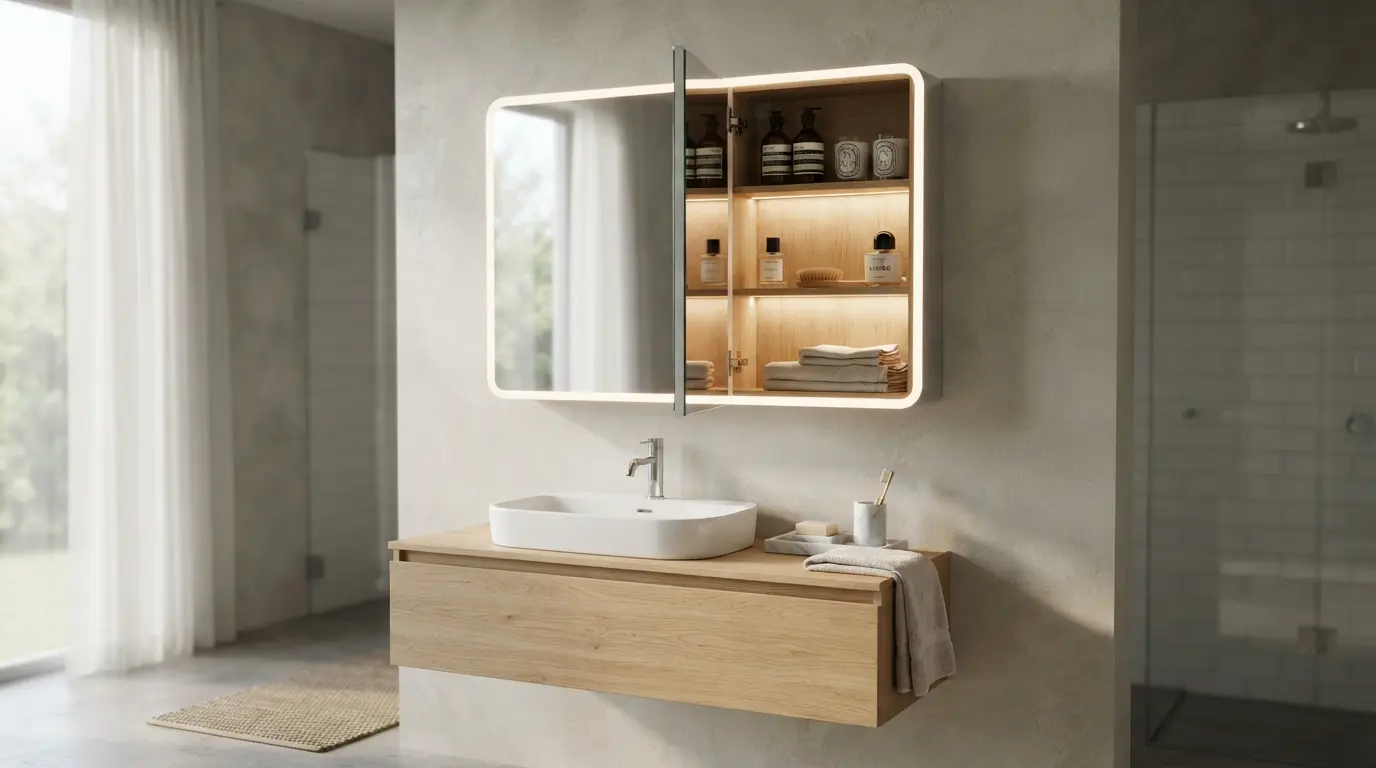
A mirrored bathroom cabinet replaces a fixture you’d need anyway, the mirror, and turns it into concealed shelving for toiletries and medicines in the same wall space. It’s the most efficient single swap available in any bathroom.
Because you’re not adding a mirror and a cabinet separately, this is genuinely free storage in terms of wall space used. Look for adjustable internal shelves so the depth suits everything from cotton pads to tall skincare bottles, and check the door swing clears any adjacent wall or towel rail before you commit to a width.
2. Illuminated Cabinets with Built-In Charging
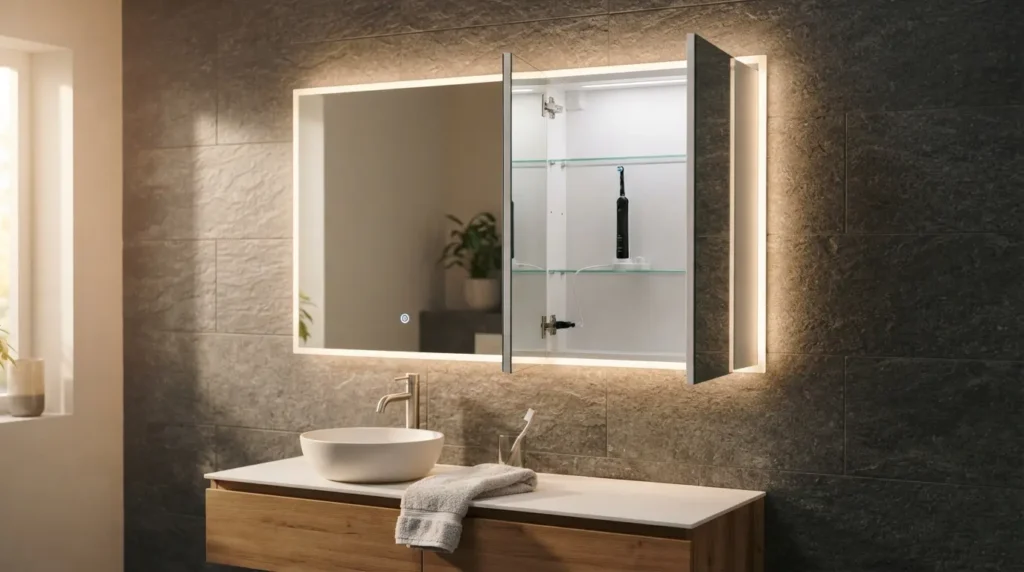
Illuminated cabinets combine LED lighting around or behind the mirror with concealed storage, and higher-spec models now include internal charging ports for an electric toothbrush or shaver so the cable stays out of sight. Contactless touch controls mean you can adjust brightness without needing dry hands.
This is a genuine upgrade over a standard cabinet rather than a gimmick: soft, even light at eye level is far kinder for shaving, applying makeup and skincare than a single harsh overhead bulb. Any cabinet with electrical components in a bathroom must carry an IP44 rating as a minimum, which means it’s protected against small objects and splashes from any direction. Check this rating before you buy, since it’s a genuine safety requirement in a wet room, not a marketing detail.
3. Recessed Cabinets for a Flush, Built-In Look
A recessed cabinet sits inside the wall cavity rather than projecting off it, giving the same storage capacity as a wall-hung unit with a flatter, more built-in appearance. It suits bathrooms where you want cabinetry to disappear rather than stand out as furniture.
This is the one idea on this list that isn’t purely a retrofit job. Recessing a cabinet means cutting into the wall, so it needs to be planned early, ideally at the same stage as any other wall work, because you’re working out whether there’s a stud cavity deep enough behind the plasterboard rather than solid masonry. If the wall is solid brick or block, recessing isn’t usually possible without significant extra work, so this idea suits a renovation project more than a quick upgrade.
4. Tallboy and Slimline Cabinets for Tight Spaces
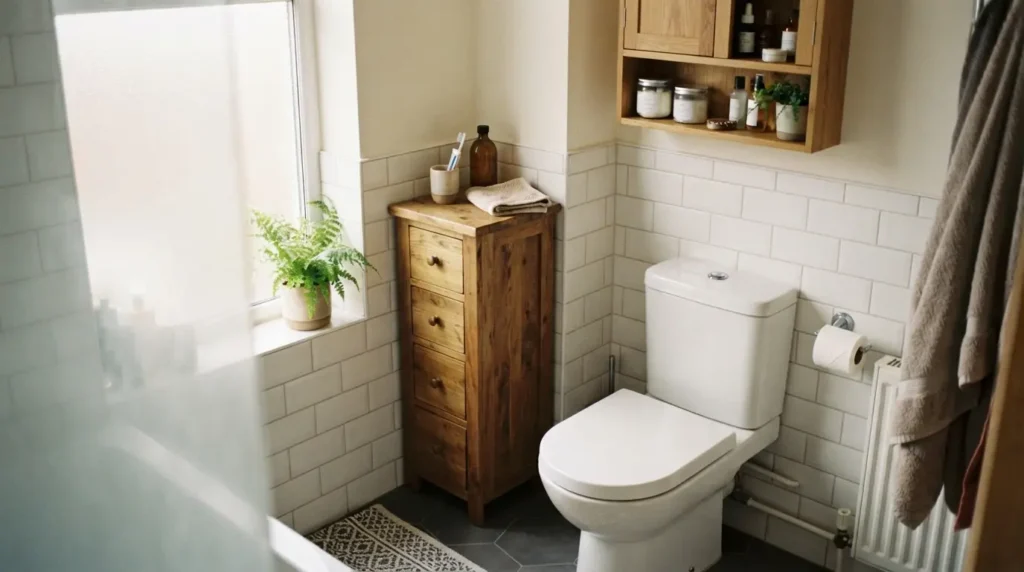
A tallboy cabinet is a narrow, floor-to-near-ceiling unit, typically 300–400mm wide, that uses vertical space instead of the floor space a small bathroom can’t spare. A slimline wall cabinet does the same job at eye level, often just 120–150mm deep, fitting into gaps a standard cabinet never would.
These are the pieces to reach for in an ensuite, cloakroom or any bathroom where the walking space is already tight. The trade-off is obvious: you’re trading width for height, so a tallboy holds plenty vertically but won’t take wide items like large towel stacks as easily as a broader unit would. Identify awkward spots first, the gap beside a toilet, above a cistern, in a dead corner, and let those dictate the dimensions rather than buying a cabinet first and hoping it fits.
5. Lockable Cabinets for Medicines and Sharp Items
A lockable cabinet keeps medication, razors and anything else you’d rather keep away from small hands secure while still leaving them accessible to adults who need them. This matters more in a family bathroom than almost any style decision on this list, and it’s the one idea competitor guides consistently skip.
If you’re fitting one, a simple first-aid sticker on the door helps guests and visiting family find plasters and painkillers quickly without needing to search every cupboard. It’s a small detail, but in fifteen years of fitting bathrooms it’s the one homeowners with young children or elderly relatives visiting almost always wish they’d thought of sooner.
6. Double Vanity Cabinets for Shared Bathrooms
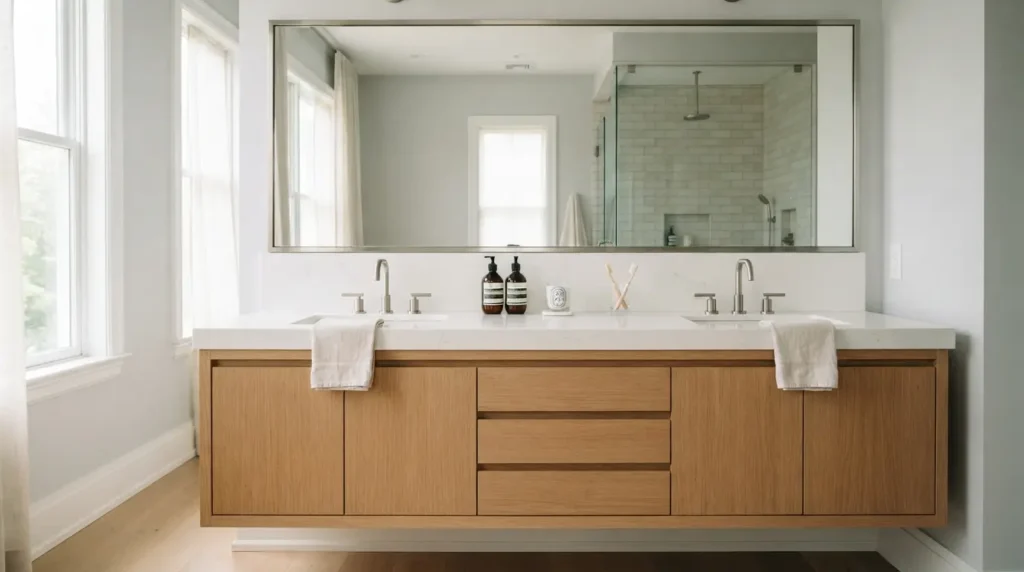
A double vanity unit pairs two basins with cabinets or drawers beneath, giving a shared bathroom double the storage capacity of a single unit alongside genuinely useful bench space for two people getting ready at once. In a family bathroom, separate smaller drawers per person work better than one large shared drawer, since it cuts down on the daily friction of shared space and stops one person’s products swallowing all the room.
This is a bigger commitment than most ideas here, both in cost and in floor space, so it suits a full or partial renovation rather than a quick swap. Expect a wider footprint to change your layout meaningfully, which means checking clearances around the basin and door swing before you fall in love with a particular unit.
7. Corner Cabinets That Use Dead Space
A corner cabinet, whether a vanity unit or a simple wall-mounted corner cupboard, claims a spot that almost never gets used otherwise, freeing the main wall runs for other fixtures. In a cloakroom or compact ensuite, this is frequently the single most efficient way to add storage without disrupting the rest of the layout.
Mirrored doors on a corner unit help bounce light around what’s usually the darkest part of a small bathroom, which partly offsets the fact that corner cabinets generally hold less than an equivalent straight-run unit of the same width. Treat it as a space-saver first and a big-capacity solution second.
8. Freestanding and Vintage-Style Cabinets
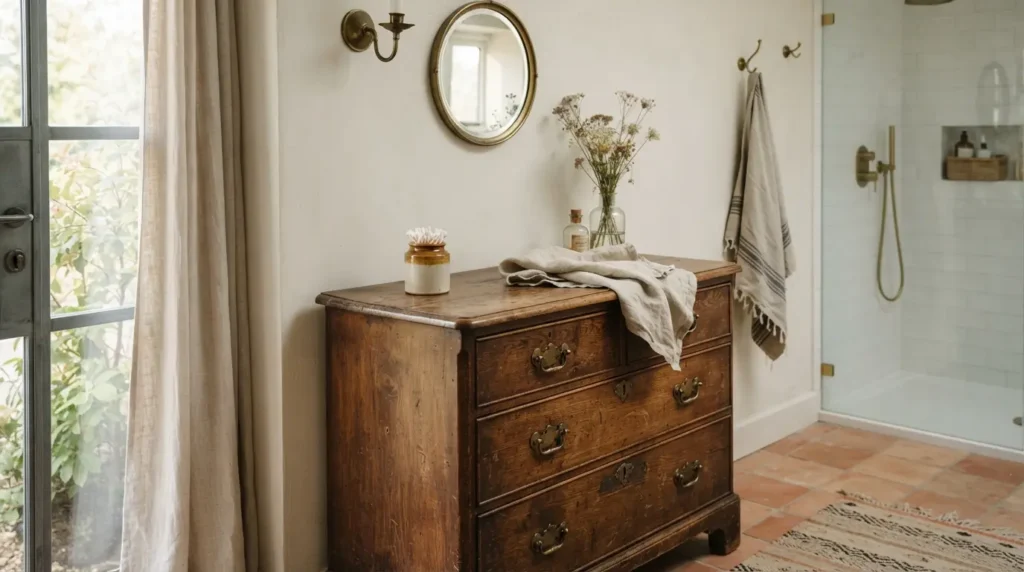
Not every cabinet needs to be wall-mounted or built in. A freestanding cabinet, whether a purpose-bought piece or genuinely vintage, brings character to a bathroom and can move with you if you renovate again or relocate. A salvaged chest of drawers or an antique cabinet, sourced and preserved rather than replaced, adds a warmth that flat-pack furniture rarely matches.
The practical trade-off is moisture resistance. Vintage pieces weren’t built for a bathroom’s humidity, so they need a spot away from direct splash zones, and it’s worth sealing or treating the wood before it goes anywhere near a shower or bath. This is the lowest-commitment idea on the list if you want to test a look before installing anything permanent, since you can simply move it if it doesn’t work.
9. Sliding-Door Cabinets for No-Clearance Storage
A cabinet with sliding rather than hinged doors needs no clearance space in front to open, which matters more than it sounds in a small bathroom where every hinged door has to swing past a toilet, a towel rail or a person standing at the basin. It’s a genuinely underused idea in most storage guides, and one of the simplest fixes for a bathroom where doors are constantly in each other’s way.
The compromise is that you only ever see half the cabinet’s contents at once, since the closed half of the door hides whatever sits behind it. It suits cabinets holding items you reach for by habit rather than ones you need to see and choose from daily.
10. Coloured and Statement-Finish Cabinets
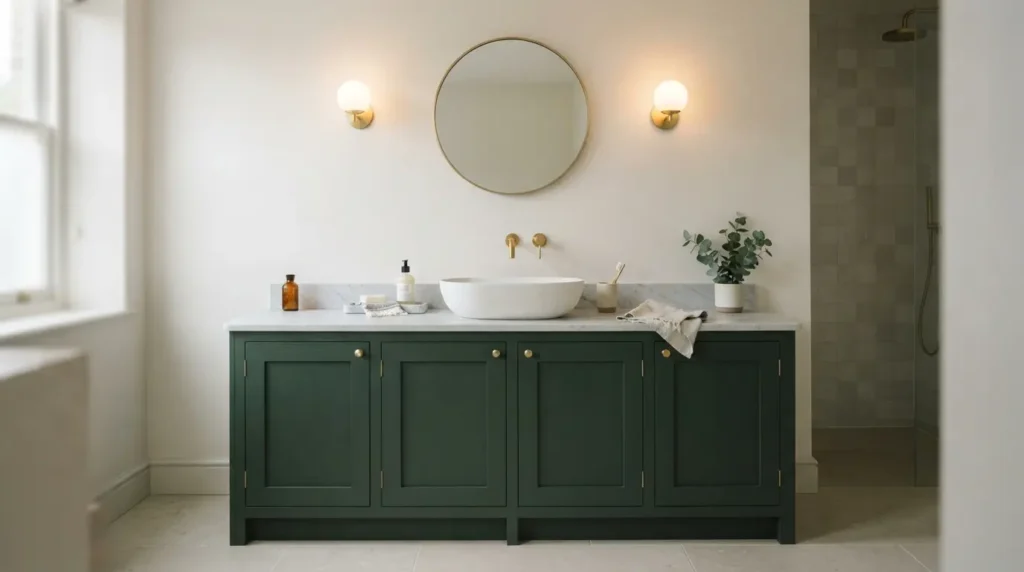
A cabinet doesn’t need to disappear into the wall. Deep greens, blues and warm woods have become a strong alternative to the all-white bathroom, and colour-blocking a single cabinet or vanity run is a low-risk way to test a bold palette without committing the whole room to it. Symmetry matters more than people expect here: a pair of matching cabinets either side of a basin, or a single centred unit, brings a sense of order that makes even a small bathroom feel calmer and more considered.
Whatever finish you choose, moisture resistance has to come first. A painted or veneered finish that isn’t rated for bathroom humidity will start lifting at the edges within a year or two of daily steam exposure, so always check the manufacturer’s spec for wet-room suitability before you fall for a colour.
11. Fluted and Textured Cabinet Fronts
Ribbed or fluted cabinet fronts add tactile depth without relying on bold colour or pattern, and they’re one of the clearest current shifts away from flat, plain cabinet doors. The grooves catch light differently depending on the angle you view them from, which gives even a single-colour cabinet a sense of movement a flat door doesn’t have.
The one practical question worth asking before you buy is how easily the grooves clean. Most modern fluted furniture is manufactured with smooth enough ridges to wipe down without trapping grime, but it’s worth checking with the supplier rather than assuming, since a badly designed groove profile will collect dust and soap scum faster than a flat surface.
12. Getting the Hardware and Internal Fit-Out Right
The handles and internal organisation of a cabinet matter as much as how it looks from across the room, because they’re what you touch every single day. A long handle gives better grip and leverage on a wide, heavy drawer full of toiletries and hair tools than a small knob does, while a modest, low-projection knob works better in a tight cloakroom where a longer pull would snag on someone squeezing past. Brushed nickel and satin brass both hold up well in a humid bathroom and tend to age more gracefully than polished chrome, which shows watermarks more readily.
Inside the cabinet, drawers generally beat cupboards for everyday items because you can see and reach everything without kneeling down, while cupboard sections still earn their place for taller bottles or things you use less often. Adjustable dividers and pull-out trays stop small items sliding to the back and getting lost, which is the single most common reason a “well-organised” cabinet stops feeling organised within a few months.
What Bathroom Cabinets Typically Cost
None of the ideas above require moving plumbing, so costs stay far lower than a full renovation, though the range is wide depending on the finish and features you choose.
| Cabinet type | Typical cost (approx., varies by country) | Fitting time |
| Basic mirrored wall cabinet | £60–£180 | 1–2 hours, DIY |
| Illuminated cabinet with charging | £200–£600 | Half a day, needs an electrician for the power connection |
| Tallboy or slimline cabinet | £80–£300 | 1–2 hours, DIY |
| Recessed cabinet | £150–£500 plus wall alteration | 1–2 days, needs a tradesperson |
| Freestanding or vintage cabinet | £50–£400 | No fitting needed |
| Double vanity cabinet unit | £400–£1,200+ | Half a day to a day, plumber needed |
These figures are a general guide rather than a quote, since prices move depending on your location, the brand and the finish. As a rule of thumb, anything electrical adds cost for the qualified installation on top of the unit price itself, and that’s not a step worth skipping given the water risk involved.
Common Mistakes Worth Avoiding
The most frequent mistake is buying a cabinet wider than the basin below it, which throws off the visual balance of the whole wall and often means the door catches on a nearby wall or window reveal when it opens. A good rule of thumb is to keep the cabinet no wider than the basin itself, and to check there’s enough clearance for the door, or both doors on a double unit, to open fully without hitting anything.
Mounting height causes almost as much frustration. Setting the base of the cabinet around 30cm above the basin keeps splash to a minimum and stops the cabinet getting dirty from everyday hand washing, while still leaving enough headroom for anyone tall in the household to use the mirror comfortably. If more than one person of noticeably different heights shares the bathroom, it’s worth checking the mirror height works for everyone before it goes on the wall, not after.
Finally, don’t underestimate the weight a loaded cabinet puts on a fixing. A cabinet full of bottles, medication and hair tools can weigh considerably more than it does empty, and a fixing rated for the wrong wall type, plasterboard plugs on a stud wall instead of fixings that reach the timber stud, is one of the most common reasons a cabinet ends up pulling away from the wall within its first year.
FAQs
What size should a bathroom cabinet be?
As a general rule, keep the cabinet no wider than the basin beneath it, and confirm the door has enough clearance to open fully without striking a wall, window or towel rail. Beyond that, let the gap you’re filling, whether that’s a narrow alcove or a wide wall run, dictate the dimensions rather than choosing a size first.
Do bathroom cabinets need to be waterproof?
They need to be moisture-resistant rather than fully waterproof, since they’re not submerged. Any cabinet with electrical components, lighting, charging ports or a demister pad, must carry a minimum IP44 rating, which protects against splashes from all directions. Materials should also be finished to resist warping and swelling in a humid room, since standard furniture-grade board will lift at the edges over time near a shower or bath.
Can I install a bathroom cabinet myself?
A standard wall-mounted or freestanding cabinet is a straightforward DIY job for most homeowners, provided you check whether the wall is solid or stud before drilling and use fixings rated for the loaded weight, not just the empty weight, of the cabinet. Anything with a mains electrical connection, an illuminated or charging cabinet, needs a qualified electrician to complete the wiring safely, even if you hang the unit yourself.
What’s the difference between a medicine cabinet and a standard bathroom cabinet?
A medicine cabinet is generally the same basic wall-mounted mirrored unit, but with a lock fitted to the door, keeping medication and anything sharp secure from children while remaining accessible to adults. If you’re buying for a family bathroom, it’s worth checking whether a locking option exists in the range you like before you commit to a non-locking version.
Choosing the right bathroom cabinet comes down to matching the idea to the actual gap you’re trying to fill, whether that’s a wide double vanity for a shared family bathroom or a slim recessed unit for a cramped ensuite. Get the size, the fixing and the moisture rating right first, and the style choice, colour, texture or finish, becomes the easy part. Start with what you genuinely need to store, then let that shape which of these bathroom cabinet ideas earns a place on your wall.