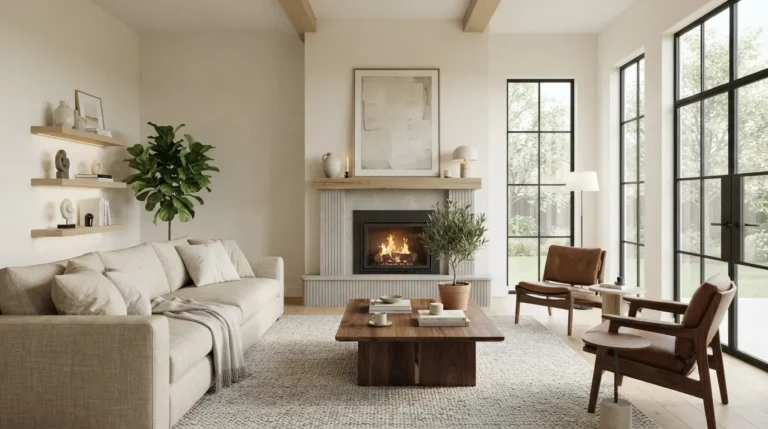
How to Choose the Right Rug Size for a Living Room

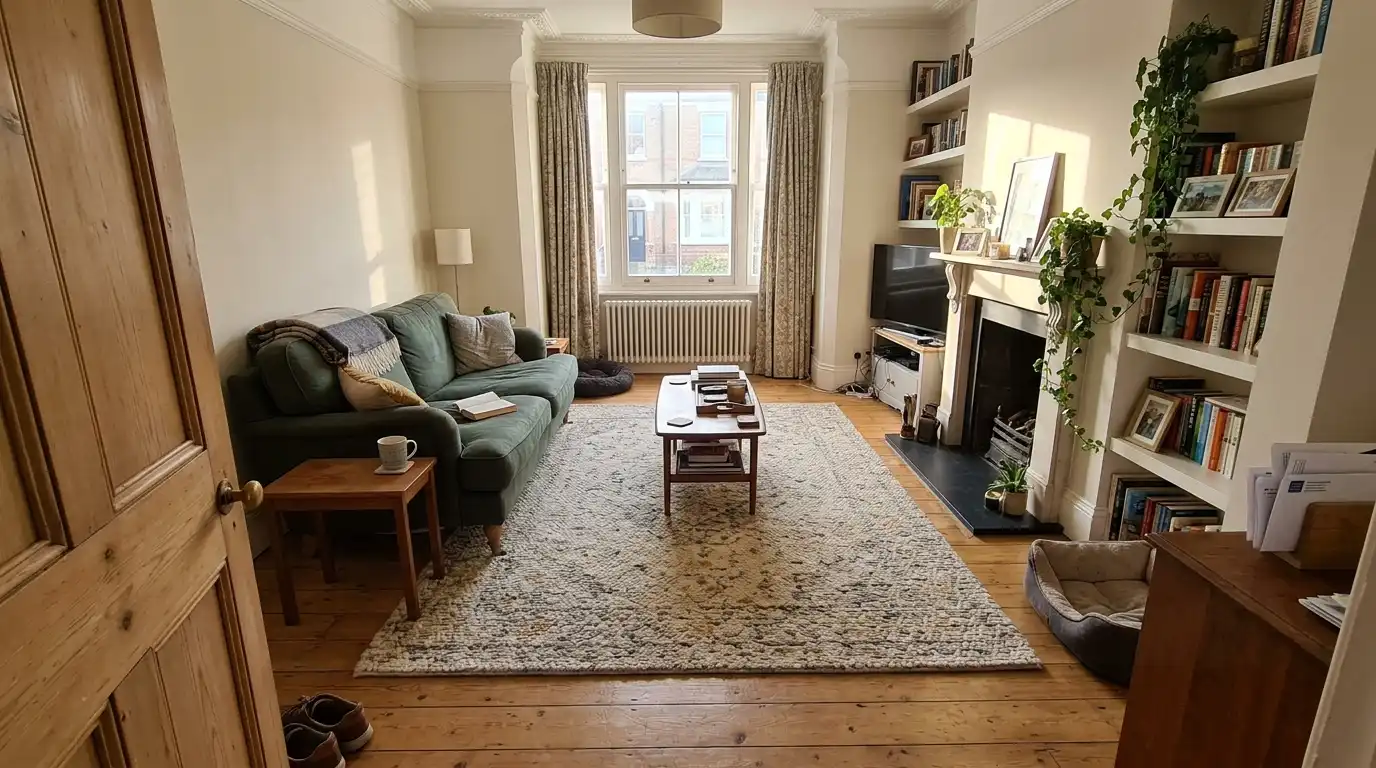
The right rug size for a living room is the one that sits under the front legs of the sofa and the chairs, with about 20 cm of rug past each end of the sofa. In a typical UK lounge of 3.5 to 4.5 metres wide, that is usually a 200 x 290 cm or 200 x 300 cm rug, not the 160 x 230 cm size most people buy first.
A rug that stops short of the sofa leaves the seating looking parked on bare floor. The fix is a measurement, not a better pattern. Size the rug to the seating group, then check the walkway left around it.
What size rug does a living room actually need?

Measure the seating zone, not the whole room. A two-seater around 160 to 180 cm wide can sit on a 160 x 230 cm rug if only the front legs need to land on it. A standard three-seater of 200 to 220 cm wide wants 200 x 290 cm at a minimum, and 200 x 300 cm is the safer living room rug dimension in a standard room.
Large rooms of 4.5 to 5.5 metres wide, or a layout with two sofas, usually need 240 x 340 cm so the coffee table and the front legs all share one surface. Open-plan zones often need 300 x 400 cm, or two rugs layered, so the lounge does not bleed into the dining area.
| Room or sofa | Rug size to start with | What must sit on it |
| Two-seater, small lounge | 160 x 230 cm | Front legs of the sofa |
| Three-seater, standard UK lounge | 200 x 290 or 200 x 300 cm | Front legs of sofa and one chair |
| Three-seater plus two chairs | 240 x 340 cm | Front legs of the whole group |
| Facing sofas or an L-shape | 300 x 400 cm | Front legs, coffee table fully on |
Should the rug go under the sofa legs?
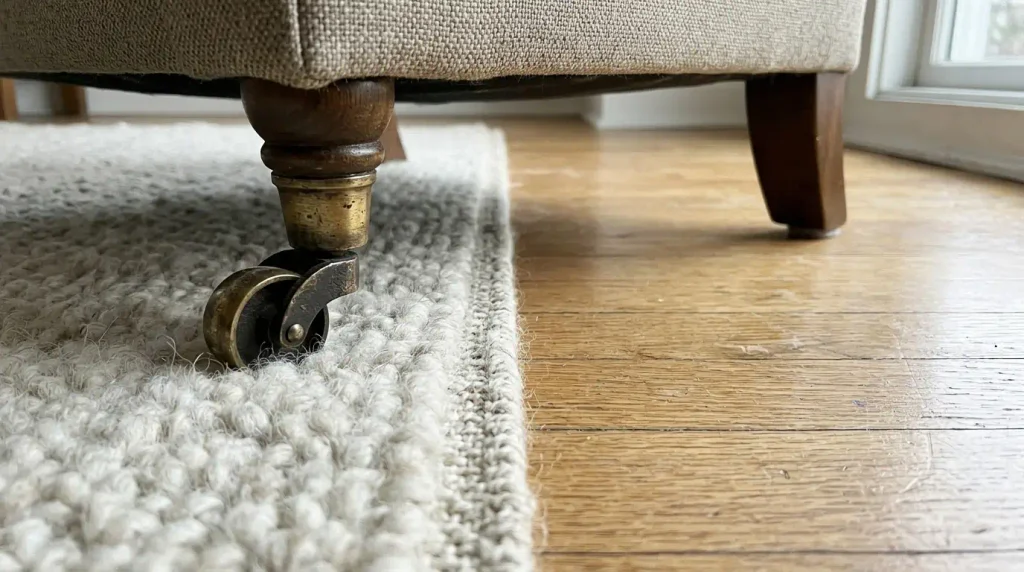
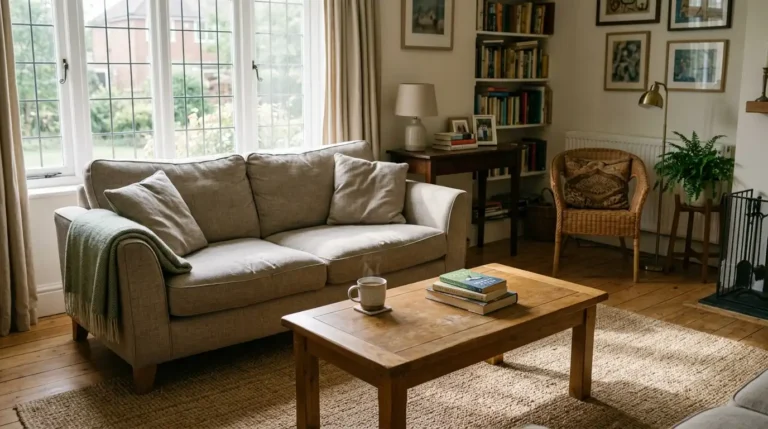
Front legs on, back legs off, is the rule that fixes most rooms. All legs on looks settled in a large room, but it needs a rug big enough that you still have 30 to 45 cm of floor, or at least a clear walkway, around the edge. All legs off, the floating rug, only works in a very small lounge or a reading nook. In a normal room it looks like a mat.
Leave 20 cm of rug beyond each sofa arm. Leave 30 to 45 cm of rug in front of the sofa so feet and the coffee table land on the pile, not on the border. If you are still choosing the table, the right coffee table should be about half to two-thirds the sofa length, and it must sit fully on the rug.
How much floor should you leave around the rug?
Keep 20 to 40 cm of bare floor between the rug edge and the wall or the skirting. Less than that and the rug looks wall-to-wall by mistake. More than about 50 cm on the sitting side and the seating group falls apart. Do not run the rug under a radiator or into a doorway. A door that catches the edge will curl it within a month.
This is also a layout decision. Once the rug is down, how to arrange furniture in a living room gets easier, because the rug is the boundary of the seating zone. If the rug cannot reach the front legs without blocking the door, the sofa is in the wrong place, not the rug.
What changes in a small or open-plan room?
In a small living room, one rug under the front legs still beats wall-to-wall carpet if you want the floor to read as bigger. A 160 x 230 cm rug centred on the sofa, not on the room, is usually enough. Do not buy a round rug for a rectangular sofa group unless the chairs form a circle. Round rugs leave the sofa arms on bare floor.
In an open-plan room, the rug should mark the lounge and stop before the dining chairs. Dining chairs need their own rule: the rug must be large enough that chairs stay on it when pulled out, which is a different size from a sofa rug. Mixing the two jobs on one small rug is the usual mistake. Living room layout ideas that separate the zones with a rug edge hold up better than a rug that tries to cover both.
Which pile and budget match the size?
A larger rug costs more than a larger paint tin, so size first, then fibre. Wool and wool-mix hold shape in a hallway-to-lounge route and often sit around £200 to £600 for 200 x 300 cm, depending on density. Polypropylene is the lower band, often £60 to £180 for a similar size, and it shrugs off spills, but it flattens and can feel plastic under bare feet. Jute and sisal look right in photos and mark fast in a family room.
A rug pad is not optional on laminate or tile. Budget £30 to £80. It stops creep and takes some wear off the backing. Prices are approximate and vary by country.
| Choice | Typical cost (GBP) | Trade-off |
| 160 x 230 cm synthetic | £40 to £120 | Easy clean, flattens sooner |
| 200 x 300 cm wool or wool-mix | £200 to £600 | Better underfoot, needs a pad |
| 240 x 340 cm wool | £400 to £900 | Right for a full seating group, heavy to move |
| Rug pad | £30 to £80 | Stops slip, adds a day of fitting |
What mistakes waste the rug?
Buying for the room width instead of the sofa width. Choosing a pattern before the size. Skipping the pad on a smooth floor. Putting only the coffee table on the rug while every chair sits off it. And ordering online from a swatch the size of a postcard: pile height changes how big a rug feels, and a thick pile eats the 30 cm you thought you had in front of the sofa.
Conclusion
Choose the rug size for the seating, not the floor area. For most living rooms that means front legs on a 200 x 290 cm or 200 x 300 cm rug, with 20 cm past the sofa arms and a clear walkway to the wall. If the tape measure cannot make that work, move the furniture before you spend on a bigger pattern.
FAQs
What is the standard rug size for a living room?
For a three-seater in a standard room, 200 x 290 cm or 200 x 300 cm. A 160 x 230 cm rug is a small-room or two-seater size.
Should a rug be bigger than the sofa?
Yes. It should run about 15 to 20 cm past each end of the sofa, and far enough forward for the front legs and the coffee table.
Can a rug be too big?
Yes, if it hits the skirting on all sides or blocks a door. Leave 20 to 40 cm of floor at the edges you walk past.
Do all sofa legs need to be on the rug?
No. Front legs on is the practical rule. All legs on needs a much larger rug and a room that can spare the floor around it.