How to Choose Garden Furniture That Lasts All Year

Choosing garden furniture that lasts all year comes down to four things: frame material, weave or fabric quality, warranty length, and basic seasonal care. Get those right and a set will still look sharp in a decade. Get them wrong and you’re back at the garden centre every couple of summers, watching cushions grow mould and frames go orange at the joints.
That replacement cycle is the real reason most people end up disappointed. A set looks good on the showroom floor, survives one hot spell, and starts sagging or rusting the moment autumn rain sets in. None of that is bad luck. It’s almost always a material or spec problem that was visible before purchase, if you knew what to check.
Start With the Frame Material, Not the Look
The frame decides how long everything else survives, so check it before you fall for the cushions. Powder-coated aluminium is the strongest all-round choice for a garden that sees real weather, because aluminium has no iron in it and simply can’t rust, and the coating protects the finish through sun and rain alike.
Steel frames look almost identical in a listing photo and usually cost less, but they begin corroding the moment the coating chips, which happens faster than most buyers expect once furniture gets moved around or knocked. Solid hardwood, particularly teak or acacia, can also live outside permanently. Teak’s natural oils make it naturally water and rot resistant, and it will slowly turn a soft silver-grey if left untreated, or keep its warm honey tone with an annual oiling. Acacia needs a proper sealer and topcoat applied before use, since it doesn’t carry the same natural oil content as teak.
A good rule of thumb: if a listing won’t tell you what the frame is made from, treat that silence as the answer. Cheaper ranges often hide the material because steel sounds less premium than aluminium.
| Material | Weather Resistance | Maintenance | Typical Lifespan |
| Powder-coated aluminium | Very good, rust-free | Low, occasional wipe down | 15 to 25 years |
| Teak or other oiled hardwood | Excellent | Low to moderate, annual oiling optional | 20-plus years |
| Steel | Fair, prone to rust at chips | Moderate to high | 5 to 10 years |
| Untreated softwood | Poor outdoors | High | 3 to 7 years |
| Synthetic weave over aluminium | Very good | Low | 10 to 15 years |
Check the Weave and Fabric Before the Cushions
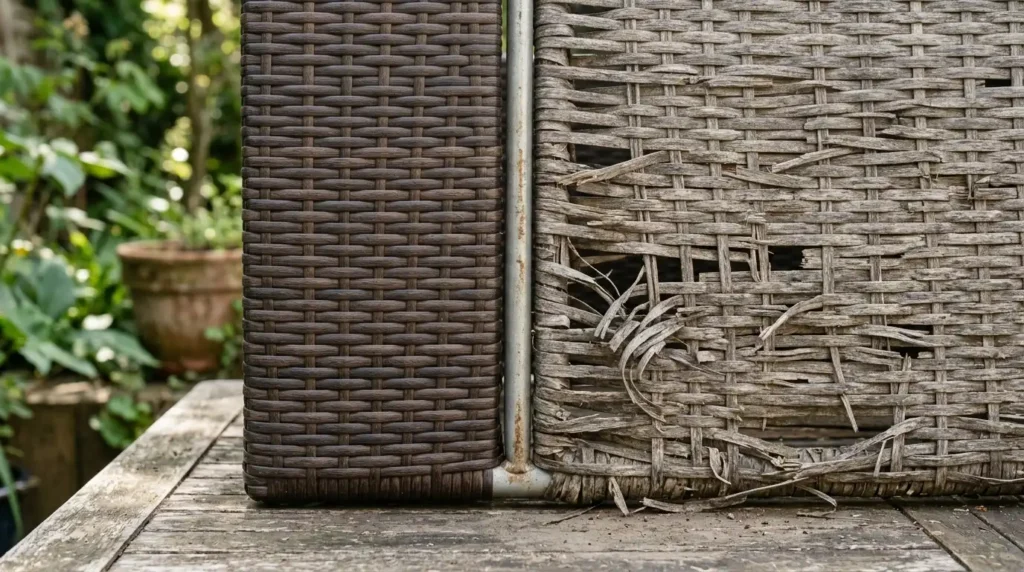
On woven furniture, this is where quality genuinely separates from the pack. When people say rattan, they usually mean one of two very different materials. Cheap PVC weave goes brittle and pale under UV light and starts cracking within a season or two outdoors. HDPE, a denser synthetic weave, holds its colour and flexibility for years in direct sun and rain, which is why it’s become the standard for durable garden furniture at the mid to upper end of the market.
The same logic applies to cushions. Ordinary indoor fabric soaks up rain, holds it, and grows mildew within weeks of being left out. Proper outdoor fabric is usually solution-dyed, meaning the colour runs through the entire fibre rather than sitting on the surface, so it resists fading even after a full summer in direct sun. Pair that with quick-dry foam inside the cushion, and you can sit down within minutes of a shower rather than waiting a full day for the padding to dry out.
A tight, even weave also matters structurally. Run a hand across a woven panel before buying if you can. A loose, sagging weave will only get worse with wear, while a taut one holds its shape for years.
Match the Set to How You Actually Use the Garden
The single most common mistake is buying the set that photographs best rather than the one that fits how the space actually gets used. Be honest about which of these describes your garden.
- If you mostly eat outside, a dining set with a table at proper eating height beats a low lounge set that leaves everyone hunched over their plate.
- If you mostly want to sit and do nothing, look for deeper, lower lounge seating with generous cushions rather than a formal dining chair.
- If your space is small, a compact bistro set with two chairs will get used far more than a full corner suite that eats the whole patio and leaves no room to walk.
- If you entertain often, modular or corner sofa sets are worth the extra cost, since they can be rearranged for a crowd one week and pulled tight for two people the next.
Measuring the space before buying avoids the classic problem of a set that looked reasonably sized online but leaves no room to pull a chair out once it’s actually in place.
Let the Warranty Do the Talking
A warranty is one of the most honest signals available on a product page, because it reflects what the manufacturer is actually willing to stand behind. Budget sets rarely offer more than a year or two of cover, mid-range synthetic weave and aluminium ranges commonly carry warranties of three to five years, and premium hardwood or engineered rope collections often stretch to ten years on the frame.
That gap in warranty length usually maps fairly closely to the gap in real-world lifespan. It’s not a guarantee, since a warranty only covers manufacturing faults rather than fading or normal wear, but a retailer confident enough to back a frame for a decade is telling you something a one-year warranty never will.
Budget for the Real Cost, Not Just the Sticker Price
Garden furniture is one of the clearer cases where the cheaper option often costs more over time. A basic set in the £200 to £400 range that needs replacing every two summers works out to a similar or higher annual cost than a well-made set bought once for £800 to £1,500 and kept for a decade. Add in the time spent reassembling flat-pack furniture every couple of years, and the maths tips even further toward buying properly the first time.
This isn’t an argument for spending the most you can. It’s a reason to spend where it actually matters: a rust-free frame, a genuine outdoor fabric, and a weave that won’t crack in a normal British summer. A modest dining set with the right specification will comfortably outlast an expensive-looking set built on steel and PVC weave.
Give It Basic Seasonal Care
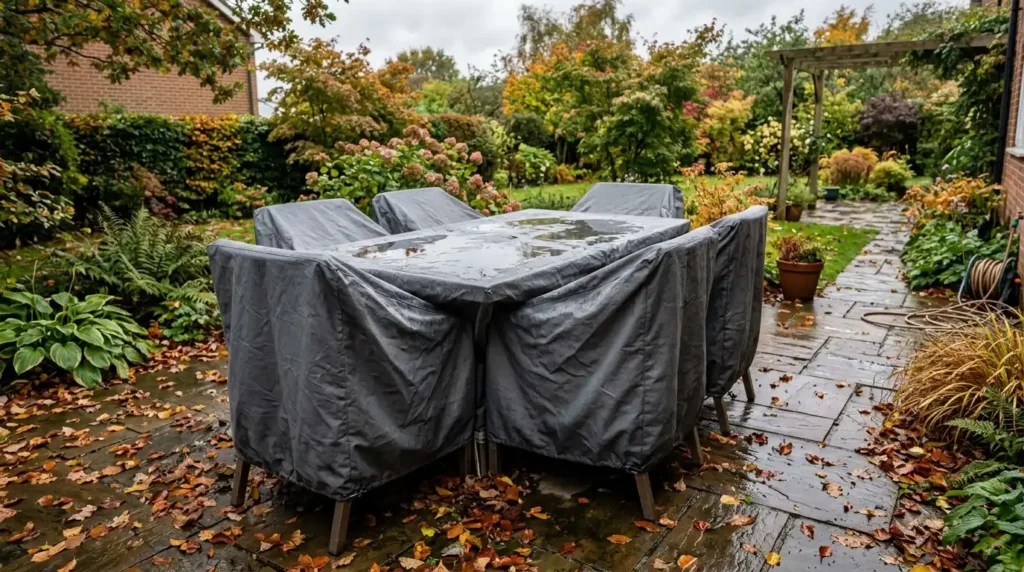
Even the best-specified furniture lasts longer with a little routine attention, and none of it takes much time.
- Wipe frames and woven sections down with warm, soapy water a couple of times a season to stop dirt and pollen building up.
- Bring cushions indoors or into a storage box overnight, or at minimum during extended wet spells, since even quick-dry foam degrades faster if it’s constantly damp.
- Fit a breathable cover over the whole set through winter. A sealed, non-breathable cover traps condensation underneath and can do more harm than leaving furniture uncovered.
- Elevate table and chair legs slightly off the ground in the coldest months, or set furniture on a firm, level surface where water can’t pool and freeze against the base.
- Check joints and fixings once or twice a year and tighten or touch up any chipped coating before moisture gets underneath it.
None of this is intensive, but skipping it entirely is usually what turns a well-made set into a five-year set instead of a fifteen-year one.
Common Mistakes to Avoid
A few habits show up again and again in buyer’s remorse. Buying based purely on the listing photo without checking frame material or fabric spec is the biggest one, since two visually identical rattan sets can have completely different lifespans underneath. Using indoor cushions outdoors is another, since they hold water and mildew far faster than anything designed for the garden. Skipping measurements is a quieter mistake that shows up later, when a set that looked fine online leaves no room to walk around the table. And leaving untreated softwood outside without oiling or sealing it, expecting it to behave like teak, tends to end in warped or split boards within a couple of wet seasons.
Conclusion
Choosing garden furniture that lasts all year isn’t about spending the most you can afford. It’s about checking the frame, the weave, and the fabric before anything else catches your eye, then giving the set a few minutes of seasonal care each year. Do that and a good set genuinely earns its price back over a decade rather than a single summer. Start with the material, match the pieces to how you actually use the space, and the rest of the decision gets a lot easier.
FAQs
What kind of garden furniture lasts the longest?
Powder-coated aluminium frames and hardwoods like teak consistently outlast steel and untreated softwood, especially when paired with a genuine outdoor fabric or a dense HDPE weave rather than PVC.
Is aluminium or wood better for garden furniture?
Both hold up well outdoors, but they suit different priorities. Aluminium is lighter, rust-free, and needs almost no upkeep, while wood like teak offers a warmer look but benefits from occasional oiling if you want to keep its original colour rather than let it silver naturally.
Can garden furniture be left outside all year?
Aluminium frames and HDPE weave can generally stay outside year round without issue. Cushions are the exception. Store them indoors or in a weatherproof box during the wettest months, and use a breathable cover over the frame itself.
How do I know if garden furniture is good quality?
Check the frame material first, then the tightness of the weave or the fabric type, and finally the warranty length. A vague or missing frame material on a listing is usually a sign the furniture wasn’t built with longevity in mind.
Is expensive garden furniture worth it?
Often, yes, though not because of the price tag itself. Higher-priced sets tend to use rust-free frames, solution-dyed fabric, and denser weaves, all of which genuinely extend lifespan, so the cost per year of ownership often ends up lower than a cheaper set replaced repeatedly.
How often should garden furniture be replaced?
Well-specified aluminium or hardwood sets can realistically last fifteen to twenty-five years with basic care. Budget steel or PVC-weave sets often need replacing within five years, sometimes sooner if left uncovered through winter.