How to Layer Kitchen Lighting for the Perfect Functional Space

A single ceiling light leaves shadows on the worktop and makes the kitchen feel flat at night. Layered lighting solves this by combining three types of light that can be controlled separately: ambient for overall brightness, task for the places you actually work, and accent for atmosphere. Done properly, the same kitchen works for morning prep, evening cooking and late-night snacks.
The process is straightforward if you plan it before the units and ceiling are finished. These steps cover what most UK kitchens need.
Understand the Three Layers
Ambient light fills the room so you can move around safely. Recessed downlights or a few flush ceiling fittings usually provide this. Task light is brighter and more focused; under-cabinet strips and pendants over the island or sink are the main tools. Accent light highlights a splashback, the inside of a glass cabinet or the toe-kick area and is optional but effective.
Each layer should be on its own switch or dimmer. This lets you use only the under-cabinet lights for a late snack or turn everything up for cooking.
Map the Work Zones First

Mark where you chop, cook, wash up and sit. These are the places that need task light. In most kitchens that means the main worktop run, the hob and the sink. If you have an island, that is usually the fourth zone. Natural light from windows reduces the need for bright ambient light during the day, so note which walls get sun.
Install Ambient Lighting Evenly
Space recessed downlights roughly 1–1.5 m apart on a grid, adjusted so the light falls across the worktops rather than only in the middle of the floor. Aim for 800–1000 lumens per fitting and a warm white colour temperature of 2700–3000 K. Avoid placing a downlight directly above a person’s head at the main prep spot; it creates harsh shadows.
If the ceiling is low or you prefer fewer holes, a combination of a central fitting and wall lights can work, but recessed lights remain the cleanest modern solution.
Add Under-Cabinet Task Lighting

LED strips or puck lights mounted under the wall units are the single most useful addition in most kitchens. Position them towards the front edge of the cabinet so the light reaches the full depth of the worktop. Choose a high colour-rendering index (CRI 90+) so food colours look accurate. Put them on a separate switch.
A continuous strip looks neater than individual spots. Budget £15–£40 per metre for decent tape and a driver.
Light the Island or Peninsula
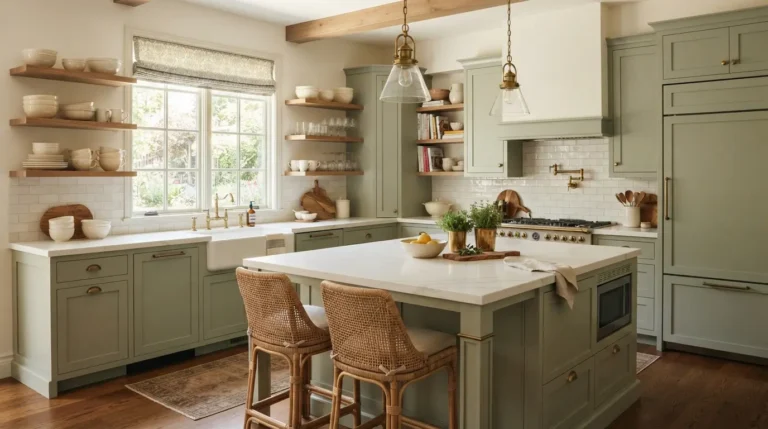
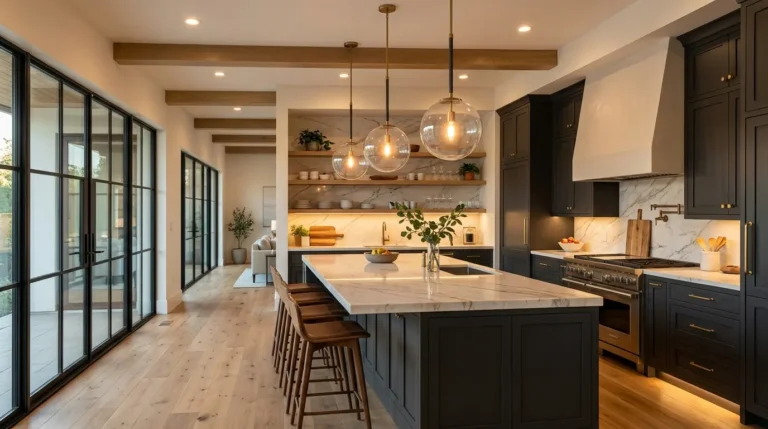
Pendants over an island serve as both task and decorative light. Hang the bottom of the shade 750–900 mm above the worktop. Space multiple pendants 600–800 mm apart. For a long island a linear bar light is often cleaner than three separate pendants. See our pendant light ideas for style options.
If the island has a sink or hob, make sure the pendants do not cast shadows on the working surface; under-island lighting or additional downlights can fill any gaps.
Include Accent Lighting If the Budget Allows
Toe-kick lighting makes cabinets appear to float and provides a soft night light. In-cabinet lighting in glass-fronted units turns everyday crockery into a feature. A slim LED strip behind a splashback or under a floating shelf adds depth. These are the finishing layers; the kitchen still works without them.
Control and Dimming
Wire the three layers to separate switches. Add dimmers to the ambient and pendant circuits so the mood can change. Smart switches or a simple scene controller let you set “cook”, “eat” and “night” with one press. Keep the under-cabinet lights independently controllable; they are often the only lights you need after dark.
Typical Specification
| Layer | Recommended specification |
| Ambient | Recessed downlights, 2700–3000 K, dimmable |
| Task | Under-cabinet LED strips, CRI 90+, separate switch |
| Accent | Toe-kick or in-cabinet LEDs, optional |
Planning and Installation Tips
Mark the positions of every light on the ceiling plan before the plasterboard goes up. Recessed downlights need joist clearance or a suitable ceiling void. Under-cabinet strips need a power feed, usually from a socket or a dedicated spur behind the units. Pendants over an island require a structural fixing point in the ceiling. In most UK renovations the electrician and the kitchen fitter need to coordinate so the cables are in the right place before the units are installed. Use dimmable LEDs throughout and choose drivers that are compatible with the dimmer switches you specify. A common mistake is installing non-dimmable strips and then discovering they cannot be dimmed. Test the colour temperature of samples in the actual kitchen before ordering quantities; light looks different under your own windows than in a showroom.
Budget for the layers separately. Recessed downlights and basic under-cabinet strips are relatively inexpensive; the pendants and any smart controls add more. Even a modest layered scheme transforms how the kitchen feels after dark. If you are only able to do one thing, add under-cabinet lighting; it removes the shadows that make prep work frustrating. For style ideas on the decorative layer, look at our kitchen pendant light ideas. The functional layers come first; the decorative ones follow.
Layered kitchen lighting starts with the work zones, not the decorative fittings. Install even ambient light, add under-cabinet task strips, light any island with pendants, and control each layer separately. The result is a kitchen that is safe and pleasant to cook in at any time of day and that still looks considered when the main lights are dimmed.
What colour temperature should kitchen lights be?
2700–3000 K (warm white) for most UK kitchens. Cooler light can make food look unappetising and the room feel clinical.
Do I need under-cabinet lights if I have good downlights?
Yes. Downlights cast shadows from your body and the wall cabinets onto the worktop. Under-cabinet strips remove those shadows.
How many pendants do I need over an island?
Usually two or three, spaced so the light is even. For a very long island a single linear fitting is often cleaner.
Can I add layered lighting to an existing kitchen?
Under-cabinet strips and plug-in pendants are relatively easy to add. Recessed downlights usually require ceiling access and are better done during a renovation.