15 Front Garden Ideas to Boost Your Home’s Kerb Appeal

Front garden ideas that genuinely boost kerb appeal combine a strong entrance focal point, planting that works across every season, and a boundary or path that suits your house style rather than fighting it. Most homeowners either overspend on one flashy feature while leaving the basics tired, or maintain everything reasonably well but miss the one or two changes that would actually make a visitor stop and notice.
This list covers fifteen front garden ideas that hold up against real planning rules, real maintenance demands, and real buyer psychology, not just what photographs well on a sunny afternoon.
1. Make the Front Door a Genuine Focal Point
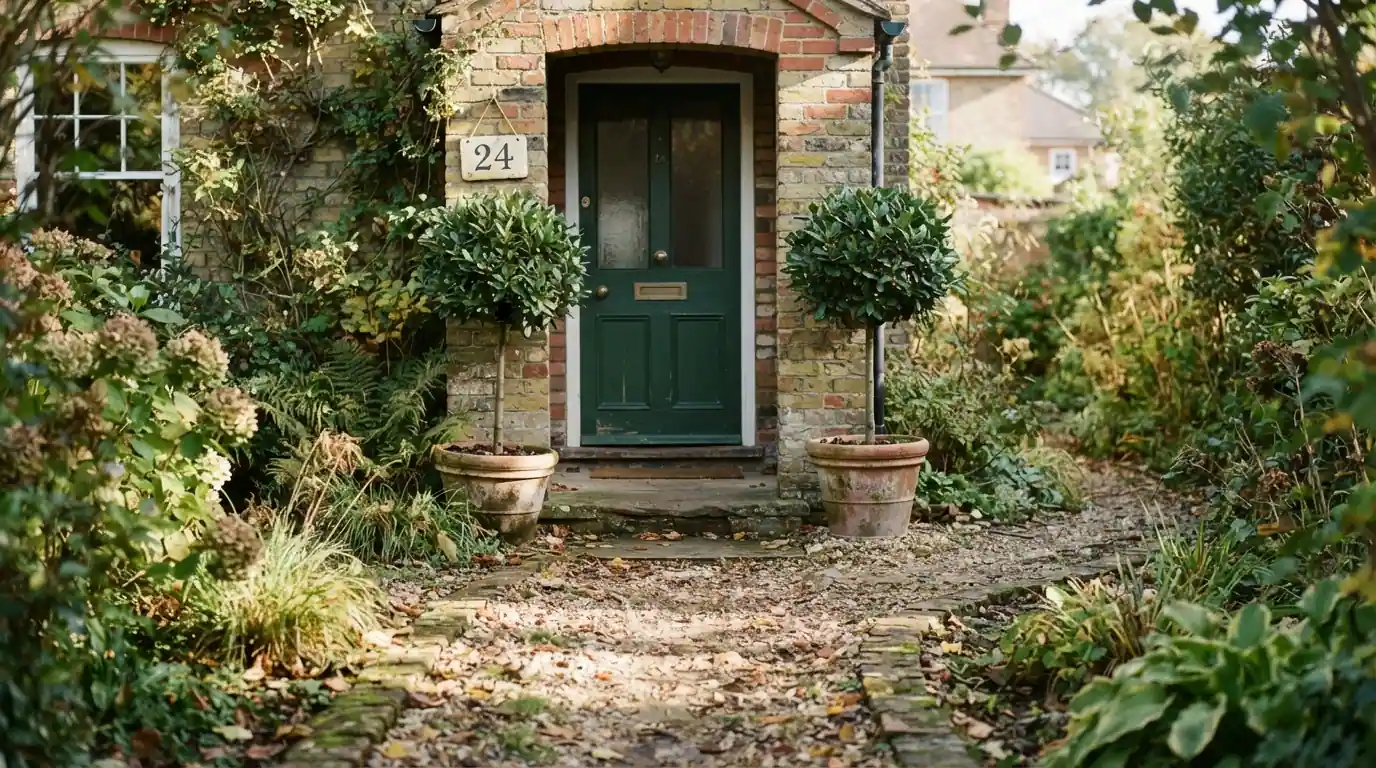
Your front door carries more weight for kerb appeal than almost any other single feature, since it sits at the centre of your home’s facade and is the first thing most visitors focus on. Dark tones like deep green, navy, or charcoal read as elegant and timeless, while a bold red brightens a plainer facade, and muted sage or pale blue suits a cottage or rural setting.
Door furniture matters here too. A polished handle, letterbox, and house number all contribute, and these details don’t have to sit on the door itself. Positioning a house number or nameplate on a nearby wall or fence post works just as well if your door design doesn’t suit added hardware. If you want to go further, adding a porch creates genuine drama at the entrance and doubles as extra storage, and in the UK a porch up to 3 metres in height and 3 square metres in floor area typically falls under permitted development, meaning you won’t need formal planning permission, though it’s worth double checking with your local authority before building.
2. Match Materials to Your Home’s Regional Style
Kerb appeal comes from more than a pretty garden. It comes from a front garden that actually looks like it belongs to the house behind it. UK regions historically built with whatever material was locally available, so a stone-fronted Cotswolds cottage and a red brick Victorian terrace call for genuinely different front garden materials to look intentional rather than mismatched.
This doesn’t mean you’re locked into a purely traditional look. Modern schemes that nod to local vernacular, whether through cladding choice or paving material, often read as more considered than either a strictly period pastiche or a jarringly contemporary scheme dropped into a traditional street.
3. Balance Evergreen Structure with Seasonal Colour
A front garden that looks good only in June and bare for the rest of the year undermines your kerb appeal for most of the year. Evergreen structure plants like boxwood, laurel, and yew hold shape and colour through winter, while seasonal layers on top, spring bulbs followed by summer perennials, keep the display changing without leaving gaps.
Colour choice matters more than most people realise here. Green and white planting combinations read as calm, unhurried colours that give visitors a moment to take in the approach to your home. Darker foliage, along with strong reds, purples, and silvers, tends to stimulate the eye more sharply and can feel slightly uneasy in large quantities, so these work best as small accents rather than the dominant palette. Variegated plants are similarly best used sparingly in a front garden, since their high visual activity can tip a small space toward looking busy rather than considered.
4. Choose a Boundary That Respects Height Rules
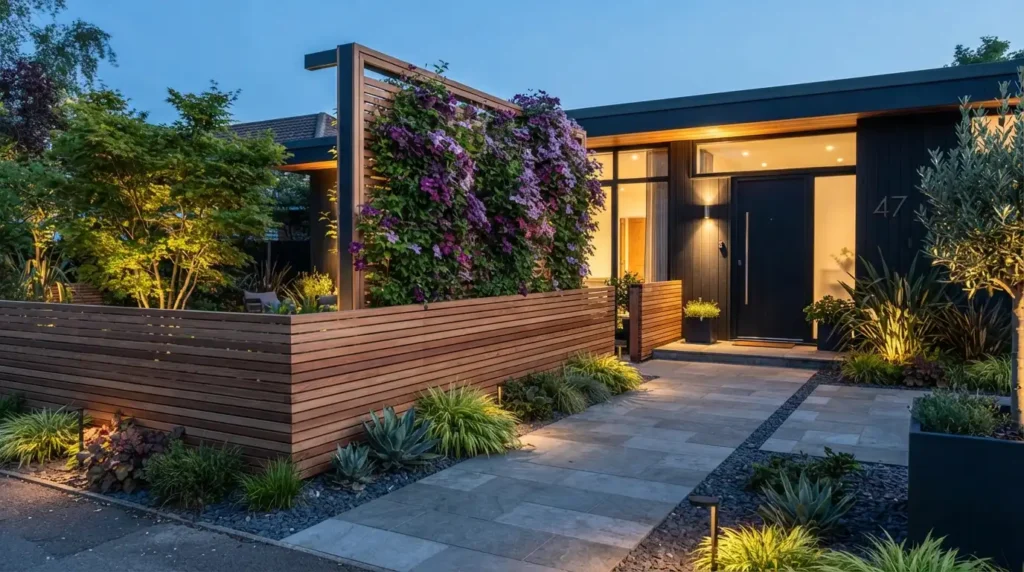
Front garden walls and fences do real work defining your property and adding privacy, but the rules genuinely differ from what applies to a back garden. In the UK, a boundary next to a highway used by vehicles is generally limited to 1 metre in height without planning permission, considerably lower than the 2 metre limit that applies to back garden fences under permitted development.
If you want more height or privacy than a 1 metre boundary allows, check with your local council on how they treat trellis specifically, since some authorities count trellis toward the total wall height, some treat it as temporary, and some only include it if it’s physically attached to the fence rather than freestanding. A freestanding trellis with its own support posts can sometimes offer a legitimate way around this limit while staying within the rules. For the boundary itself, solid timber panels give full privacy but can feel heavy from the street, while a wrought iron fence keeps sightlines open and reads as more elegant, particularly on period properties.
5. Create a Clearly Defined Pathway
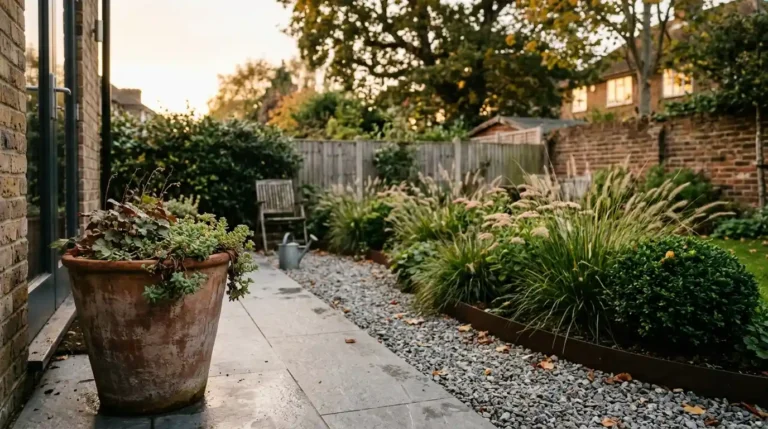
A neat, well-bordered path does more for kerb appeal than most people give it credit for, since a defined route to your door signals care in a way that a vague, unedged strip of paving never quite manages. Match the material to your house rather than choosing on price alone: natural sandstone or period-style tiles suit older properties, slate works well against a slate roof, and pebble paths fit naturally with coastal homes.
Bordering your path with gravel, brick, or a simple trimmed grass edge sharpens the whole look considerably, and it’s one of the cheaper upgrades on this list. Whichever material you choose, ongoing maintenance differs by type. Gravel needs occasional topping up and raking level, while paving slabs need weeding between joints and an occasional pressure wash to shift moss and algae buildup.
6. Get the Driveway Surface Right
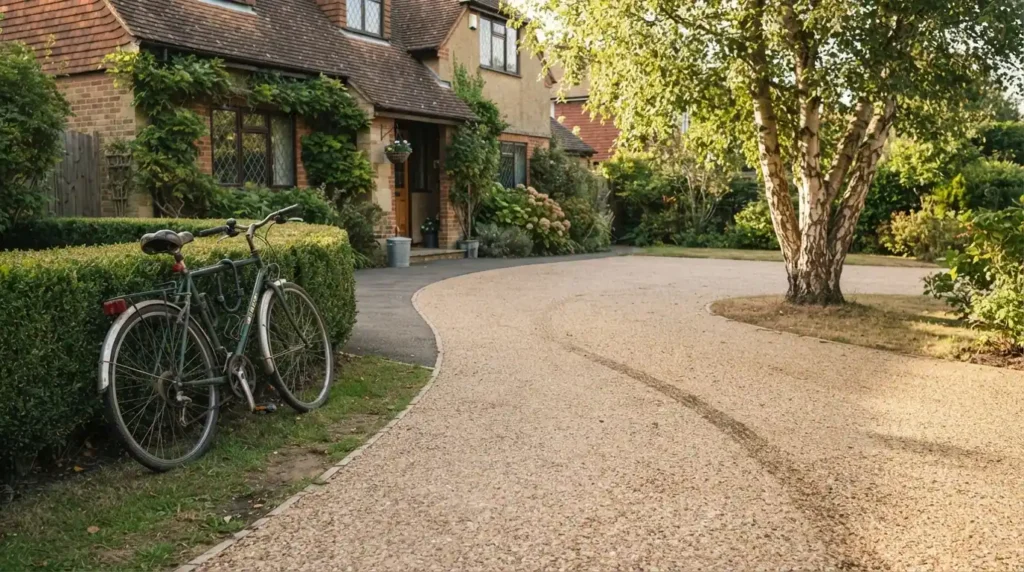
Your driveway typically takes up more visual space than any other single front garden element, so its surface material has an outsized effect on the whole approach. Block paving offers durability and pattern flexibility, resin-bound surfacing gives a sleek, weed-resistant finish that stays permeable for drainage, and natural stone delivers a premium, long-lasting look that suits traditional homes particularly well. Gravel remains one of the cheapest options and has the added practical benefit of crunching underfoot, which some homeowners specifically value as a low-cost deterrent against unwanted visitors approaching unnoticed.
A driveway on its own can look stark and slightly industrial no matter which material you choose, so softening the edges with a strip of lawn, a run of low box hedging, or a single well-placed tree keeps the space from feeling like a car park bolted onto a house. If you’re adding a new dropped kerb to create vehicle access, this typically needs separate permission from your local council, since it can affect underground utilities and pavement strength.
7. Add Symmetry Where the Entrance Calls for It
A balanced, symmetrical layout either side of the front door reads as considered and calm, and it’s a particularly forgiving design choice for anyone nervous about getting proportions wrong. Matching topiary balls, a pair of standard bay trees, or identical planted pots either side of the entrance all achieve this without much ongoing design judgement required once they’re in place.
This approach suits period and contemporary houses equally well. On a traditional facade it reads as classically formal, while on a clean-lined modern house the restrained repetition complements the architecture’s simplicity rather than competing with it.
8. Train Climbing Plants for Height Without Losing Ground Space
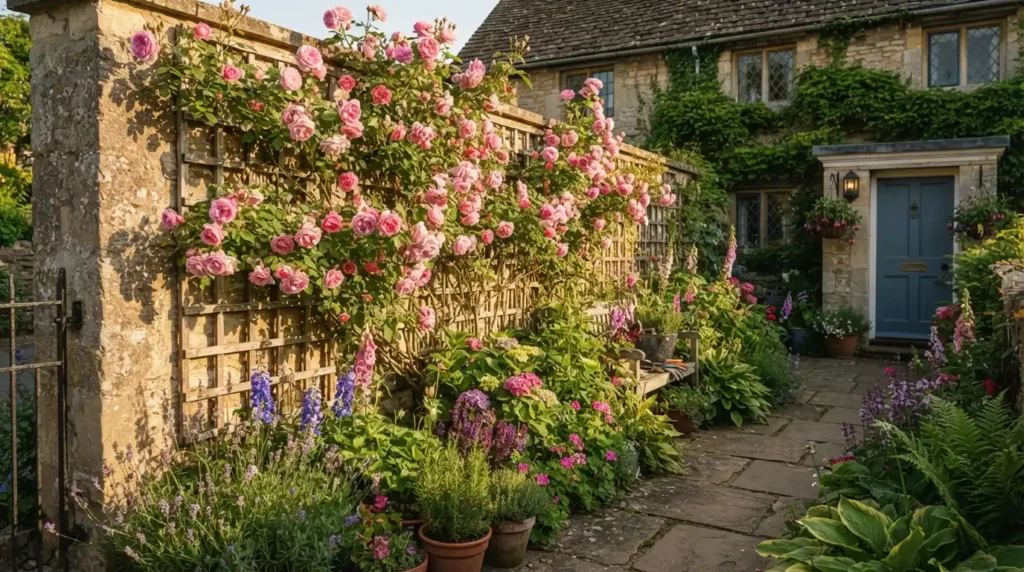
Climbing plants add genuine height and softness to a front garden without eating into limited border space, which makes them one of the most space-efficient upgrades available for smaller plots. Climbing roses and wisteria deliver classic countryside charm, clematis offers a huge range of flower colours and forms, and jasmine tolerates partial shade better than most other popular climbers.
You’ll need to give the plant something to climb. Wire and vine eyes screwed directly into masonry work well for a subtle, near-invisible support structure, while a simple wooden trellis suits a more decorative, cottage-style approach and can be positioned as an arch over a porch or doorway to frame the entrance as the plant matures.
9. Choose Low-Maintenance Planting If Weekly Upkeep Isn’t Realistic
Not every homeowner has time for a front garden that demands weekly attention, and that’s a genuinely reasonable constraint to design around rather than fight. Gravel beds suppress weeds and drain well, evergreen shrubs hold their look year round with minimal intervention, and hardy, drought-tolerant plants like lavender, hebe, and ornamental grasses need very little beyond an occasional trim.
Artificial grass removes mowing entirely if a lawn area is important to you visually, though real turf kept small and sharply edged is a reasonable middle ground for anyone who prefers the real thing. Raised planters also genuinely reduce effort, since containing soil in a defined bed makes weeding and watering noticeably quicker than tending an open border of the same size.
10. Add Colour Without Digging a Single Bed
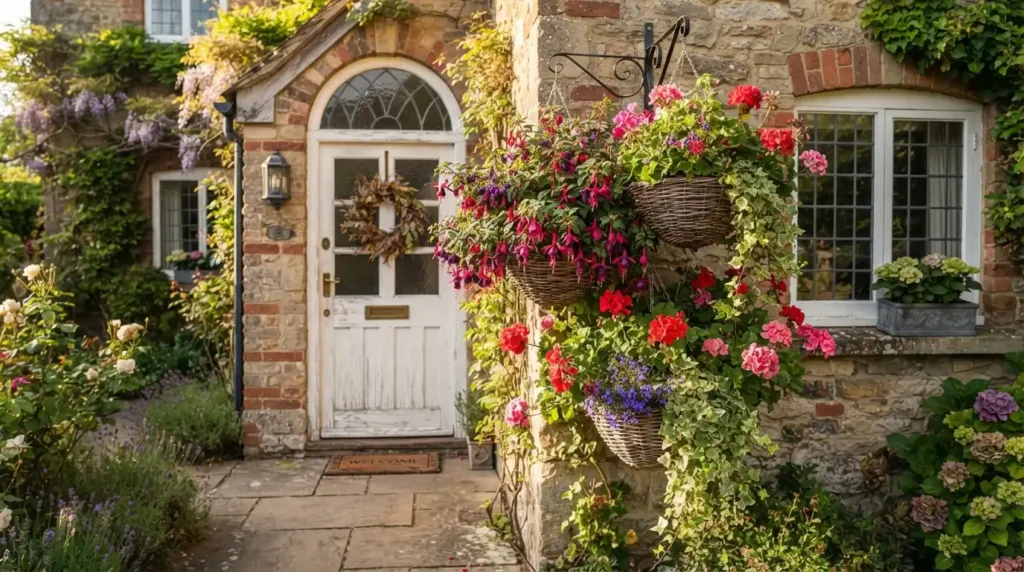
Pots, window boxes, and hanging baskets deliver immediate colour without committing to any permanent planting scheme, which makes them ideal for rented properties or anyone not ready to redesign their whole garden. Choosing perennials like geraniums, fuchsias, and dianthus for these containers is more budget-friendly over time than replacing bedding annuals every season, since perennials come back reliably year after year with basic care.
Hanging pots in particular work well for small front gardens, since they add height and visual interest without taking up any ground space at all, and clustering a few together at varying heights creates more impact than a single isolated basket.
11. Give Bins and Bikes a Dedicated, Discreet Home
Overflowing bins or bikes leaned against a wall undercut even a beautifully planted front garden, and this is one of the most overlooked fixes on this list precisely because it’s unglamorous. A simple timber bin store, whether bought ready-made or built as a weekend DIY project, keeps collection day clutter out of sight while still being easy to access.
If you’re planning a more substantial front garden project, check whether your local council requires bike or bin storage to be included in any formal planning application you submit, since some authorities do specify this for larger schemes. Screening a storage unit with climbing plants or positioning it discreetly to the side of the property both work well if you’d rather not make a design feature of it.
12. Light the Approach for Safety and Evening Kerb Appeal
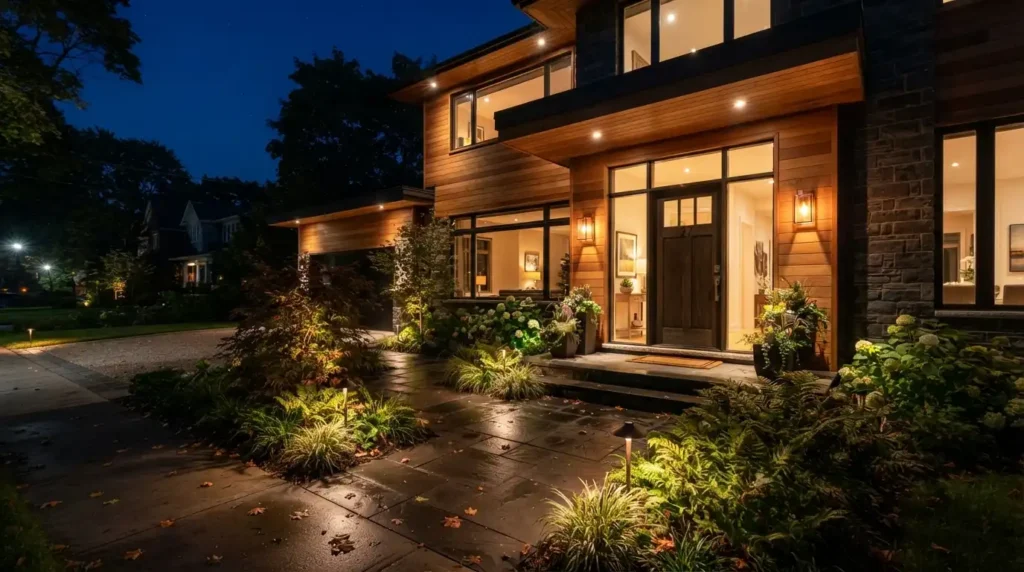
Outdoor lighting extends kerb appeal into the evening, when a genuinely well-designed front garden without lighting simply disappears from view after dark. Path lights guide visitors safely to your door, wall lights can pick out architectural details or brickwork texture, and uplighting on a specimen tree or shrub creates a dramatic focal point after dusk.
Beyond aesthetics, motion-sensor lighting adds a real security benefit, since an automatically lit approach discourages loitering and helps you see who’s at the door before you open it. Warm-toned bulbs generally suit a front garden better than cool white light, which can feel clinical against soft planting and natural materials.
13. Keep the Building Fabric in Good Repair
[EXPERTISE DEPTH HERE] No amount of good planting compensates for a roof with cracked tiles, peeling render, or crumbling brickwork, since these elements sit at eye level and register instantly, even subconsciously, as neglect. Clay roof tiles genuinely improve with age, developing a natural patina and colour depth that concrete tiles don’t replicate, since concrete tiles rely on a surface coating that tends to fade and wear within a couple of decades rather than weathering gracefully.
Repointing brickwork where mortar has cracked or crumbled typically costs a modest amount per square metre for a straightforward job, though prices vary considerably by region and how much scaffolding or access work is involved, and it protects the building fabric from damp while also sharpening the visual texture of the wall. Rainwater goods are worth checking too. PVCu guttering and downpipes are the cheapest and easiest to install, while cast iron and copper suit heritage properties specifically and hold their character for decades, albeit at a considerably higher cost than PVCu. For windows, genuine timber frames can often be repaired and repainted rather than replaced if the underlying wood is sound, which is typically far cheaper than a full replacement, though severely rotted frames or single-glazed units nearing the end of their life are usually more cost-effective to replace outright once you factor in energy performance and the ongoing cost of repeated repairs.
14. Add Privacy Screening Without Blocking All Natural Light
Privacy screening matters for most front gardens, since they sit directly facing a public street, but evergreen trees and shrubs used too heavily can noticeably reduce light into your front-facing rooms. Choosing selectively, rather than defaulting to a solid evergreen hedge along the whole boundary, protects both privacy and daylight.
Pleached trees, most commonly hornbeam, trained to a specific height and shape on a raised, clear stem, offer one of the more elegant workarounds for anyone hitting the front garden fence height restriction, since a pleached screen effectively creates a green wall well above the 1 metre boundary limit without counting as a fence under most planning definitions. Deep, mixed borders combining small trees, shrubs, and herbaceous planting also genuinely help buffer traffic noise from a busy road, and certain species, such as alders or London plane trees, are recognised for helping filter urban air pollution in heavily trafficked settings.
15. Turn the Front Garden Into Genuinely Usable Space
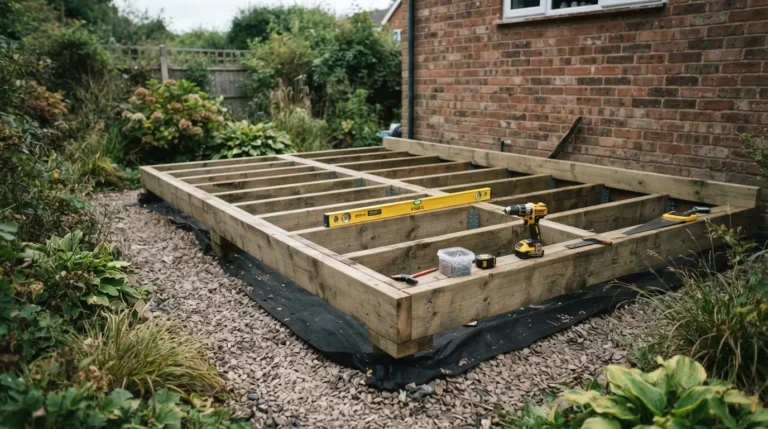
A front garden doesn’t have to be purely ornamental. Raised decking with a bench or porch swing, paired with weatherproof furniture, gives you somewhere to actually sit rather than just walk past, and it works particularly well on properties where the back garden is smaller or more overlooked than the front.
A water feature adds a genuinely calming sensory element to a front garden, greeting you with the sound of moving water as you arrive home, though it does need occasional cleaning and a power source if it’s pump driven. Front garden furniture more generally works best when it doesn’t obstruct the main pathway or overwhelm a small space. A single bench or a compact bistro set reads as an inviting addition, while overcrowding the space with furniture undercuts the same kerb appeal you’re trying to build.
Front Garden Improvement Cost and Effort Comparison
| Improvement | Approximate Cost | Ongoing Effort |
| Repaint front door | Low | Low, occasional touch-up |
| Add pots and hanging baskets | Low to moderate | Moderate, regular watering |
| Gravel path or bed | Low to moderate | Low, occasional topping up |
| Timber bin store | Moderate | Very low |
| Path or wall lighting | Moderate | Low, occasional bulb changes |
| New boundary fence or wall | Moderate to high | Low to moderate |
| Block paving or resin driveway | High | Low |
| Repointing brickwork | Moderate to high | Very low once done |
| Full front garden landscaping redesign | High | Varies by planting choice |
These figures vary considerably by region, property size, and whether work is DIY or professionally installed, so treat them as a general guide for comparing relative scale rather than a fixed quote.
Common Front Garden Mistakes Worth Avoiding
The most common mistake is choosing planting or hard landscaping based purely on how it photographs rather than how much upkeep it actually demands. A common trade-off worth knowing: older buyers or residents often find front steps and high-maintenance planting off-putting, while younger buyers tend to be put off by overly formal, labour-intensive schemes, so a front garden pitched too far in either direction can narrow its own appeal.
The second frequent issue is neglecting maintenance on the building itself while investing heavily in plants and paving. A gorgeous border in front of a peeling front door or cracked render draws the eye to the contrast rather than the garden, so tackling both together, or at minimum in the right order, gets far better results than focusing entirely on soft landscaping.
Conclusion
The best front garden ideas work together rather than in isolation. A freshly painted door loses its impact next to an overgrown, unedged path, and a beautifully planted border can’t compensate for cracked render or a chaotic bin situation. Start with the building fabric and boundary rules, layer in planting that suits your maintenance appetite and your home’s actual style, and finish with the lighting and furniture that make the space feel genuinely used rather than just looked at. Get that order right, and your front garden ends up boosting kerb appeal in every season, not just the one it happened to be photographed in.
FAQs
Do front garden improvements actually increase property value?
Yes, a well-maintained front garden consistently influences buyer interest and perceived property value, since it forms the first impression before anyone views the interior.
What is the best low-maintenance front garden idea?
Gravel beds combined with hardy, drought-tolerant planting like lavender, hebe, and ornamental grasses require minimal ongoing care while still looking considered year round.
Do I need planning permission for a front garden wall or fence?
In the UK, a boundary facing a highway is generally limited to 1 metre in height without planning permission, compared to 2 metres for back garden boundaries, so checking this before building matters.
How can I add privacy to my front garden without blocking all the light?
Selective evergreen planting, pleached trees trained above the fence height limit, or a deep mixed border all add privacy without the light loss that a full solid evergreen hedge can cause.
What front garden improvements make the biggest difference on a budget?
Repainting the front door, adding defined path edging, and cleaning up bin storage typically deliver the most visible improvement relative to their cost.
Should I match my front garden style to my house’s architecture?
Yes, using local or regionally appropriate materials and matching plant choices to your property’s era generally reads as more considered than an unrelated style dropped in regardless of the house behind it.