How to Choose Living Room Curtains That Work with Your Decor

Living room curtains have to do several jobs at once: frame the window, control glare and privacy, and sit comfortably with the sofa, floor and wall colour that are already fixed. The practical route is to decide the light and privacy level first, measure the pole or track properly, then choose fabric and heading that match the existing room rather than fighting it. Most problems come from buying too narrow, too short, or the wrong weight for the hardware already in place.
Start by noting which way the window faces and how the room is used in the evening. A street-facing sitting room needs better night-time coverage than one that looks onto a garden. Once those points are clear, the rest of the choices become narrower. Our Windows & Doors section has related guides on measuring and fabric.
Decide the Light and Privacy Level First
Living rooms are rarely used only in daylight. If the window faces the street or a close neighbour, you will want something that gives proper coverage once the lights are on. Light-filtering linen or cotton softens the day but shows silhouettes at night. Room-darkening or blackout-lined options reduce that without making the room feel heavy during the day if you choose a lighter face fabric.
Thermal linings help on single-glazed sash windows common in older UK houses, cutting the draught without changing the look from inside. Check the product description carefully: thermal does not automatically mean blackout, and blackout does not always mean the fabric is heavy. Order a sample and hold it up at the window at different times of day.
Measure the Pole or Track, Not the Window
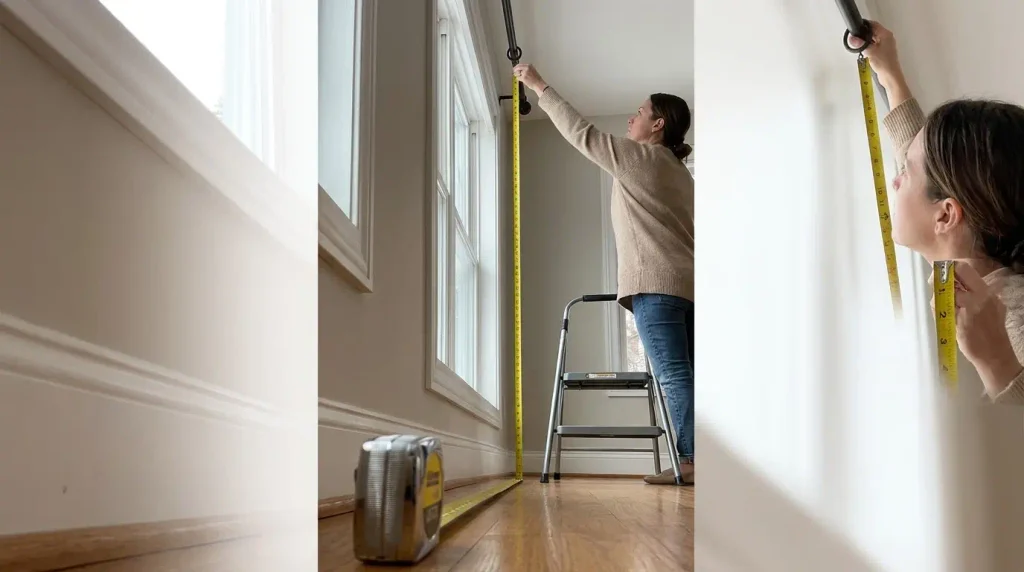
The finished curtain width is based on the pole or track length, not the glass. For a full look, plan for total fabric of roughly 1.5 to 2.5 times that length depending on the heading. Eyelets and tab tops need less fullness; pencil and pinch pleats need more. Measure the drop from the hanging point (top of pole for eyelets, eye of the ring for pleated styles) to the floor in three places and take the shortest so the hem clears the floor by 1 to 2 cm. How to measure for curtains correctly walks through the exact points to take.
Extend the pole 15 to 20 cm beyond the frame on each side where the wall allows, so the curtains stack clear of the glass when open. In a bay, measure each section separately. Ready-made sizes often stop at 229 cm drop; anything taller usually needs made-to-measure.
Match the Fabric Weight and Colour to the Room
Medium-weight linen or linen blends suit most living rooms and soften strong sunlight without feeling formal. Heavier velvet or chenille works if the room already has dark furniture or if you want more sound absorption on hard floors. Avoid very pale fabric on a north-facing window if the room already feels cool; a warmer neutral or soft green holds better.
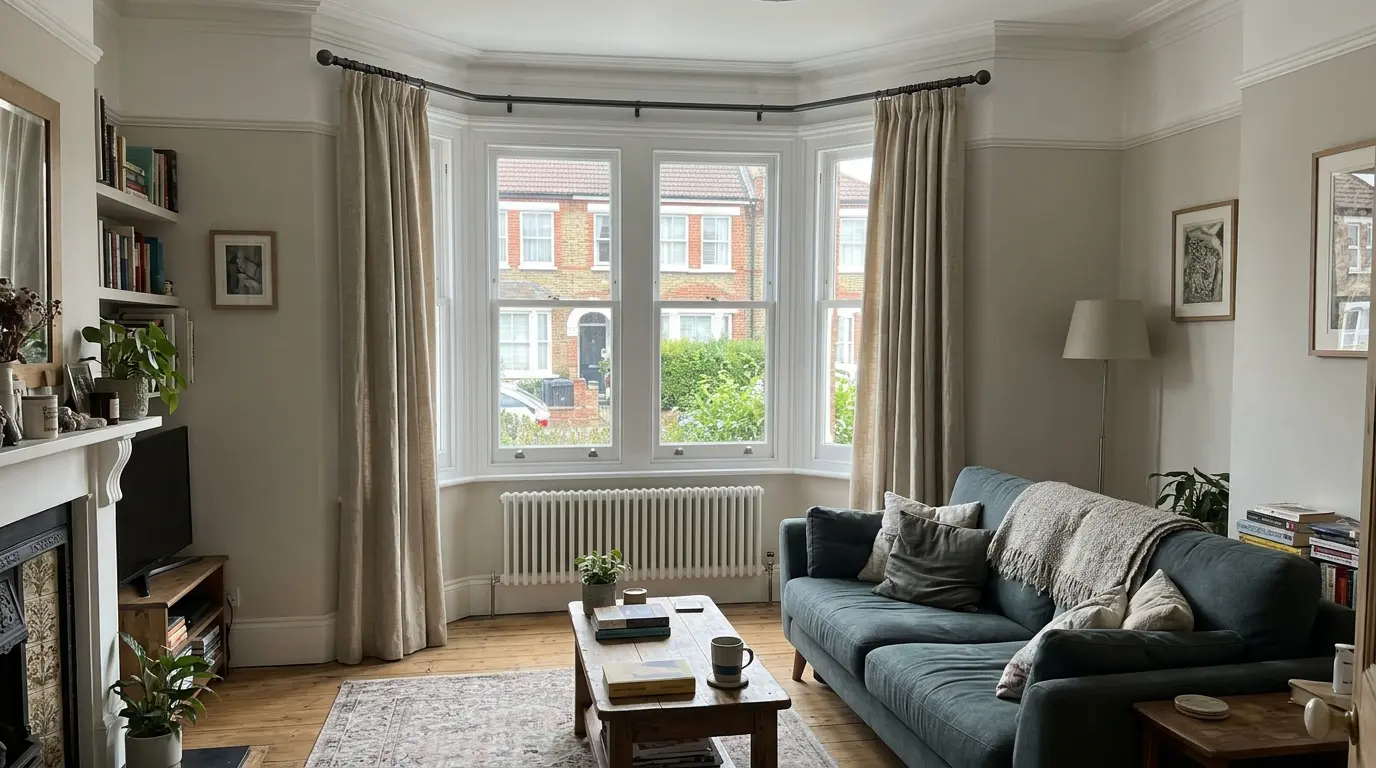
Test the colour against the wall and the sofa in both daylight and evening light. Pattern should be used sparingly if the rest of the room already has strong prints on cushions or a rug. Our guide on how to choose the best curtain fabric for every room covers the practical differences between pure linen, blends and heavier cloths.
Choose a Heading That Works with Your Existing Hardware
If you already have a pole, eyelet or tab-top curtains are the simplest. Pencil or pinch pleat need rings or a track. Wave headings require a compatible track and give very even folds, which suits modern rooms. The heading also changes the measuring point for the drop, so decide it before you order.
Heavy curtains need solid brackets fixed into masonry or with suitable plasterboard anchors. Check the weight rating on the pole before hanging lined pairs. In open-plan living rooms that share space with a kitchen, a simpler heading and washable fabric is usually more practical than a formal pinch pleat.
Layer if the Room Needs Both Daylight and Night Privacy
A sheer or light-filtering curtain on a slim track close to the glass, plus a heavier outer pair, solves most street-facing living rooms. The sheer stays closed during the day for privacy and glare control; the outer curtains close at night. Make sure both finish at a similar drop so the layers look intentional.
This also works if you have a radiator under the window: the outer curtains can be sill-length or just below, while the sheer covers the glass.
Common Mistakes to Avoid Before Ordering
Buying panels that only equal the window width leaves the curtains looking sparse once open. Ignoring the drop on uneven floors leads to hems that drag or float. Choosing an unlined pale fabric for a south-facing window can mean rapid fading. Forgetting to check window handles or the depth of the recess if you also plan a blind underneath causes the two treatments to fight.
Order samples of both the face fabric and any lining, and live with them in the room for several days. Confirm the pole diameter and whether the brackets can take the weight. In older properties check for draughts around the frame; a well-fitted curtain with a thermal lining can make a noticeable difference without secondary glazing. If the living room opens onto a kitchen or dining area, choose a fabric that can be wiped or washed easily rather than a delicate pure linen that marks.
Consider the Floor, Radiator and Furniture Clearance
If a radiator sits under the window, floor-length curtains can trap heat. In that case finish the curtains just below the sill or use a separate blind for the glass and keep the curtains as dressing only. Check the swing of any patio doors or the path of a sofa so the curtains do not catch when drawn. In open-plan rooms the same fabric can continue onto adjacent windows so the whole space feels connected rather than a collection of different treatments.
Hard floors show more dust at the hem, so a 1 to 2 cm clearance is practical. Soft carpet can hide a slightly longer drop, but still avoid a deep puddle that becomes a trip hazard.
Conclusion
Living room curtains work best when the light, privacy and measuring decisions are made before the colour or pattern. Match the weight and heading to the hardware and the way the room is used, and the fabric will sit properly with the rest of the decor rather than looking like an afterthought.
What fullness do living room curtains need?
Between 1.5 and 2.5 times the pole or track width. More for formal pleats, less for eyelets or tab tops.
Should living room curtains touch the floor?
Finishing 1 to 2 cm above the floor is the most practical for everyday use. Measure in three places and use the shortest drop.
Do I need blackout curtains in a living room?
Only if the window faces a busy street or strong lights and you use the room after dark. A room-darkening lining is often enough.