12 Bedroom Curtain Ideas for the Perfect Window Dressing

Bedroom curtain ideas need to do two jobs a living room’s never has to: look good and genuinely help you sleep. The 12 ideas below cover the styles worth considering, along with the real hanging technique and light-control detail that most general curtain roundups skip because they’re written for any room, not specifically the one where poor light control actually costs you sleep.
1. Floor-to-Ceiling Drapes to Add Height and Drama
Hanging curtains from as close to the ceiling as possible, rather than just above the window frame, and letting them fall fully to the floor, is the single most reliable trick for making a bedroom feel taller and more finished. It works in almost any style, from a soft, relaxed drape to a more structured pleat, and it’s a change you can make to existing curtains simply by rehanging the pole higher, without buying anything new. Some newer builds set the curtain track into a ceiling recess so the fabric falls in one continuous line with no visible pole at all, a genuinely striking, hotel-like effect if you’re planning from scratch, though it needs to be built in at the construction or renovation stage rather than retrofitted easily.
2. Layer Sheer and Blackout for Day-and-Night Flexibility
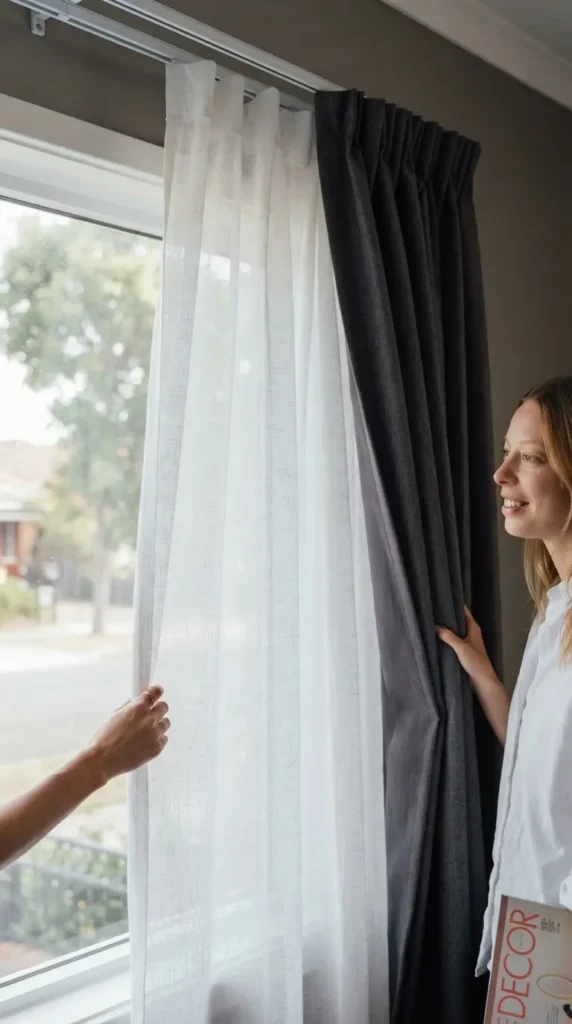
Pairing a sheer curtain with a separate blackout layer behind it solves the one genuine conflict bedroom windows create: wanting soft, diffused light during the day and near-total darkness at night. Run them on a double track or two poles, sheer at the window, blackout further out, so you can adjust light levels through the day rather than living with one fixed level of brightness whether you want it or not. This setup also gives you a genuinely useful middle ground on evenings when you want to keep some soft, diffused daylight coming in without full darkness yet, closing just the sheer layer and leaving the blackout curtain open at the sides.
3. A Wide Pole to Make a Window and Room Feel Bigger
Extending your curtain pole well beyond the window frame on each side, rather than fitting it tightly to the window itself, lets the curtains stack back fully off the glass when open, showing more of the window and letting in more light. This is one of the most reliable tricks for making a small bedroom or a narrow window feel more generous, and it costs nothing beyond a slightly longer pole than you might have defaulted to.
4. Rich Velvet for Warmth and a Sense of Luxury
Velvet curtains bring genuine warmth, both visually and in terms of insulation, since the dense weave naturally blocks more draught and light than a thinner fabric. They suit a darker, more atmospheric bedroom particularly well, and the fabric’s natural weight tends to hang with a fuller, more structured fold than lighter materials. The trade-off: velvet shows dust more visibly over time than a smoother weave, so it’s worth a more regular vacuum with an upholstery attachment to keep it looking sharp. Velvet is also almost always a dry-clean-only fabric once it’s fully lined, which is worth factoring into the ongoing cost of the curtains rather than a one-off purchase decision, particularly if the room sees any cooking smoke or smoking nearby that might need more frequent cleaning than a lighter fabric would.
5. Linen or Linen-Mix for a Relaxed, Natural Look
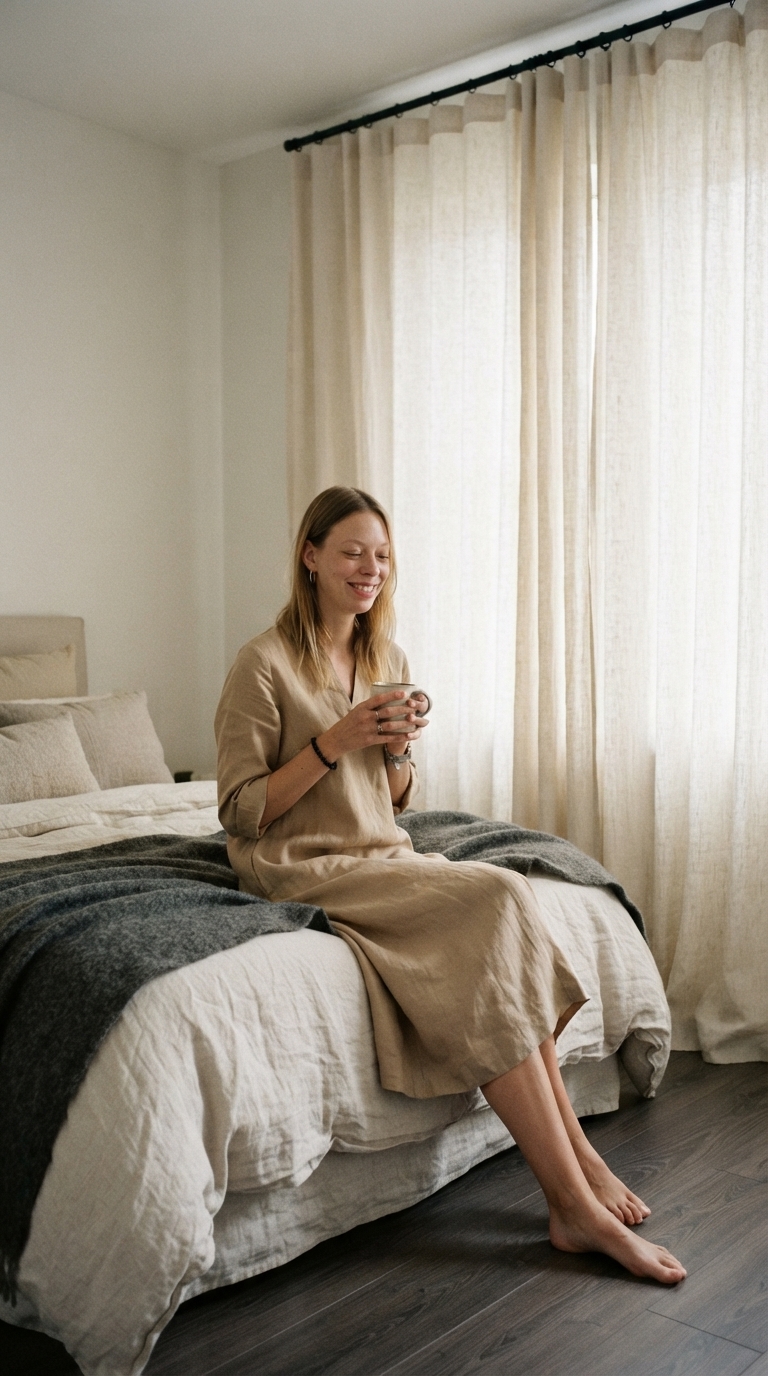
Linen curtains bring a softer, more relaxed feel than velvet or heavier cotton, with a natural texture that suits a calmer, pared-back bedroom particularly well. A linen-cotton mix is worth considering over pure linen if you want some of that natural texture with a bit more structure and less of the creasing pure linen is known for. On their own, linen curtains are fairly sheer, so they’re a better pairing behind a proper blackout layer than a genuine light-blocking solution on their own. Linen also creases more visibly than most synthetic or cotton blends, which some people genuinely like as part of the relaxed look, and others find looks unkempt, so it’s worth seeing a real sample hung and left for a few days before committing to a full set if a crisper finish matters to you.
6. A Bold Print as the Room’s One Statement Layer
A patterned curtain, botanical, geometric, or a bold check, works best as the room’s single loud element, with everything else, walls, bedding, rugs, kept in more subdued, complementary tones. This keeps even a genuinely bold print from tipping the room into visual chaos, and it’s worth choosing a print where the background tone is close to your wall colour, so the pattern reads as a deliberate feature rather than a clashing addition. A room can actually hold more pattern than people expect, several different prints across cushions, art, and curtains can still look calm together, provided the underlying tones stay in the same subdued family rather than mixing genuinely competing colour temperatures.
7. Curved Track for a Bay Window or Alcove
A bay window or a curtain track built into an alcove needs a curved or bendable track rather than a straight pole, so the curtain can follow the wall’s shape and actually close fully without gaps at the corners. This is a genuinely underused idea outside of period properties, but it works just as well in a modern bay, and it solves the common frustration of a straight pole leaving an awkward, undraped triangle of glass at each end. Measuring and fitting a curved track is a more involved job than a standard straight pole, since it needs to follow the exact angles of the bay, so it’s worth having it professionally measured and fitted rather than guessing at a DIY bend, particularly if blackout-lined curtains are going on it, since the added weight makes a poorly fitted curve more likely to sag over time.
Coloured or Blackout-Lined Curtains for Genuine Light Control
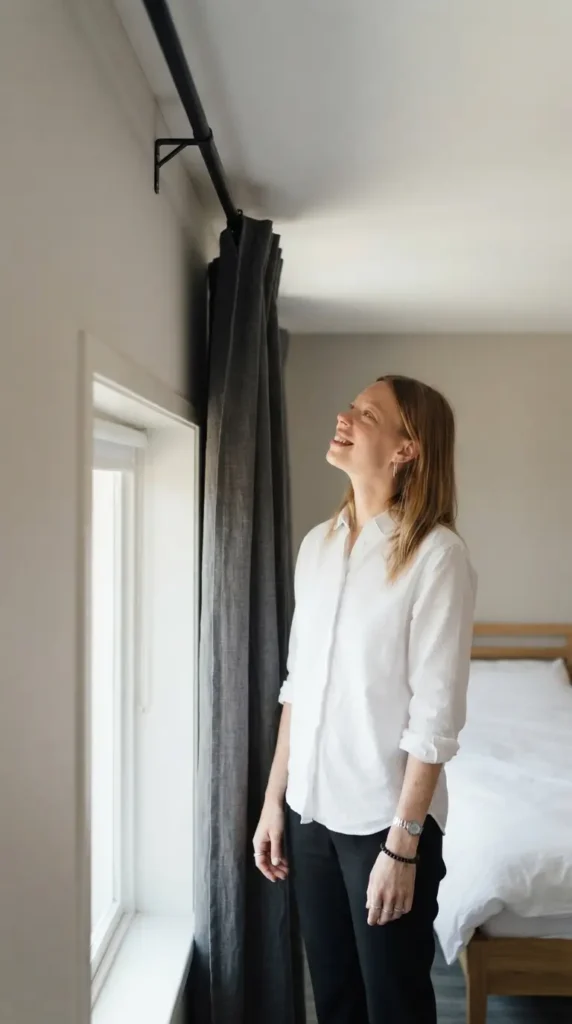
A proper blackout lining, not just a heavy fabric, is what actually blocks light, and it’s worth checking the lining quality specifically rather than assuming a dark or thick-looking curtain will do the job on its own. Extend the pole roughly 15-20cm above the window trim and the same distance beyond each side, this single adjustment does more to stop light leaking around the edges than almost any other change. Some blackout linings also come in a coloured facing, grey or black rather than the standard white or cream, which is worth considering if you want the lining itself to disappear against a darker curtain fabric rather than showing through as a pale edge. A well-fitted hook-and-eye catch on the wall, positioned where the outer edge of the closed curtain naturally sits, closes off the last stubborn gap of light along the sides that even a well-extended pole sometimes leaves, a small, inexpensive fix worth adding once the curtains are up if any light still creeps in.
9. A Dark Curtain Pole as a Deliberate Design Line
Swapping a plain or matching pole for one in a contrasting dark finish, matte black or bronze against a pale curtain, turns the hardware itself into a design detail rather than something you’re meant to ignore. It draws a clean horizontal line across the top of the window, which works particularly well in a room with otherwise soft, neutral tones that could use one confident, graphic element.
10. Coordinate, Don’t Match, Your Curtains to Bedding
Curtains that share a colour family or a similar mood with your bedding, rather than an exact fabric match, tend to look more considered and less like a matching set bought in one trip. Treat your bedding as the room’s main event and let the curtains pick up one supporting thread of colour from it, this gives you far more freedom in fabric and pattern than trying to find a curtain that matches a specific duvet cover exactly.
11. Wooden Shutters as a Curtain Alternative for a Period Room
Shutters aren’t curtains, but they’re worth considering as an alternative or a companion in a period property, offering privacy and light control with a cleaner, more architectural look than fabric alone. They cost more upfront than a standard curtain, and white tends to be the safer long-term choice over a bolder colour, since a shutter is a much longer-term, harder-to-change commitment than swapping out a curtain.
12. Check Pole Weight and Fabric Care Before You Commit
This is the detail most curtain guides skip, and it’s the one that decides whether idea eight actually works long-term. Blackout-lined curtains are genuinely heavier than sheer or unlined fabric, so confirm your pole or track is rated for the weight before hanging a full-length, fully-lined pair, a rail that sags under the load will need replacing sooner than the curtains themselves. Most heavier, lined curtains are also dry-clean only rather than machine washable, so factor that ongoing cost into the decision if you’re choosing between a few different fabric weights. A well-made pole rated for the load will hold a full-length blackout pair without sagging for years, but a lightweight or decorative-only pole pushed beyond its rating is one of the more common, avoidable disappointments in an otherwise well-planned bedroom curtain project, worth checking the manufacturer’s weight rating against your chosen fabric before you order rather than after the curtains arrive.
Final Thoughts
The best bedroom curtain ideas balance how the window looks with how well it actually helps you sleep, a distinction most general curtain guides never make because they’re not written specifically for the one room where light control genuinely matters most. Choose the fabric and style you love, then get the hanging height, pole width, and lining right, and the curtains will do their job properly as well as looking finished. Get the practical details sorted first and the styling choices, colour, pattern, texture, become the easy part rather than something you’re compromising on to fix a light leak or a sagging pole later.
FAQs
Do bedroom curtains need to be blackout?
Not always, but a genuine blackout lining makes a real difference for light-sensitive sleepers, shift workers, or anyone with streetlights or early sunrise light reaching the window. Pairing a sheer layer with a separate blackout layer gives you the flexibility of both rather than committing to one fixed level of darkness.
How wide should a curtain pole be for a bedroom window?
Extend the pole at least 15-20cm beyond each side of the window frame, and slightly higher than the frame itself, so curtains can stack back fully off the glass when open and light leak is minimised when closed.
Should curtains match the bedding?
No, coordinating is generally more effective than matching exactly. Pick up one colour or tone from your bedding rather than trying to find an identical fabric, which gives you more flexibility and tends to look more intentional.
Can I combine curtains and blinds in a bedroom?
Yes, this is a genuinely practical combination, particularly a blackout blind paired with a lighter curtain, giving you a two-in-one solution for both privacy and full darkness when needed, and a softer look during the day.
How do I stop light leaking around blackout curtains?
Extend the pole well beyond the window frame on both sides and above the top, and consider a hook-and-eye fitting at the outer edge of each curtain to hold the fabric close to the wall, both genuinely reduce the light gaps a straight, tightly-fitted pole leaves behind.
Are linen curtains good for bedrooms?
Linen brings a relaxed, natural texture but is fairly sheer on its own, so it works best paired with a proper blackout layer behind it rather than relied on alone if genuine light control matters to you.