7 Dark Paint Ideas for a Dramatic Living Room

These 7 dark paint ideas for a dramatic living room are soft black, deep navy, forest green, warm charcoal, bronze brown, burgundy and a fully drenched scheme where walls, ceiling and woodwork share one colour. Pick a shade with warm or soft undertones, test it in your own light, and layer your lighting before you open the tin.
Most people hesitate because they fear a cave: a gloomy room that swallows every lamp. The fear is fair, but the problem is rarely the colour. It is usually poor lighting, a flat scheme and no contrast. Get those right and a dark painted living room feels closer to a boutique hotel than a basement.
What Counts as a Dark Paint Colour?
A dark paint colour has a light reflectance value, or LRV, of roughly 2 to 10, where 0 is black and 100 is white. Medium-dark shades sit around 11 to 20. LRV tells you how much light a colour bounces back, so it predicts how heavy a shade will feel in your room.
A living room with one small window usually copes better with a medium-dark shade, such as Sherwin-Williams Gauntlet Gray (LRV 17) or Benjamin Moore Knoxville Gray (LRV 14). A bright room can carry the full dark band, like Iron Ore (about 6) or Hale Navy (about 8). Brands usually publish the LRV on each colour page, so check before you buy. Perception varies too, so treat the number as a guide, not a guarantee.
1. Soft Black for Maximum Drama
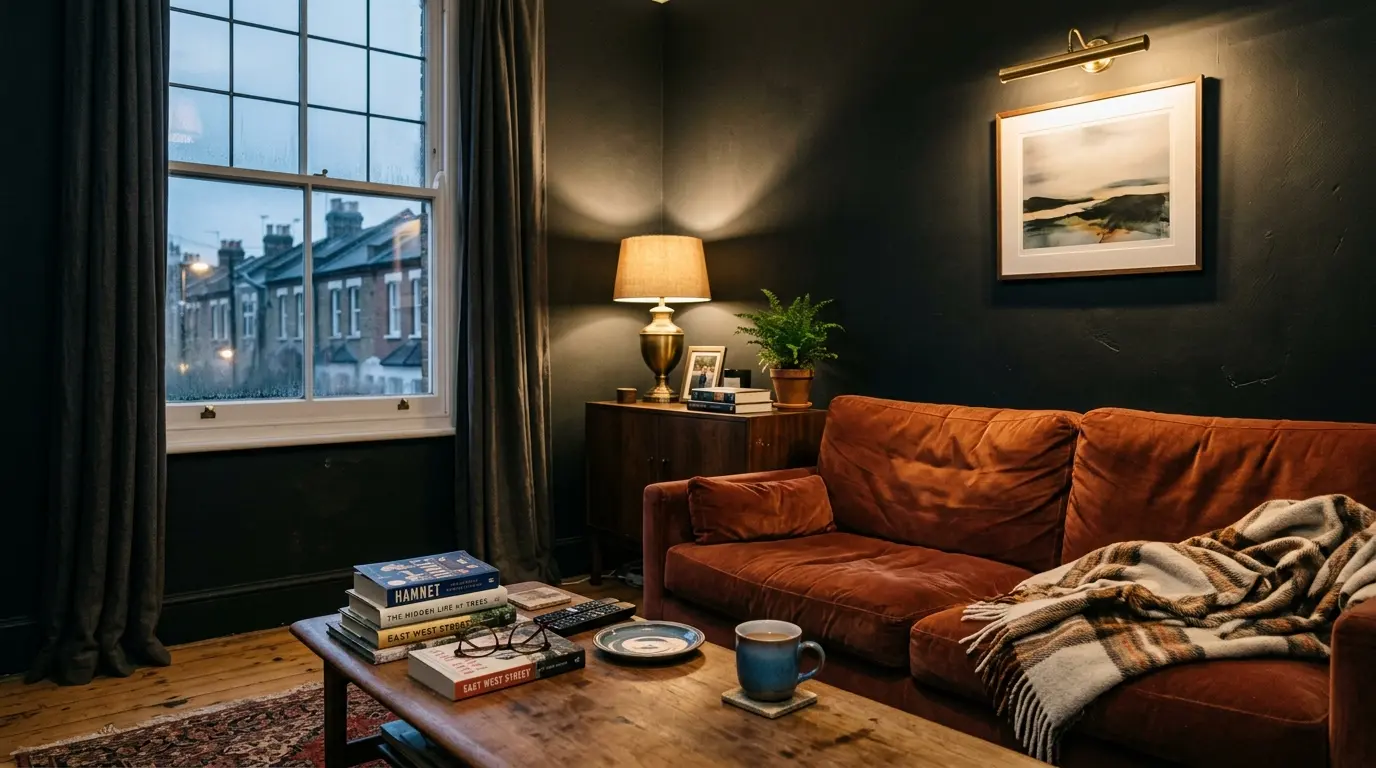
Soft black gives you the drama of black without the hard edge. Shades such as Farrow & Ball Off-Black or Sherwin-Williams Iron Ore read as deep charcoal with warm or green-tinged undertones, so they feel enveloping rather than harsh. They suit rooms with decent daylight, a fireplace or strong architecture.
This is the strongest moody living room paint choice, and it needs contrast to work. A warm white on the trim sharpens the edges, while brass, aged wood and a pale rug give the black something to push against. If you like the idea, compare several blacks side by side. Farrow & Ball alone offers Pitch Black, Hopper Head and Off-Black, and each reads differently.
The trade-off is upkeep. Black shows dust, pale scuffs and fingerprints faster than any other dark shade, so choose a washable matt finish and keep a labelled tin for repairs.
2. Deep Navy for a Classic Look
Deep navy is the safest first step into a dark colour living room because it still reads as colour, not just shadow. Benjamin Moore Hale Navy has an LRV of about 8, while Sherwin-Williams Cyberspace is greyer and calmer. Pair either with brass, tan leather and crisp white trim.
Choose carefully if light is limited. Cyberspace can look almost black when daylight is weak, and very greyed blues can fade in a dim room. Hale Navy holds its blue better. If you want something closer to black, Farrow & Ball Railings is a deep, almost black blue.
Navy looks sharp by day, but under cold white LEDs it can feel chilly in the evening. Warm white bulbs fix that for a few pounds.
3. Forest or Pewter Green for a Grounded Feel
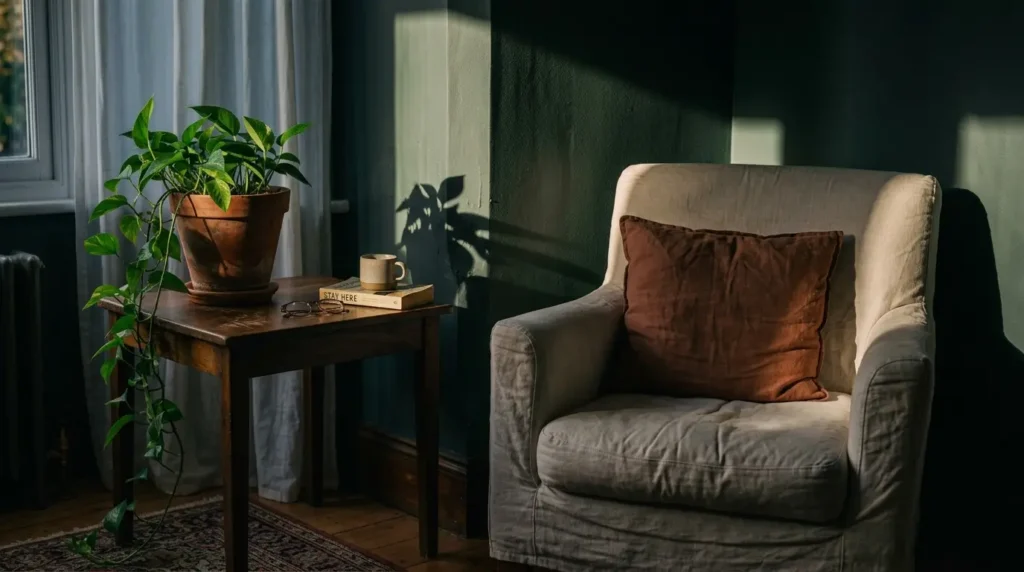
Dark green feels natural and restful, which is why it works so well in a dark painted living room. Sherwin-Williams Pewter Green (LRV 12) is a forgiving starting point, while Benjamin Moore Black Forest Green is a darker, earthier option. Both sit well with walnut, terracotta, cream and soft grey.
If you want more blue in the mix, Benjamin Moore Gentleman’s Gray is a very dark teal. For a more olive, brown-leaning green, Sherwin-Williams Cast Iron fits the brief. Green is also one of the better choices for rooms with little daylight, because it reads restful rather than heavy.
Check your bulbs before you commit. Warm yellow light can push green towards olive, so judge the colour at night as well as at noon.
4. Warm Charcoal Grey for a Flexible Backdrop
Charcoal grey suits most homes because it works with modern flats and period houses alike. Choose a warm version, such as Sherwin-Williams Gauntlet Gray (LRV 17) or Benjamin Moore Gray 2121-10 (LRV 11.5), if your room gets limited light. Cooler, bluer charcoals look crisper but can feel cold after dark.
Undertones decide the result. Sherwin-Williams Grizzle Gray shows a noticeable green, and Benjamin Moore Stormy Sky leans violet-blue. Farrow & Ball Down Pipe is another option to sample. Warm greys pair well with ochre, blush and cream.
A good rule of thumb: grey is the easiest dark shade to match with furniture you already own, so it is a sensible pick if you are not replacing the sofa.
5. Bronze and Espresso Brown for Warmth
Bronze and espresso browns are the warmest dark shades, and they flatter wood, leather and cream upholstery. Sherwin-Williams Urbane Bronze mixes grey, brown and green for an earthy, near-black effect at an LRV of about 8. Farrow & Ball Tanner’s Brown is another deep option.
Pair these with cream, beige and tan so the walls feel rich rather than muddy. A quality matt finish gives brown a velvety look that glossier sheens lose.
Brown tends to look great in photos but heavy in real life when it meets dark floors and dark curtains too. A mid-toned oak floor or a lighter rug keeps the room from closing in.
6. Burgundy and Plum for Bold Colour
Burgundy and deep plum suit people who want bold paint for a living room that feels like a lounge bar, not a bedroom. Farrow & Ball lists Incarnadine, Radicchio and Eating Room Red among its dark reds. Use them on a feature wall or in a fully enclosed snug where the mood is the point.
Burgundy pairs well with deep teal, gold and dusty rose. Plum looks best with silky textures, bronze details and lighter accents. Keep the rest of the palette quiet so the wall does the talking.
Dark reds can look brown by day and wine-coloured by night. Test them in the morning and again under evening lamps before buying a full tin.
7. Drench Walls, Ceiling and Woodwork in One Colour
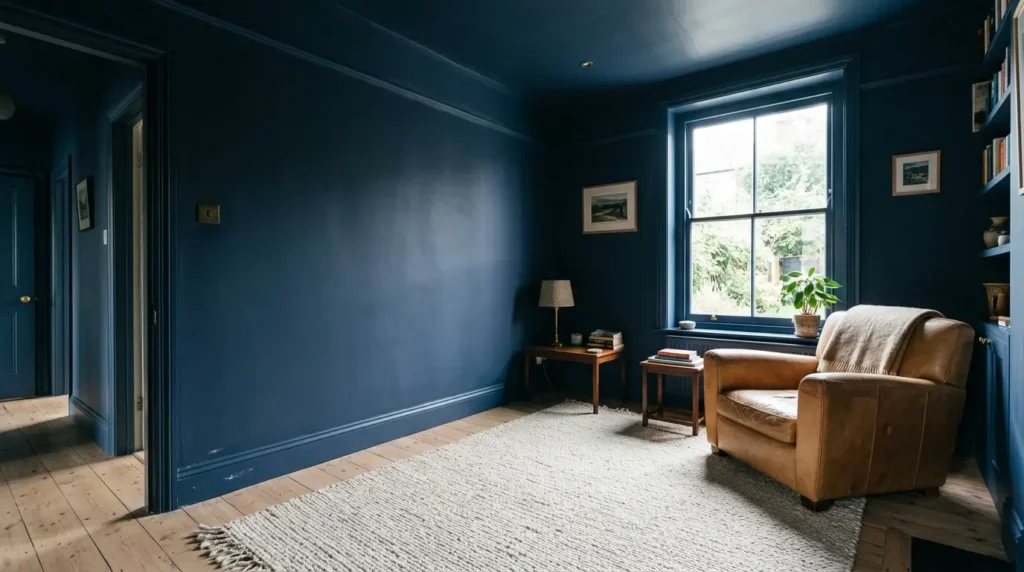
Colour drenching means painting walls, ceiling, skirting and often doors in the same shade. It removes the hard lines that make a dark room feel boxed in, so the corners blur and the room feels deeper. It works best in a room with good lighting and a ceiling in decent condition.
A simple way to keep it interesting is to use matt on the walls and eggshell in the same colour on the woodwork. The subtle change in sheen adds depth without a second colour.
Watch the ceiling height. In a tall room a dark ceiling feels cocooning, but in a low room, a slightly lighter ceiling protects the sense of height. A textured ceiling is often neater left white, because dark paint on a flat ceiling is easier to get even. Drenching also adds a day or two of work, and ceilings show every patch under raking light.
How Do You Test Dark Paint and Choose the Finish?
Use a good-quality matt or flat emulsion on dark walls, because it absorbs light and hides surface flaws, then add an eggshell finish on skirting and doors for a subtle sheen. Test two or three shades on large cards, not small patches, and judge them morning, afternoon and evening.
Paint A2-sized sheets of card, then move them around the room and tape them to the darkest and brightest walls. Look at them under the bulbs you will really use. Peel-and-stick samples are a tidy alternative to pots. Remember that flat finishes mark easily, so choose a washable matt if you have children or pets.
A note on brands: Farrow & Ball is sold across the UK, Europe and North America, while Sherwin-Williams and Benjamin Moore are strongest in North America. Most paint shops can colour-match a chip, though results vary, so sample the matched paint too.
How Do You Stop a Dark Living Room Feeling Like a Cave?
Layer at least three kinds of light, keep some pale or reflective surfaces in the room, and put every light on a dimmer. Ambient, task and accent lighting stop dark walls from swallowing the room. Add a large mirror opposite a window and a mid-toned floor or rug for relief.
In practice, that means a ceiling light for general use, table or floor lamps for reading, and a picture light or uplighter to wash a wall with a soft glow. Bring in texture too: velvet, wool, linen and leather stop a single dark colour from looking flat. Light-toned art mounts, a cream armchair and metallic accents give your eye somewhere to rest.
How Much Does a Dark Paint Living Room Project Cost?
For an average living room, expect roughly £100 to £350 in materials if you paint it yourself, or around £400 to £1,000 all in with a professional, depending on your country and paint brand. Dark colours usually need two to three coats, which adds paint and time.
| Item | Approx. cost (GBP) | What to know |
| Samples (2 to 3 shades) | £10 to £30 | Tester pots or peel-and-stick samples |
| Premium emulsion, 2 to 3 tins of 2.5L | £70 to £220 | Designer brands sit at the top end |
| Stain-blocking primer or undercoat | £15 to £40 | Useful over glossy, stained or very pale walls |
| Ceiling and woodwork paint (drenching only) | £30 to £100 | Adds roughly another day of work |
| Brushes, rollers, tape, dust sheets | £20 to £50 | A decent roller cuts down streaks |
| Professional labour, 2 to 4 days | £300 to £800 | Varies widely by country and region |
All figures are approximate and will change with your location, room size and the brand you choose.
For timing, allow a day for prep, then one to two days for coats, since most water-based emulsions need a few hours between coats (check the tin). Drenching adds a day or two. Paint feels dry within hours but takes a few weeks to fully harden, so go gently when cleaning.
What Are the Downsides and Common Mistakes With Dark Walls?
Dark walls show dust, scuffs and touch-up marks more than pale ones, and they punish poor lighting. The common mistakes are skipping large samples, using one overhead light, and leaving no pale surfaces for contrast. All three are cheap to avoid before you paint.
Dark walls in a living room also show roller marks and patchy edges more clearly, so keep a wet edge and work in sections. Keep the leftover tin sealed and labelled for repairs.
Think about the exit plan too. Going back to a pale colour usually takes a stain-blocking primer plus two or three coats, and that means extra time and money. In a rented home, check your lease first.
Conclusion
Of these 7 dark paint ideas for a dramatic living room, soft black and colour drenching deliver the most impact, while navy, green and warm charcoal are the easiest to live with. Sample on large cards, plan three layers of light, and keep a few pale surfaces in the room. Do that and your moody living room paint scheme will feel warm instead of heavy. Pick one shade from this list, order two tester pots and judge them on an evening before you buy the full tin.
FAQs
Do dark walls make a living room look smaller?
Not always. Deep colours blur corners and edges, so many small rooms feel more intimate than cramped. The room will feel less bright, though, so balance the walls with pale furniture, mirrors and layered lighting. If daylight is very limited, choose a medium-dark shade rather than the darkest.
What colours go with dark living room walls?
Warm neutrals such as cream, tan leather and ochre work with most dark shades. Brass or aged gold adds warmth, and crisp white trim sharpens the edges. For colour, try teal, burnt orange or dusty rose in cushions and art instead of adding more paint.
Is black too much for a living room?
Not if you choose a soft black and plan the lighting. True black needs strong contrast, good daylight and plenty of texture. Most homeowners find soft blacks like Off-Black or Iron Ore easier to live with, because their undertones make them feel warmer.
Should I paint the ceiling dark too?
In a tall room, yes, because it creates a cocooning effect. In a low room, keep the ceiling lighter to protect the sense of height. If the ceiling is textured, leaving it white with white trim often looks neater.
Is matt or eggshell better for dark walls?
Matt or flat suits walls because it absorbs light and hides flaws. Choose a washable matt if you have children or pets, since flat finishes mark easily. Eggshell works on skirting and doors, where wear and wipe-downs are heavier.
Can I use dark paint in a north-facing or dim living room?
Yes, with care. Warm-toned dark shades such as green, bronze or burgundy tend to read richer than cool greys in low light. Go medium-dark rather than near-black, test on the darkest wall, and sort out your lighting before you decorate.
How hard is it to paint over dark walls later?
Expect a stain-blocking primer plus two coats of the new colour, sometimes three for very pale shades. Budget an extra day and roughly £50 to £150 more in paint and primer, depending on your country and brand.
How do I touch up dark paint without it showing?
Keep the original tin sealed and labelled. Touch up with a small roller instead of a brush so the texture matches, and paint to a natural break such as a corner if you can. Do it in good light, since dark paint shows patches at an angle.